
Government launches expert panel to revise National Security Strategy ahead of 2026 deadline
Japan convenes an expert council to revise its National Security Strategy, sparking debate over defense spending increases, technology-driven warfare, and possible reassessment of the non-nuclear principles.
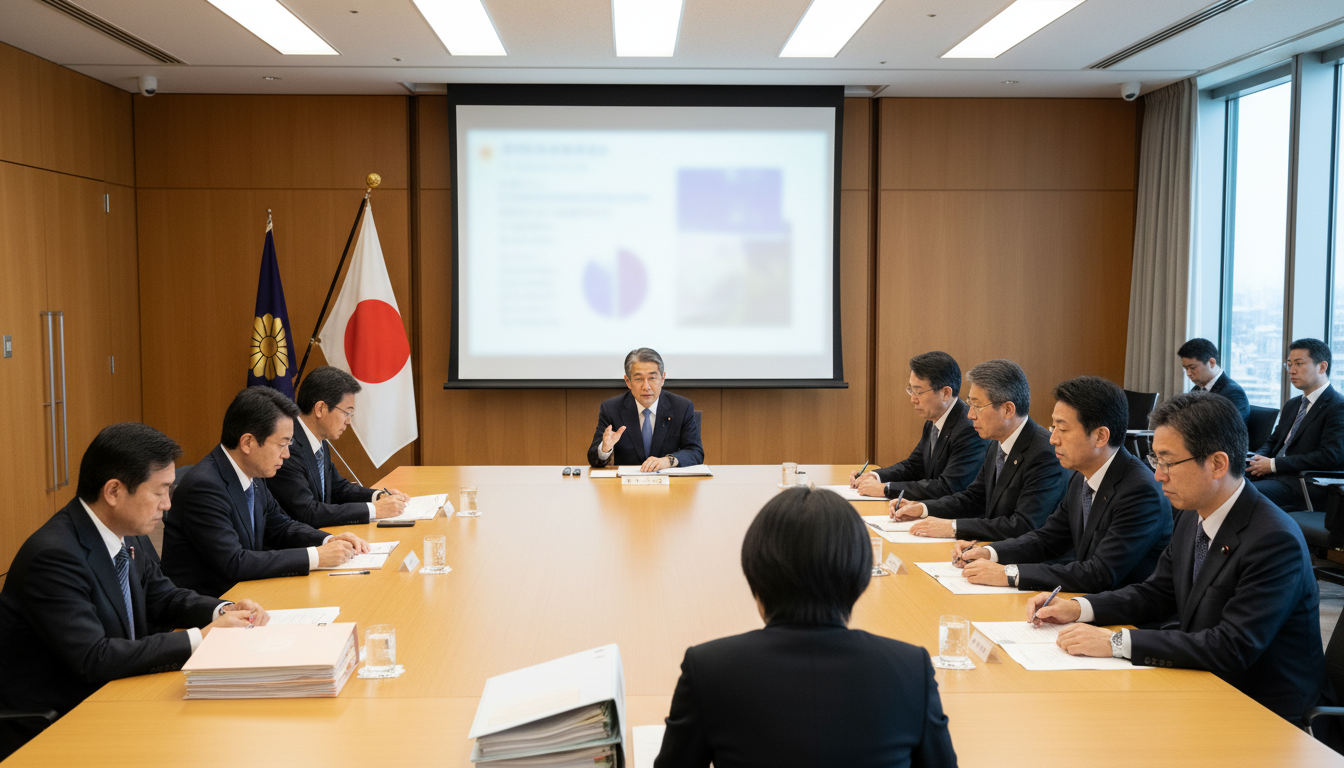
The government on April 27, 2026, convened the first meeting of a new expert council to lead revisions of Japan’s National Security Strategy and two related security documents, aiming to complete changes by the end of 2026. Prime Minister Sanae Takaichi framed the revisions as part of a push for “fundamental strengthening of defense capabilities,” setting the stage for intensive policy debate across the cabinet and public sphere. The advisory body, formally titled the “Experts’ Council on National Power and Security” (総合的な国力から安全保障を考える有識者会議), will examine defense spending, technological responses to new forms of warfare, and broader strategic doctrines.
Panel inauguration and government participation
The inaugural session was held at the Prime Minister’s Office on the evening of April 27, with Prime Minister Takaichi and Chief Cabinet Secretary Minoru Kihara among the ministers attending. The government announced that the council’s deliberations would directly inform revisions to the three core security documents: the National Security Strategy, the National Defense Program Guidelines, and the National Security Strategy-related documents slated for completion by late 2026. Officials described the meeting as the start of a sustained, high-level process intended to produce concrete policy options ahead of the end-of-year deadline.
The timing reflects the administration’s priority to present a clear strategic posture amid rising regional tensions and rapid technological change. The government emphasized that the council’s work would be public-facing and that ministers would participate in key sessions to hear the panel’s findings and recommendations.
Composition of the experts’ council
The council comprises 15 members drawn from academia, former government and military officials, business leaders, and media figures. Notable appointees include former Ambassador Kenichiro Sasae, academics such as University of Tokyo public policy professor Hitori Suzuki and AI researcher Yutaka Matsuo, and former senior defense officials including ex-Defense Bureau vice minister Tetsuro Kuroe and former Joint Staff Chairman Koji Yamazaki.
Representatives from the private sector and media will also serve, with corporate leaders and news executives among the appointees. The government described the membership as intended to bring diverse perspectives on national power, economic resilience, scientific and technological capacity, and public communication. Observers noted the inclusion of both security veterans and technology experts signals an intent to marry traditional defense policy with responses to emerging threats.
Defense spending and fiscal trade-offs under scrutiny
A central point expected to dominate the council’s deliberations is Japan’s defense budget and its financing. The administration is weighing a sizable increase from the longstanding 2% target of GDP for defense spending, language that Prime Minister Takaichi has signaled support for in past remarks. The council will evaluate scenarios for scaling defense capabilities and identify potential fiscal measures to sustain higher military investment.
Reports indicate that the U.S. administration has unofficially urged Tokyo to aim for defense outlays around 3.5% of GDP, a figure that would imply a major acceleration of Japan’s military spending trajectory. Government officials and analysts caution that any decision will involve trade-offs in domestic spending priorities and require public and parliamentary consensus, highlighting the political sensitivity of the debate.
Technology, drones and new forms of warfare
Panel members will also assess how emerging technologies reshape defense requirements, with particular attention to drones, artificial intelligence, cyber capabilities, and information operations. Lessons from recent conflicts have underscored the operational impact of unmanned systems and AI-enabled tools, prompting calls for doctrinal and industrial changes to integrate these capabilities into Japan’s defense posture.
Experts on the council are expected to recommend expanded investment in research and development, industrial partnerships, and legal frameworks to regulate and employ advanced systems. The review will also examine procurement timelines, interoperability with allied forces, and organizational reforms needed to respond faster to technological shifts on the battlefield.
Non-nuclear principles and constitutional constraints discussed
The government acknowledged that the council may tackle sensitive strategic issues, including the standing “Three Non-Nuclear Principles” that have shaped Japan’s postwar posture. While Prime Minister Takaichi has focused public attention on defense strengthening, any formal reconsideration of nuclear-related doctrine would be a politically charged step requiring broad public debate and legal scrutiny.
Council deliberations will likewise consider how existing constitutional constraints and collective self-defense interpretations influence force posture and alliance coordination. Officials stressed that any policy shifts would respect Japan’s legal framework while seeking to ensure credible deterrence and national survival amid changing regional dynamics.
Next steps and public engagement timeline
The council has been tasked with producing recommendations to feed into the government’s revision process, with an explicit target to finalize the three security documents by the end of 2026. Sessions will mix closed-door deliberations with public briefings, and ministers will hold hearings to review draft proposals before formal cabinet endorsement. The government said it aims to balance expert input with parliamentary scrutiny and public explanation to secure legitimacy for major policy moves.
Opposition parties and civil society groups have already signaled close attention to the council’s work, foreshadowing contentious debate over budgetary allocations and strategic doctrine in the months ahead. The administration will need to manage political divisions as it seeks to translate expert recommendations into concrete legislative and budgetary action.
The council’s formation marks the most significant rear-guard effort yet by the government to reshape Japan’s security architecture, combining traditional strategic planning with attention to technological and fiscal realities.

