
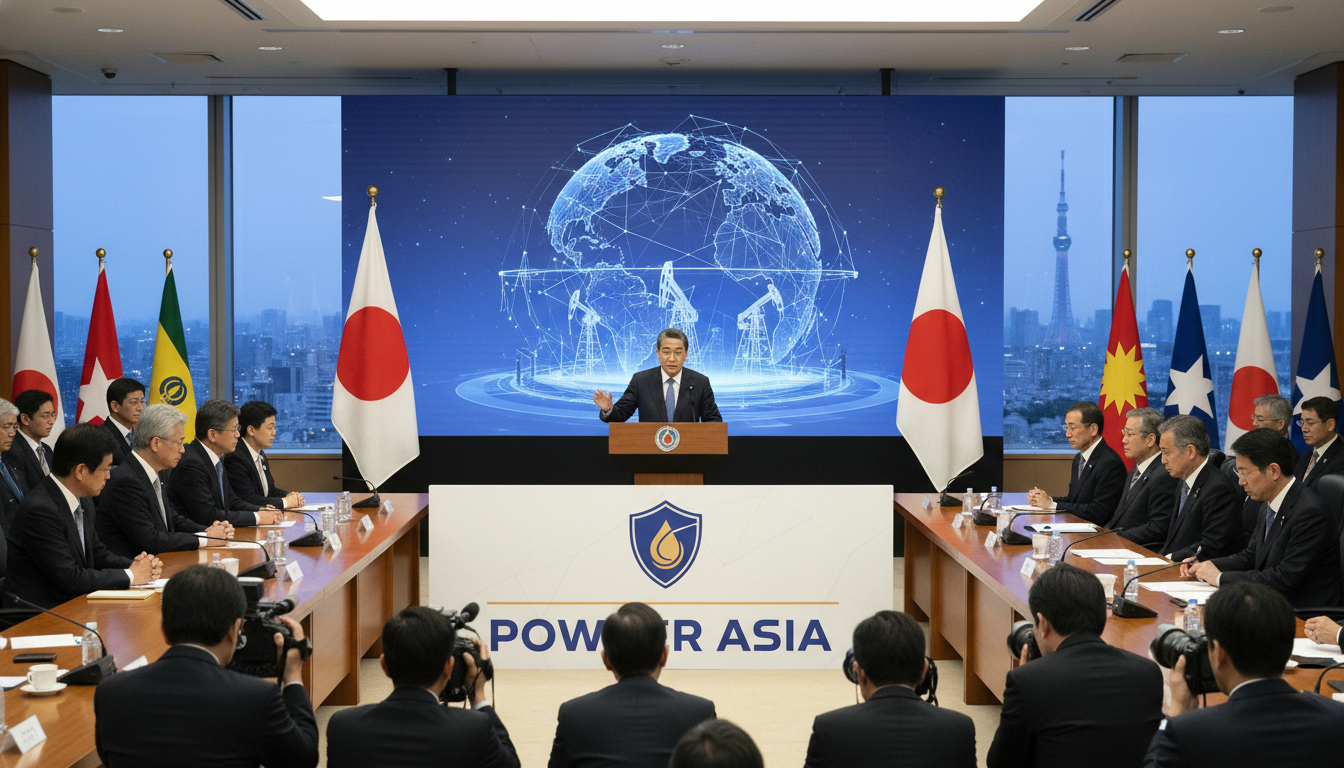
Japan energy security initiative POWERR Asia targets regional oil stockpiles and financing to bolster Asia-Pacific resilience
Japan’s energy security initiative POWERR Asia aims to build regional oil stockpiles and financial safety nets to strengthen Asia-Pacific resilience and cooperation.
TOKYO — Japan on Thursday rolled out the POWERR Asia plan, a new Japan energy security initiative designed to deepen regional cooperation on emergency fuel supplies and coordinated financing. The initiative, announced by Prime Minister Sanae Takaichi, is centered on pooled oil stockpiles and targeted financial support to reduce the impact of supply shocks across the Asia-Pacific. Officials say the plan was assembled rapidly under time pressure and is intended to provide a visible signal of Tokyo’s willingness to lead on regional energy safety.
Takaichi frames POWERR Asia as a practical regional tool
Prime Minister Sanae Takaichi has framed POWERR Asia as a pragmatic response to recent supply disruptions and price volatility in global energy markets. During meetings with Asia-Pacific counterparts on April 15, Takaichi emphasized financial backing and the creation of a regional stockpiling system as the initiative’s cornerstones. Tokyo’s presentation stressed cooperation with regional partners and the need for mechanisms that can be mobilized quickly in a crisis.
The branding of the effort — POWERR Asia — came together quickly, reflecting both urgency and a political priority to show leadership. Government briefings described the initiative as flexible rather than prescriptive, designed to accommodate countries at different stages of market development and strategic planning. Officials have signaled that Tokyo will work to translate the concept into concrete agreements in the coming months.
Design of the oil stockpiling system
At the core of the Japan energy security initiative is a proposal for regional oil stockpiles that can be accessed in emergencies to stabilize supplies. The concept envisions pooled reserves held in multiple jurisdictions or through shared commercial arrangements, allowing partners to draw on pre-arranged volumes during disruptions. That approach would aim to smooth temporary shortages and buy time for market adjustments.
Implementing such a system will require coordination on technical standards, legal frameworks for access, and transparent rules for release and replenishment. Tokyo’s planners are also discussing storage logistics, insurance and commercial arrangements to make joint holdings feasible without forcing national governments into unacceptable fiscal or sovereignty compromises.
Financing and guarantees to support partners
Alongside stockpiling, POWERR Asia emphasizes financial instruments to support vulnerable economies confronting price spikes or supply interruptions. The initiative proposes targeted financing and credit lines that could be drawn down in emergencies, reducing the need for abrupt fiscal reallocations. Tokyo presents these measures as complements to physical reserves rather than substitutes.
Japanese authorities indicate that the financial component could involve a mixture of public and private capital, risk-sharing mechanisms, and partnerships with regional development banks. Careful design will be required to ensure timely disbursement and to avoid moral hazard while still providing meaningful relief during acute episodes.
Regional reception and potential partners
Initial discussions around POWERR Asia were held with a range of Asia-Pacific leaders, reflecting broad interest in strengthening collective defences against energy shocks. Officials did not release a definitive list of partners, but the initiative is aimed at economies across Southeast Asia, Northeast Asia and Pacific island states that face varying degrees of import dependence and fiscal capacity. Diplomats say the plan’s flexibility is intended to attract both large and small partners.
Observers note that buy-in will depend on perceived fairness of access, cost-sharing arrangements, and the clarity of governance mechanisms. Some countries may prefer bilateral stockpiles or private commercial safeguards, while others will see pooled reserves and financing as a cost-efficient insurance mechanism. Tokyo’s task will be to reconcile those preferences into a functioning regional architecture.
Practical challenges and political sensitivities
Despite broad rationale, POWERR Asia faces several hurdles before it can operate at scale. Logistical challenges include locating and maintaining storage facilities, ensuring fuel quality standards, and coordinating rapid releases without disrupting markets. Legal and contractual arrangements will also be complex, particularly when reserves cross national borders or involve private sector holdings.
Political sensitivities around sovereignty and decision-making authority may slow agreement on joint release triggers and replenishment responsibilities. Moreover, the initiative must navigate competing national priorities and budgetary constraints, especially among smaller economies with limited fiscal headroom. Analysts caution that turning a compact plan into an operational safety net will take sustained diplomacy and technical work.
Japan’s quick launch of the POWERR Asia concept signals a desire to prompt action rather than produce a fully detailed blueprint immediately. The coming months are likely to focus on piloting arrangements, convening technical working groups and securing initial commitments from willing partners.
Looking ahead, the success of this Japan energy security initiative will depend on credible financing, transparent governance and practical mechanisms that deliver speed and predictability in crises. If Tokyo can marshal technical expertise and international partners to flesh out the plan, POWERR Asia could become a tangible addition to regional energy resilience efforts.

