
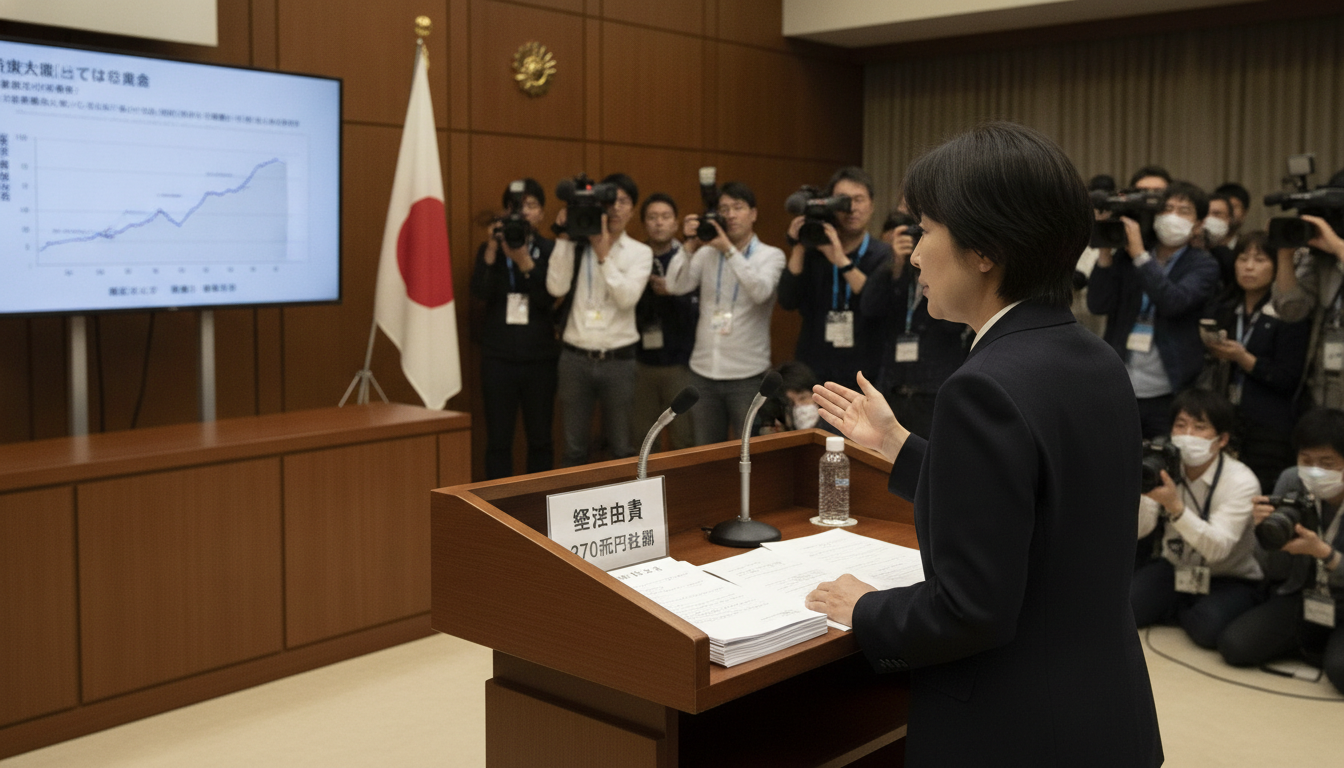
Cabinet Office: Business Capital Investment in Japan Rises as Firms Pass on Higher Costs
Cabinet Office: rising prices lift business capital investment in Japan; white paper urges clearer investment strategy and cites a ¥370tn target by 2040.
Japan’s Cabinet Office said on July 24, 2026 that business capital investment in Japan is increasing as firms are more able to pass higher costs onto customers.
The fiscal 2026 white paper links rising prices and stronger profit margins to an uptick in corporate spending, while urging clearer coordination between public and private investment strategies.
The report underscores the government’s push to align fiscal planning with business incentives as Tokyo seeks sustained capital formation through the next decade.
Cabinet Office white paper and key findings
The white paper, published July 24, 2026, identifies inflation and cost pass-through as primary drivers of the investment rise.
It highlights that firms, having regained pricing power, are now more willing to commit to new plant, equipment, and technology spending.
The document calls for more explicit government guidelines to maximize the impact of private investment and to avoid wasteful public spending.
Inflation and cost pass‑through bolster corporate spending
Analysts cited in the report say that moderate inflation has improved corporate margins and reduced the real cost of investment in some sectors.
With higher selling prices, firms can recoup upfront capital outlays faster, improving the return on equipment and digitalization projects.
The white paper cautions, however, that persistent inflation without productivity gains would erode purchasing power and could blunt long-term investment incentives.
Sanae Takaichi’s ¥370 trillion framework to 2040
Prime Minister Sanae Takaichi’s investment strategy, referenced in the paper, sets an ambition of more than ¥370 trillion in public and private spending by fiscal 2040.
The white paper frames that target as a guideline for aligning government budgets, regulatory reform, and tax incentives with corporate capex plans.
Officials described the figure as a long-range objective intended to mobilize both state resources and private financing toward digital transformation and decarbonization.
Technology, energy and manufacturing patterns in capex
The Cabinet Office points to technology and energy transitions as focal areas for new investment, with firms prioritizing automation, cloud infrastructure, and renewable energy projects.
Manufacturing companies are also reported to be upgrading production lines to improve resilience and reduce supply-chain vulnerability.
Investment in data centers, AI-enabled equipment, and green hydrogen pilots is highlighted as likely to accelerate if policy support and financing prove reliable.
Risks: interest rates, external demand and labour constraints
The white paper warns that a tightening in global financial conditions could raise borrowing costs and slow the momentum of business capital investment in Japan.
Weakness in overseas demand and disruptions to supply chains remain potential headwinds for exporters and heavy industry.
Domestic constraints such as skill shortages and regional inequalities could also limit the pace at which investment translates into productivity gains.
Policy recommendations and the need for coordination
To sustain the investment upswing, the report recommends clearer public-private coordination, targeted fiscal measures, and streamlined permitting for strategic projects.
It stresses that tax incentives and co-investment schemes should be designed to spur private risk-taking while protecting fiscal sustainability.
The Cabinet Office also urges enhanced data collection on firm-level capex to monitor progress and refine policy responses.
The white paper presents a cautiously optimistic view: rising prices and improved margins are creating conditions conducive to higher corporate spending, but the long-term benefits will depend on Japan’s ability to convert that spending into productivity gains.
Policymakers and business leaders will need to work in concert to ensure that the ¥370 trillion aspiration becomes a measured, efficient program of public and private investment rather than a headline figure without follow-through.

