
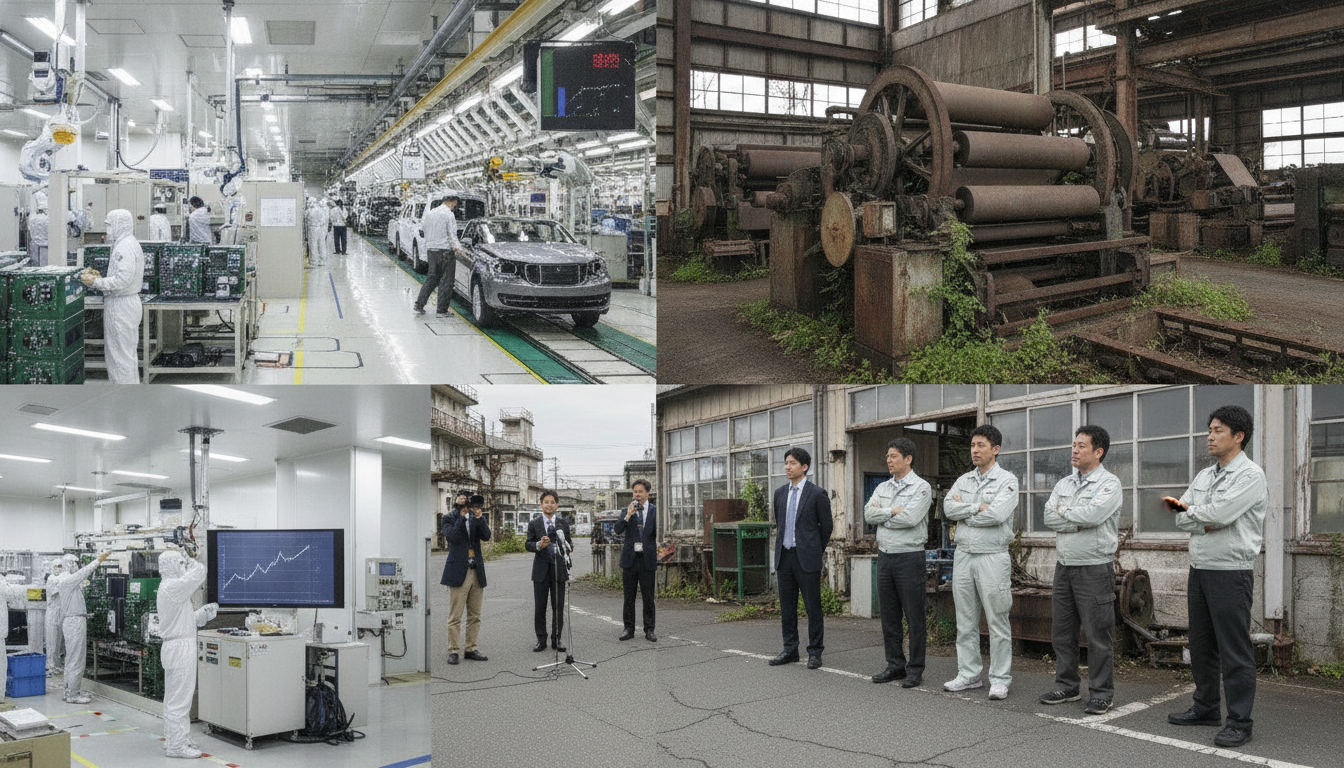
Kumamoto earthquake: Semiconductors and Automakers Largely Resume, Local Damage Slows Recovery
One month after the Kumamoto earthquake on July 30, 2026, semiconductor and automobile production in the prefecture has mostly recovered, but severe damage near the quake’s epicenter continues to hamper full regional recovery. Industry officials and company representatives say pre-established disaster plans and post-2016 reinforcements helped shorten downtime. Local firms closest to the epicenter still face structural damage, liquefaction and disrupted operations that will take longer to mend.
Semiconductor hubs restored to near-normal output within weeks
Major semiconductor facilities across Kumamoto reported that production lines were back to pre-quake levels by mid-August 2026. Companies say the quicker recovery compared with the 2016 shocks reflects investments in seismic reinforcement, stockpiling of critical components and updated business continuity plans. Engineers and supply-chain teams worked with partner firms to replace damaged parts and share scarce tooling, allowing many plants to restart within days to weeks.
Smaller precision-equipment manufacturers supplying the chip sector also resumed operations after short interruptions. One Yatsushiro-based maker of inspection and processing equipment suffered heavy shaking and ground liquefaction that warped factory floors. The company received emergency parts and alternative machining services from suppliers and expects to restore full production by mid-September 2026.
Renesas’ Kawashiri plant returns after long-term mitigation measures
Renesas Electronics’ Kawashiri plant, in operation since 1970, illustrates how long-term mitigation paid off during the Kumamoto earthquake. The site had been retrofitted with base-isolation systems and updated continuity plans following the earlier quake in 2016. Those measures, together with rapid damage assessments, enabled the Kawashiri facility to resume output to pre-earthquake levels on August 23, 2026.
Company engineers said a combination of structural upgrades and ready access to replacement parts narrowed the window of halted production. The experience underlines industry officials’ view that sustained investment in resilience — not only immediate emergency response — is crucial for minimizing disruption in a highly interconnected global supply chain.
Automakers use supplier mapping and databases to limit outages
Automobile manufacturers with plants in and around Kyushu also managed a faster recovery than in 2016 by employing detailed supplier-mapping tools and pre-identified alternate sourcing. Toyota, which temporarily halted operations at three factories in Fukuoka Prefecture, restarted production approximately one week after the quake on August 6, 2026. Company officials credited a supplier database that helped identify unaffected vendors and route parts from alternative locations.
Automakers note that lessons from a decade ago prompted tighter coordination across the parts network and more conservative inventory policies for key components. Those changes reduced the need for prolonged plant stoppages and prevented a cascade of shutdowns across the national production system.
Severe local damage leaves some firms unable to resume quickly
Despite broad progress among major manufacturers, damage near the epicenter remains acute and has left some companies without clear timelines for full recovery. A pulp and paper mill in Yatsushiro suffered visible structural harm, including a toppled chimney, and repairs are expected to be prolonged. Ground liquefaction in coastal and river-adjacent zones has distorted factory foundations and complicated restoration work.
Local business leaders say smaller suppliers and plants that rely on specialized, hard-to-replace equipment face particular difficulty. Even when assembly lines themselves are intact, disrupted logistics, road damage and worker displacement are slowing a return to normal activity for many community-based firms.
Outlook: partial resilience, but uneven path to full recovery
Industry analysts and regional officials caution that while base manufacturing capacity has largely been stabilized, recovery remains uneven across Kumamoto. High-tech and large-scale manufacturers that invested in seismic measures are bouncing back faster, whereas small and medium-sized enterprises around the epicenter will likely need extended support to rebuild. Officials have called for coordinated public-private efforts to repair infrastructure and expedite permits for reconstruction.
Companies report that workforce availability, supply-chain rerouting and the physical repair of severely damaged sites will determine the speed of final recovery. Several firms are also reviewing their contingency plans again, saying the latest quake underscores the need for continued investment in resilience and for better regional cooperation among suppliers.
One month after the July 30, 2026, quake, the picture is thus mixed: critical national industries are operating again, but rebuilding communities and restoring every local business will take months, if not longer, and will require sustained attention from both industry and government.

