
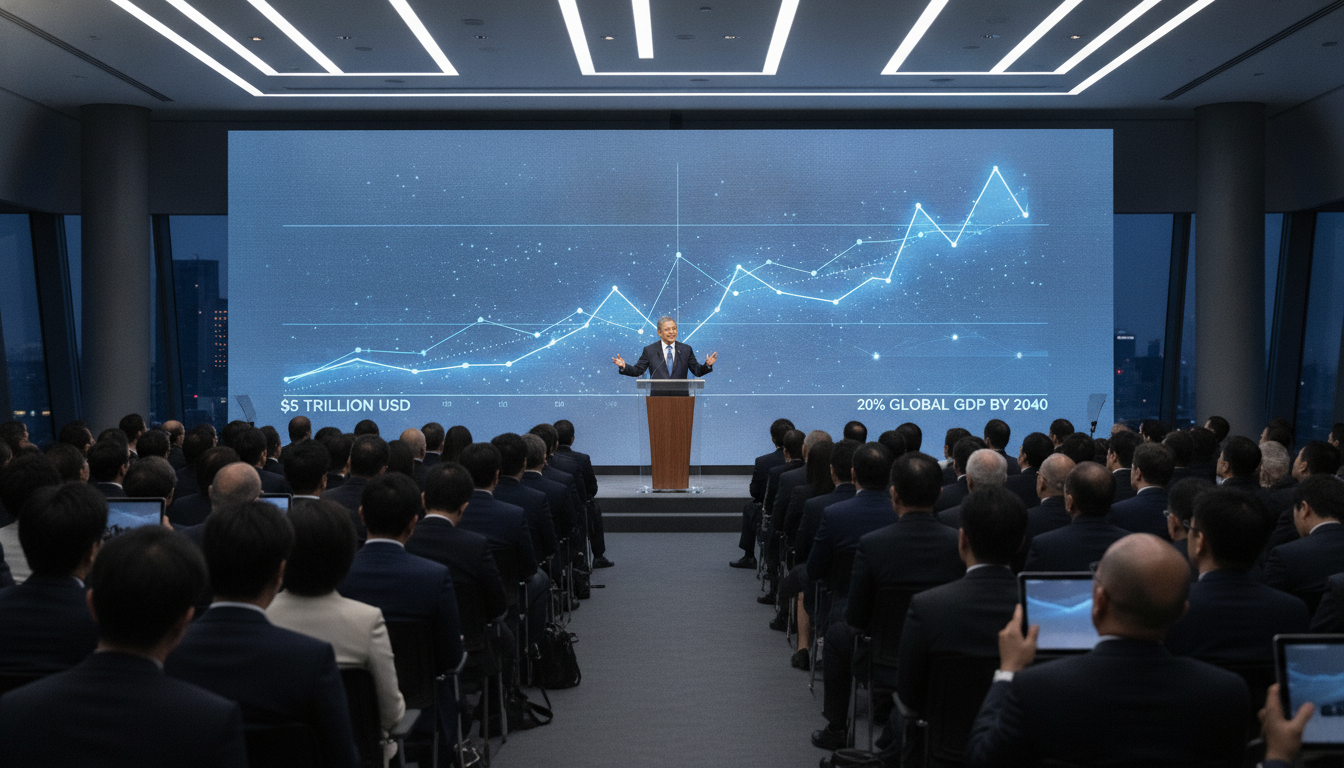
SoftBank’s Son: AI infrastructure will require $5 trillion annually by 2040
Masayoshi Son warns AI infrastructure will need $5 trillion annually by 2040 as agents and humanoid robots reshape labor, he said at SoftBank World in Tokyo.
SoftBank Group founder Masayoshi Son on July 14 in Tokyo projected that global AI infrastructure will require roughly $5 trillion in annual investment by 2040. He told delegates at SoftBank World 2026 that the spending would cover data centers, expanded power capacity and a new class of humanoid robots and software agents. Son framed the forecast as part of a broader shift away from traditional human-centered work toward machine-driven production and services.
Son outlines $5 trillion annual investment need by 2040
Son said the $5 trillion figure reflects the combined cost of physical and digital systems needed to run advanced artificial intelligence at scale. He emphasized that the investment would not be limited to computing hardware but would also include the energy, cooling and infrastructure upgrades that data-driven AI demands. The projection accompanies his estimate that AI will account for about 20 percent of world GDP by 2040, a scale change that would reorient corporate and public spending priorities.
The SoftBank chairman described the investment as an ongoing, multi-decade challenge rather than a one-off outlay. He argued that governments, energy companies and private investors must plan for continual capacity expansions to keep pace with accelerating AI adoption. Son’s comments were presented as a call to action for policymakers and industry to coordinate long-term financing and build more resilient supply chains.
Humanoids and software agents to reshape labor market
At the conference, Son predicted that humanoid robots and autonomous software agents would move many routine and physically demanding tasks away from humans. He portrayed these technologies as complementary: humanoids taking on embodied roles while agents handle decision-making and coordination across systems. This dual shift, he said, will change how firms staff factories, warehouses and service operations.
Son cautioned that the transition will require new workforce planning and skills development to minimize social disruption. He suggested that education and training systems must adapt to prepare workers for roles that emphasize oversight, creativity and complex problem-solving. The founder presented the rise of agents and humanoids as both an economic opportunity and a governance challenge.
Data centers and power demand to expand globally
A central component of Son’s forecast was the expansion of data centers to support increasingly large AI models and continuous inference workloads. He noted that these facilities will drive significant incremental demand for electricity and cooling capacity worldwide. As AI workloads migrate closer to consumers and edge devices multiply, Son said the footprint of data infrastructure will widen geographically.
The implication is that energy systems will need both scale and flexibility, with greater investment in grids, storage and low-carbon generation. Son highlighted power supply as a critical constraint if AI infrastructure growth is not matched with targeted energy planning. He urged collaboration between technology firms and utilities to accelerate grid upgrades and incorporate renewable resources.
SoftBank’s message to investors and industry leaders
SoftBank used its annual gathering to position itself at the center of the coming AI build-out, with Son framing the company’s long-term outlook around infrastructure-scale opportunities. The presentation reiterated SoftBank’s broader strategic view that foundational technologies — including chips, networks and robots — will underpin the next wave of economic expansion. Son’s remarks signaled to investors that the company sees sizable, structural markets emerging around AI deployment.
The talk also doubled as a market signal for partners and startups attending the event, highlighting areas likely to attract capital and commercial partnerships. By quantifying the scale of future needs, Son provided a reference point for corporate planning and venture funding priorities. His emphasis on infrastructure suggests SoftBank anticipates both direct and indirect investment opportunities as AI moves into core sectors.
Policy, finance and workforce implications for governments
Son’s forecast places pressure on policymakers to consider how public finance, regulation and industrial policy will support or hinder AI infrastructure growth. Governments may need to rethink permitting, energy policy and incentives to enable rapid deployment of data centers and robotics at scale. At the same time, fiscal planners will face decisions about public investment, subsidies and cross-border coordination for strategic assets.
Financial markets and institutional investors also confront new allocation questions as long-duration infrastructure becomes central to technological competitiveness. Son’s timeline — stretching to 2040 — implies the need for sustained capital commitments and risk-sharing arrangements between the public and private sectors. Equally, regulators will be asked to balance rapid innovation with safeguards on labor, safety and environmental impact.
The SoftBank World presentation underscored a shift in the debate from AI as software innovation to AI as an industrial-scale ecosystem requiring physical build-out, steady funding and coordinated policy. As Masayoshi Son framed it, the coming decades will demand unprecedented investment in AI infrastructure, and decisions made now will shape the shape and pace of that transformation.

