
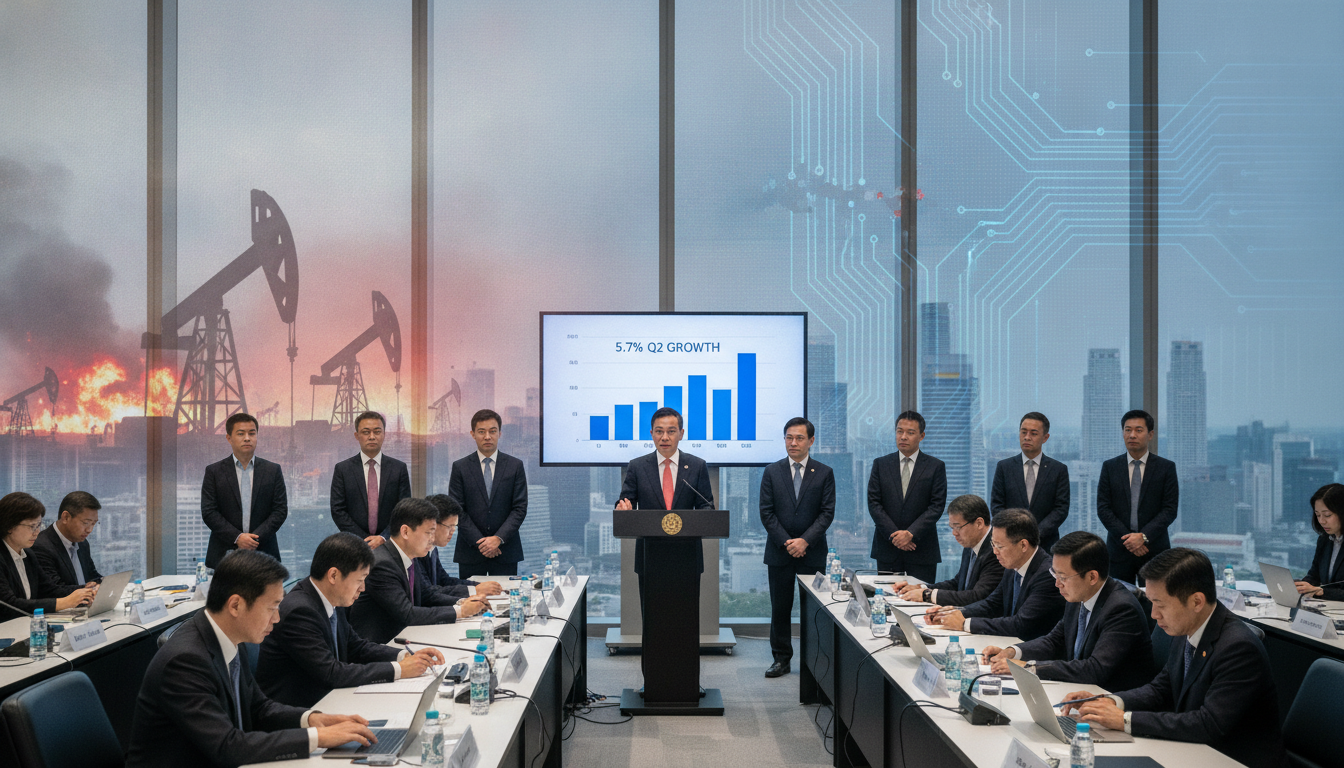
Singapore economy slows to 5.7% in Q2 2026 as Middle East conflict tempers AI-driven gains
Singapore economy grew 5.7% year-on-year in Q2 2026, slowing from Q1 as Middle East conflict offsets gains from an AI-driven investment surge and risks.
Singapore’s economy expanded by 5.7% in the April–June period compared with a year earlier, preliminary official data released on July 14, 2026 showed, cooling from a 6.3% pace in the first quarter. The slowdown came as gains from an ongoing AI investment boom were partly offset by spillovers from conflict in the Middle East, leaving downside risks to the outlook. Policymakers and businesses are assessing how resilient export demand and domestic investment will be as external uncertainties persist.
Q2 GDP Rises 5.7% Year-on-Year, Down from Q1
The headline GDP figure for the second quarter marked a moderation from the 6.3% year-on-year expansion recorded in the first quarter. Officials described the numbers as preliminary, noting that detailed sectoral breakdowns would follow when comprehensive data are published. Despite the slower pace, the level of activity remains above pre-pandemic norms, reflecting continued momentum in several high-value segments.
Short-term comparisons show the economy still growing at a solid clip, but economists caution that annualized quarter-on-quarter readings will be closely watched for signs of a genuine deceleration. Business investment tied to artificial intelligence projects lifted headline growth, while other components registered more mixed outcomes.
AI Investment Lifts Services and Technology Sectors
Corporate investment in AI-related hardware and software continued to underpin growth, with firms accelerating spending on data centres, cloud infrastructure and automation tools. Services sectors tied to technology and finance benefited from higher activity, supporting employment in specialist professional roles. Observers noted that the AI boom has so far translated into stronger demand for high-skill services and certain categories of capital goods.
Export performance in semiconductors and electronics played a role as well, though the boost was uneven across subsegments. The combination of private digital investment and robust tech services has become a new engine of expansion for the city-state, even as its traditional trade channels face intermittent headwinds.
Middle East Conflict Weighs on External Demand and Sentiment
At the same time, fallout from the conflict in the Middle East has clouded external demand and raised costs for trade and insurance, according to analysts tracking the latest data. Shipping disruptions, higher freight premiums and risk-averse corporate behaviour in some markets contributed to weaker-than-expected orders for parts of Singapore’s export sector. The geopolitical shock has also heightened global financial market volatility, which can feed back into investment decisions.
Policy-makers and business leaders warned that sustained geopolitical tensions could amplify downside risks, particularly if energy prices or financing costs move sharply in response to further escalations. For a small, trade-dependent economy like Singapore’s, such external shocks can have outsized effects on growth trajectories.
Analysts Forecast Softer Growth in Coming Quarters
Market analysts and forecasters reacted by tempering near-term GDP projections, saying the 5.7% print reflects a mix of structural shifts and transient shocks. Several research houses highlighted the likelihood of softer quarterly growth ahead, driven by uneven global demand and the possibility of a slowdown in AI-related capital spending once large projects are completed. At the same time, others emphasized that strong fundamentals and fiscal buffers provide scope for managing cyclical swings.
Analysts urged attention to forward-looking indicators — including new manufacturing orders, business sentiment surveys and investment announcements — as better gauges of momentum than headline GDP alone. That data will be critical for firms planning hiring and capital outlays in the months ahead.
Monetary and Corporate Responses Under Consideration
The central bank and fiscal authorities face a balancing act between sustaining growth and containing inflationary pressures that can accompany rapid technology-led investment. While official commentary has stressed flexibility, policy decisions will likely hinge on incoming inflation data, labour market tightness and external conditions. Monetary and macroprudential policy settings may be adjusted if core price dynamics or wage growth accelerate beyond expectations.
Corporates, too, are weighing strategic responses: some are accelerating automation and AI adoption to lift productivity, while others are prioritizing resilience measures such as supply-chain diversification and hedging against geopolitical risk. Investment patterns over the next two quarters will signal whether the AI-driven expansion broadens or consolidates in specific clusters.
Implications for Jobs, Prices and Long-Term Growth
Employment in technology, finance and specialized services has remained relatively robust, supporting household incomes even as some trade-exposed sectors face softer demand. Wage negotiation dynamics may shift if the job mix continues to favour high-skill roles over lower-skilled positions. Inflationary pressures have been mixed, with policymakers looking to manage price stability without stifling investment flows.
Longer-term prospects hinge on whether the surge in AI-related capital and skills translates into sustained productivity gains. If that transformation spreads across the economy, potential growth could be lifted materially. Conversely, persistent external shocks would erode near-term momentum and complicate the transition.
Singapore’s immediate economic profile now blends the promise of an AI-led investment cycle with the realities of a volatile global backdrop. The preliminary Q2 reading underscores both the strengths and vulnerabilities of a small open economy navigating rapid technological change amid geopolitical uncertainty.

