
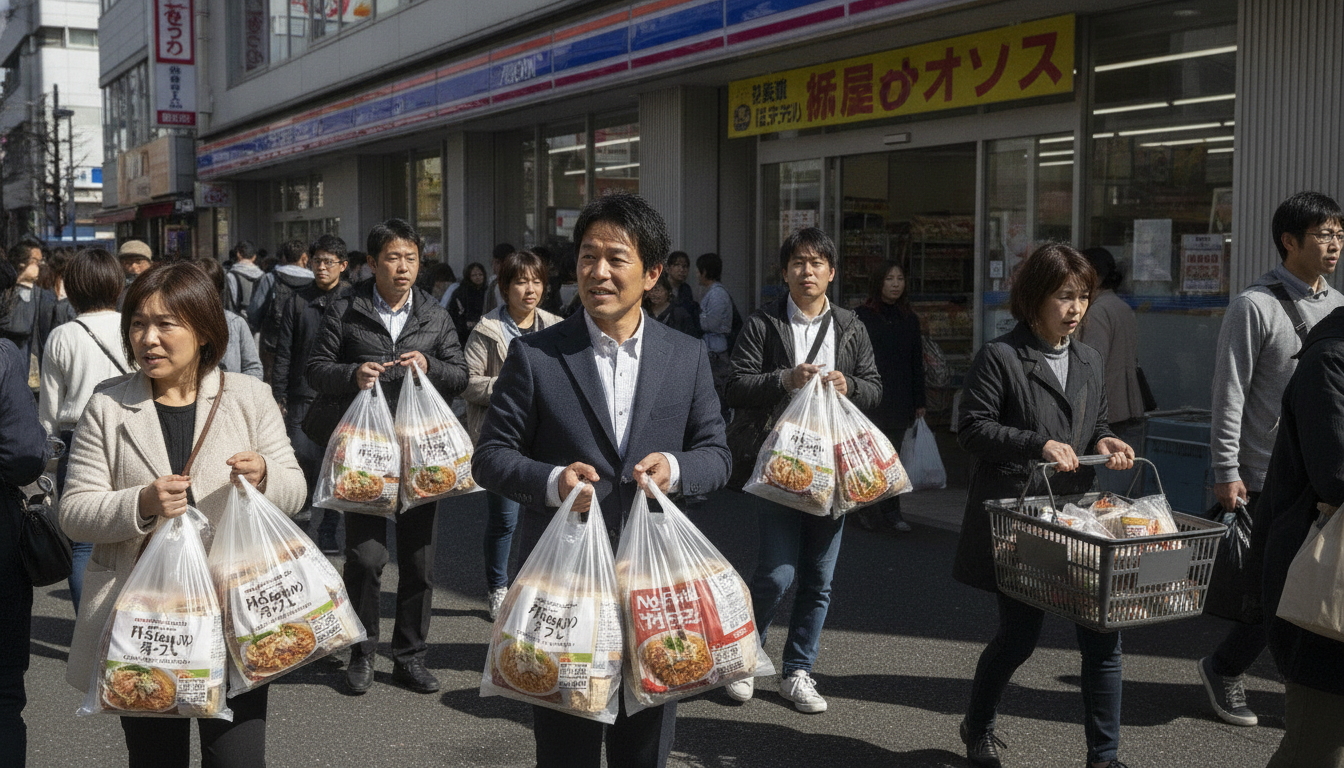
No-frills noodles surge as Lawson and Aeon expand budget lines amid Japan’s food inflation
Retailers roll out no-frills noodles—topping-free ramen, yakisoba and soba—priced to attract budget-conscious shoppers as living costs rise across Japan.
Japan’s major retailers have ramped up offerings of no-frills noodles as food inflation pressures household budgets, with Lawson and Aeon introducing topping-free products that prioritize price and portion size. The trend toward topping-free and frozen noodles is a direct response to consumers seeking lower-cost meal options without sacrificing flavor or convenience. Retailers are betting that stripped-down noodle products will appeal to shoppers who want affordable, customizable meals amid persistent price increases.
Lawson launches budget frozen and cup noodles
Lawson began marketing two types of frozen topping-free noodles in late June 2026, each priced at ¥297, more than 20 percent cheaper than comparable frozen noodles sold with toppings. The convenience-store chain’s strategy builds on an earlier success: a topping-free cup noodle introduced in October 2024 that emphasized a high-quality broth and sold more than five million units. Lawson product division official Kanako Ochi said the company is responding to consumers tightening their belts by offering products that lower the entry price while allowing customers to add ingredients as they prefer.
Lawson’s pricing and product mix aim to broaden choice for shoppers who want both low cost and convenience. The frozen format targets evening meals and quick lunches, while the cup noodle variant tapped into the customization trend by letting buyers top the broth with their own ingredients or eat it as-is. Retail analysts say Lawson’s approach mirrors larger shifts in the convenience-store category toward value-focused SKUs.
Aeon expands topping-free yakisoba and soba nationwide
Supermarket chain Aeon introduced a topping-free fried noodle product in April 2025 that contains three times the noodle portion of its existing yakisoba offering and is priced at about ¥320. Initially sold in select areas including the Tokyo metropolitan region, the item was rolled out nationwide after sales exceeded expectations by roughly tenfold. Aeon followed up in July 2026 with a topping-free soba variant that doubles the noodle quantity of its prior product, reinforcing the chain’s emphasis on larger portions at lower unit prices.
Aeon attributed the popularity to the product’s cost advantage during a period of rising household expenses. Company spokespeople said shoppers valued the ability to stretch a single purchase into multiple meals or to add inexpensive home ingredients such as vegetables or leftover protein, enhancing perceived value without raising price points.
Price positioning and consumer behavior
Retailers are intentionally positioning topping-free lines to sit several tiers below full-meal SKUs, with prices often 20 percent or more lower than versions that include meat, vegetables or other toppings. That spread gives consumers a visible saving while preserving retailer margins through lower ingredient costs and simplified packaging. For many buyers, the headline price is decisive, and the absence of toppings is framed as an allowance for personalization rather than a reduction in quality.
Consumer responses suggest two complementary motivations: cost containment and customization. Some shoppers are choosing no-frills noodles as a deliberately economical base for home-cooked additions, while others appreciate the ability to buy a cheaper ready-to-eat option for single-portion meals. Retail surveys and sales data point to steady demand for these items among students, single-person households and budget-conscious families.
Broader market context and inflation data
The move toward no-frills noodle products comes amid widespread price adjustments across Japan’s retail sector. According to research firm Teikoku Databank, as of July 31, 2026 some 18,000 products either had seen price increases earlier in the year or were scheduled to be raised by November 2026. That wave of adjustments has prompted retailers to carve out value niches that can attract price-sensitive consumers without eroding brand positioning.
Economic commentators note that persistent input-cost pressures and general inflationary trends are likely to keep shoppers focused on unit price and portion value. In that environment, simple, lower-priced food staples become strategic tools for retailers to maintain traffic and drive incremental basket purchases.
Operational and supply considerations for topping-free lines
Removing toppings simplifies sourcing and preparation for retailers, reducing variability in inventory and lowering labor and packaging requirements. For frozen and cup formats, fewer ingredients mean longer shelf stability and streamlined logistics, which can translate into cost savings that are passed on to consumers. Retail buyers say that standardizing noodle-only SKUs also makes assortment planning more predictable across store chains.
At the same time, retailers must balance savings with taste expectations. Companies like Lawson have invested in broth quality and noodle texture for their topping-free products to avoid positioning them as cheap or inferior. The goal is to preserve a satisfying eating experience while offering a lower headline price.
Implications for consumers and product strategy
The rise of no-frills noodles signals a tactical shift by retailers to address both inflation and changing household composition in Japan. By offering topping-free ramen, yakisoba and soba at lower price points and larger portions, chains are targeting shoppers who prioritize cost per meal and flexibility. If inflation continues, industry observers expect such value-focused SKUs to expand further into private-brand ranges and promotional assortments.
Retailers also see opportunities to convert price-conscious shoppers into repeat customers by pairing no-frills noodles with add-on items and seasonal flavoring options. The popularity of topping-free lines so far suggests a durable niche that blends affordability with the continuing consumer preference for customization.
As food prices remain under pressure, no-frills noodles are likely to remain a fixture on Japanese supermarket and convenience-store shelves, offering a pragmatic compromise between cost and quality for everyday meals.

