
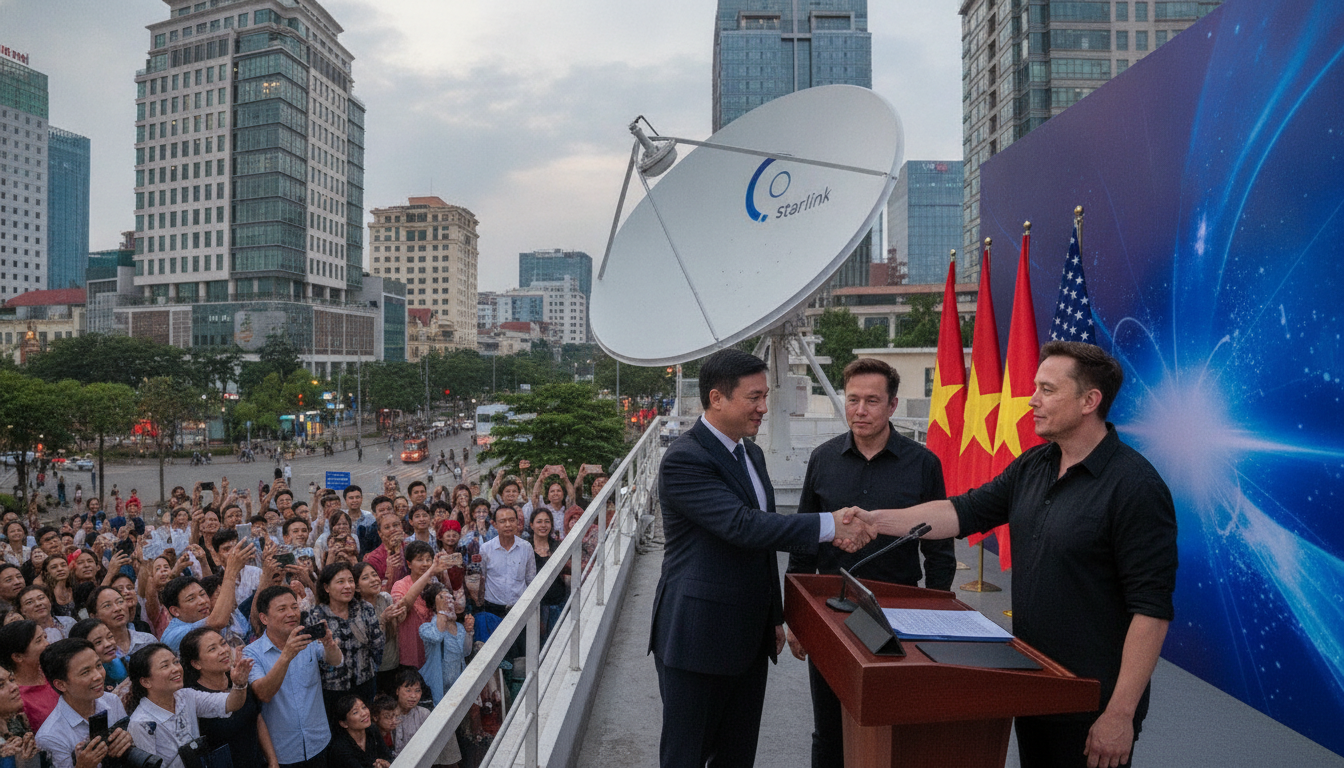
Starlink begins accepting orders in Vietnam after Hanoi lifts foreign-ownership limits
Starlink begins accepting orders in Vietnam after Hanoi relaxed ownership rules, receiving a five-year pilot licence to offer satellite internet across the country.
Starlink, the satellite internet service operated by SpaceX, has started taking orders in Vietnam through a local website as Hanoi moves to open the market to low-Earth-orbit services under a five-year pilot scheme. The rollout follows government decisions that remove foreign-ownership limits for the trial and set regulatory conditions for spectrum use and equipment, creating a legal framework for Starlink Services Vietnam to operate. (theinvestor.vn)
Starlink begins taking orders in Vietnam
Starlink’s Vietnam page lists service packages, equipment costs and subscription rates for residential customers, and the company has begun accepting deposits for new accounts. Published local reports say the first-year total cost, including equipment and taxes, is comparable to regional markets, and advertised peak download speeds range into the hundreds of megabits per second. (theinvestor.vn)
The offering targets fixed-location residential plans with unlimited data and requires an upfront equipment purchase, reflecting Starlink’s standard global commercial model adapted to Vietnamese pricing and tax rules. Early posts on the site and local press coverage indicate the company is preparing local distribution and service support through its Vietnamese entity. (theinvestor.vn)
Hanoi’s regulatory shift and foreign-ownership waiver
Vietnam’s government formally authorised a pilot framework allowing low-Earth-orbit satellite services to operate on a trial basis without the usual foreign-ownership caps, a significant policy change that enabled Starlink’s local registration and commercial activity. Officials framed the decision as a controlled pilot to expand connectivity while safeguarding national security and public order. (investing.com)
The move reverses long-standing restrictions that limited foreign stakes in domestic telecom operations, and it follows consultations between Vietnamese ministries and the company’s local representatives. Authorities emphasised that the pilot would be bound by conditions on subscriber numbers and technical compliance. (en.nhandan.vn)
Terms of the five-year pilot and spectrum approval
Regulatory documents and ministry announcements show Starlink Services Vietnam was granted both a pilot licence to operate satellite-based telecom services and approvals to use radio frequencies and related equipment, establishing legal permission for operations. The Ministry of Science and Technology signed off on spectrum assignments and device authorisations required to deploy satellite terminals and ground infrastructure. (mst.gov.vn)
The pilot licence includes a fixed timeframe and limits intended to let regulators monitor technical performance, market impacts and security implications before any permanent regulatory changes. Reports indicate a cap on trial-period subscribers and a requirement for the operator to coordinate with defence and public-safety agencies. (investing.com)
Market impact and competition with domestic networks
Analysts say Starlink’s entry provides an alternative connectivity option for remote islands, mountain districts and offshore operations where terrestrial networks remain weak, but it is unlikely to displace established fibre and mobile broadband in major urban centers. Pricing and upfront equipment costs make Starlink comparatively expensive against urban fibre packages, suggesting the service will compete chiefly on reach and resilience rather than price. (theinvestor.vn)
Domestic carriers and fixed-line operators may see the service as both a complement and a competitive pressure point, particularly for enterprise and emergency communications markets. Industry observers expect partnerships, wholesale arrangements or roaming agreements to emerge as market participants adjust to the new entrant. (theinvestor.vn)
Regulatory safeguards and national-security conditions
Vietnamese authorities have tied the pilot to national-security safeguards and technical compliance obligations, making clear that equipment imported or used must meet certification and frequency-management rules. Regulators have warned consumers to use only officially distributed Starlink terminals and to avoid uncertified imports that could violate local rules. (mst.gov.vn)
Officials also signalled that the ministry responsible for radio frequencies will closely monitor spectrum use to prevent harmful interference with existing services and to ensure that emergency and defence systems are protected. The pilot’s conditional nature means licences could be adjusted or revoked if security or interference issues arise. (mst.gov.vn)
Industry response and next steps for commercial rollout
SpaceX’s Starlink has established a local corporate structure to comply with Vietnamese requirements and appears to be building distribution channels for equipment and customer support. Observers expect the company to scale subscriber acquisition within the trial limits while authorities assess technical performance, pricing impacts and compliance with regulatory safeguards. (theinvestor.vn)
Market watchers say the pilot will be closely scrutinised for its effect on rural connectivity, disaster-response capability and the competitive landscape in Southeast Asia, where several countries are evaluating LEO satellite services. The outcome of Vietnam’s five-year experiment could influence regulatory approaches elsewhere in the region. (investing.com)
Vietnam’s conditional approval and Starlink’s appearance on the local marketplace mark a notable development in the country’s telecom sector, testing how global satellite operators and national regulators balance rapid technology adoption with security and market stability.

