
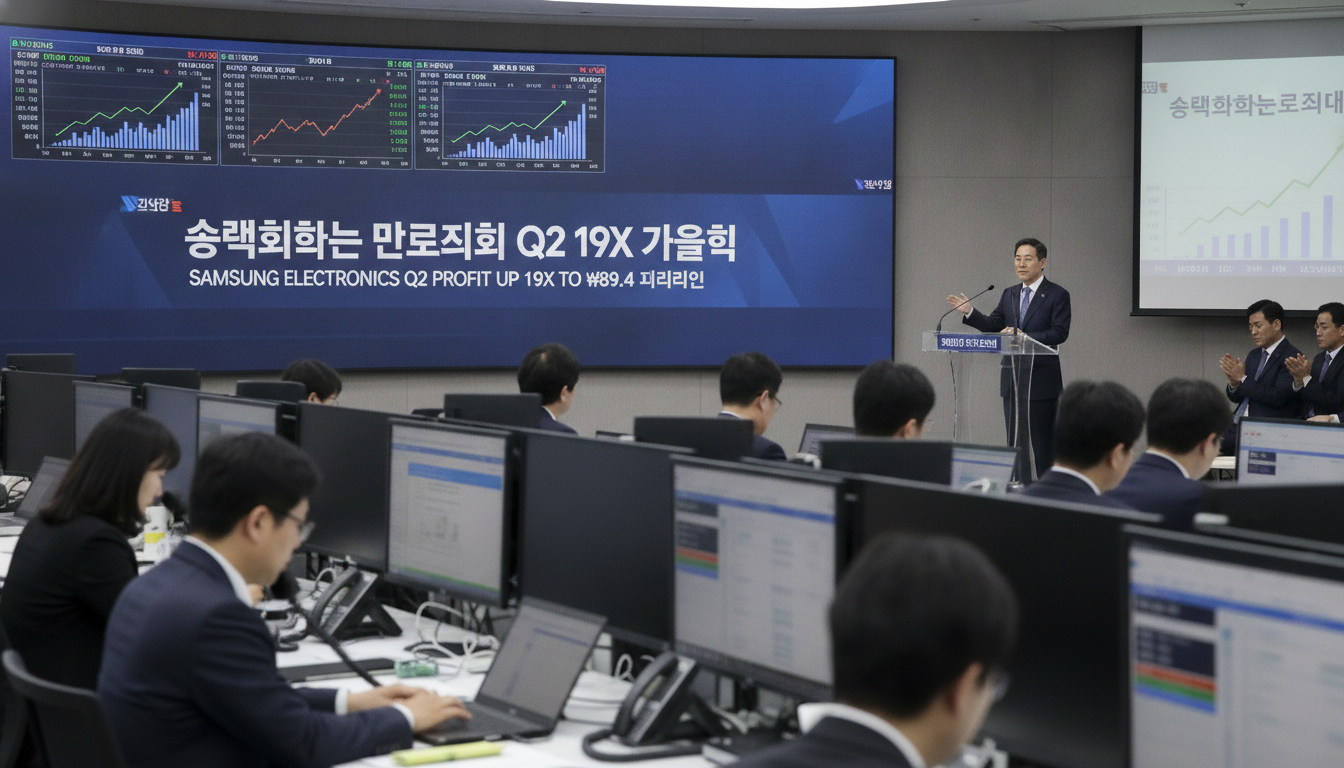
Samsung Q2 profit surge: Operating profit jumps 19-fold to 89.4 trillion won on AI-driven memory demand
Samsung Q2 profit surge: Samsung Electronics reported a 19-fold jump in operating profit to 89.4 trillion won in Q2, driven by AI-related memory shortages and stronger data‑centre demand.
Samsung Electronics recorded a dramatic second-quarter operating profit surge, reporting 89.4 trillion won ($58.4 billion), a more than 19-fold increase from the same period a year earlier. The company attributed the leap to sustained tightness in the memory chip market as demand for artificial intelligence computing pushed buyers to secure additional DRAM and NAND inventory.
The result marks one of the largest quarterly swings in Samsung’s recent history and underscores how the AI boom has reshaped chip-market dynamics. Revenue across the company rose alongside profit, led by its semiconductor business which supplied critical components for cloud providers and AI accelerator builders.
Samsung posts record second-quarter operating profit
Samsung’s second-quarter operating profit of 89.4 trillion won eclipsed analysts’ expectations and reversed a year of weakness in memory prices. The company said the surge reflected strong sales of memory chips used in servers and AI accelerators, where buyers are racing to expand capacity.
Margins expanded sharply as spot prices for key memory products remained elevated amid constrained supply. Samsung’s results highlight a shift in the industry from cyclical oversupply to a tighter market structure driven by rapid increases in AI computing workloads.
Memory chip shortage fuels gains
Industry sources and supplier checks indicate that the memory shortage is broad-based, affecting both high‑bandwidth DRAM for AI training and high-density NAND used in data-center storage. Buyers have been accelerating purchases to ensure capacity for large model training and inference workloads.
The shortage has translated into higher selling prices and improved utilization rates at major fabs, supporting Samsung’s profitability. Market observers note the shortage may persist until supply additions — which require significant capital and time — come online.
AI demand and data‑centre spending reshape markets
The AI-driven increase in compute demand has altered procurement patterns among cloud providers and hyperscalers, prompting them to place larger, faster orders and extend contracts to secure chip supply. This behavior has amplified the memory cycle, benefiting major manufacturers with leading-edge capacity.
Samsung’s results exemplify how AI workloads are now a primary growth engine for the semiconductor sector, with effects spilling over into equipment orders, foundry relationships, and system-level investments. The trend is expected to influence planning across the supply chain for the remainder of the year.
Samsung outlines plans to expand fabrication capacity
Responding to the demand surge, Samsung said it will accelerate plans to build additional fabrication capacity to meet long-term customer needs. The company has signaled a multi-year investment push to expand memory fabs and develop next-generation process nodes.
New fabs and capacity expansions are capital-intensive and typically require multiple years to reach full production, which means market tightness may continue in the near term. Samsung’s capacity roadmap will be a key variable for how quickly supply can catch up with AI-driven demand.
Investments, margins and the capital-spending outlook
Samsung’s strong cash flow from the quarter provides room for elevated capital expenditure, research and development, and dividends or shareholder returns. Management faces decisions on balancing aggressive investment in fabs against maintaining robust profitability and financial flexibility.
Analysts will watch Samsung’s guidance for capital spending and margin targets closely, as these will shape expectations for the memory market and for competitors planning their own expansions. The scale of investment required to materially ease shortages could keep the industry in a tight supply phase for several quarters.
Market reaction and analyst perspectives
Following the results, market participants revised near-term earnings forecasts for Samsung and for other memory suppliers, reflecting stronger-than-expected demand fundamentals. Analysts cautioned that while the quarter was exceptional, future performance will hinge on product mix, pricing dynamics, and the pace of capacity additions.
Investors also considered how expanded fab spending might impact semiconductor equipment suppliers and regional production balances. For customers, the immediate message was to expect continued competition for available memory supply as AI workloads ramp.
The surge in Samsung’s operating profit underscores the sweeping impact of artificial intelligence on the semiconductor industry and highlights the strategic importance of memory supply in the race to scale large models. As Samsung proceeds with capacity investments, the balance between short-term tightness and longer-term supply growth will be pivotal for chip makers, cloud operators, and the broader technology ecosystem.

