
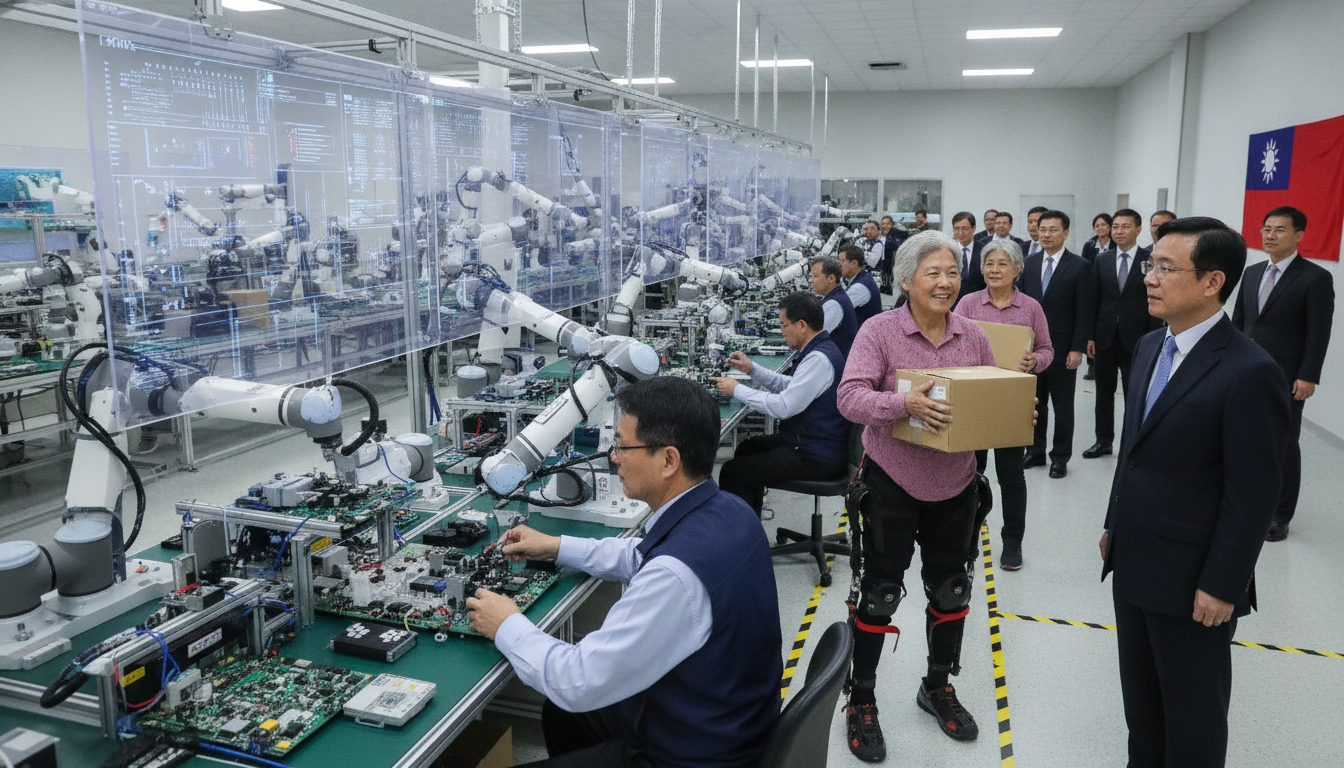
Taiwan ramps up robotics industry to strengthen AI supply chains and support an aging society, says tech minister
Taiwan accelerates its robotics industry to bolster AI supply chains, ease demographic strains and expand exports, top tech official Wu Cheng-wen says.
Taiwan’s top technology official outlined a deliberate push to develop the Taiwan robotics industry as a dual strategy to fortify AI supply chains and address the island’s demographic pressures. Wu Cheng-wen framed the initiative as commercially driven and civilian in scope, distinguishing it from what he described as China’s military-focused robotics development. The announcement signals closer coordination between government, chipmakers and contract manufacturers to translate semiconductor strength into robotics hardware and applied AI.
Government roadmap emphasizes industrial-scale adoption
The Ministry of Digital Affairs and related agencies are moving to translate policy into industrial outcomes by encouraging large-scale deployment of robots across factories and service sectors. Officials say incentives will target integration projects that combine local chips, sensors and machine-vision software to reduce reliance on foreign suppliers. The roadmap prioritizes interoperable standards and pilot programs that demonstrate cost savings and productivity gains for small and medium-sized enterprises.
AI supply chain resilience and local manufacturing
Strengthening the AI technology supply chain is central to the strategy, according to Wu, who highlighted Taiwan’s semiconductor ecosystem as a competitive asset. Policymakers are promoting closer ties between chipmakers, AI software firms and mechanical component suppliers to ensure full-stack manufacturing capability. Industry observers note that developing domestic capabilities for actuators, power electronics and specialized AI accelerators will be critical to reduce bottlenecks in robot production.
Foxconn and private sector demonstrations bolster momentum
Private companies have begun to showcase advances that underline the government’s ambitions, with major contract manufacturers exhibiting humanoid and industrial robots at trade events. Foxconn’s November 2025 tech day featured an industrial humanoid that drew attention to manufacturing applications and human–machine collaboration on assembly lines. Executives say these demonstrations are designed to attract global customers and to prove that Taiwan can deliver integrated robotics solutions at scale.
Elder care and social-service applications highlighted
A key policy rationale for investing in robotics is Taiwan’s rapidly aging population, which the government says will strain healthcare and social services in the coming decades. Officials expect service robots, remote-monitoring systems and assistive devices to relieve pressure on caregivers and extend independent living for older adults. Pilot projects in community clinics and elder-care facilities are being accelerated to test usability and regulatory frameworks for medical and assistive technologies.
**Funding, standards and regulatory adjustments under review】
To translate prototypes into commercially viable products, Taipei plans to expand R&D grants, tax incentives and matching funds for public–private projects. Regulators are also reviewing safety standards and certification processes specific to robots operating in public and clinical settings. The goal is to shorten time-to-market while maintaining safety and interoperability, balancing innovation incentives with consumer protections.
Workforce training and talent pipeline initiatives
Expanding the Taiwan robotics industry will require both engineering talent and technicians capable of installation, maintenance and systems integration. Government programs aim to re-skill workers from traditional manufacturing and to create cross-disciplinary university courses that combine robotics, AI and biomechanics. Partnerships with industry are planned to ensure curricula match employer needs, and accelerated apprenticeship schemes will be piloted to place graduates quickly into deployment projects.
Geopolitical context and export strategy
Wu framed Taiwan’s robotics push as commercial and civilian, explicitly contrasting it with developments in neighboring jurisdictions that prioritize military uses. Still, industry observers say geopolitical dynamics will shape export strategies, supply-chain partnerships and international standards work. Taipei is positioning robotics as an export growth area that leverages the island’s chip-making prowess and contract-manufacturing networks to capture demand in Asia and beyond.
The Taiwan robotics industry push reflects a broader attempt to convert national strengths in semiconductors and precision manufacturing into higher-value products for aging societies and industrial clients. By coordinating policy, funding and industry demonstrations, Taipei aims to accelerate adoption and build an exportable robotics ecosystem while maintaining a civilian, commercially focused posture. The coming months will test whether pilot projects and regulatory changes can translate technological promise into sustained industrial growth.

