
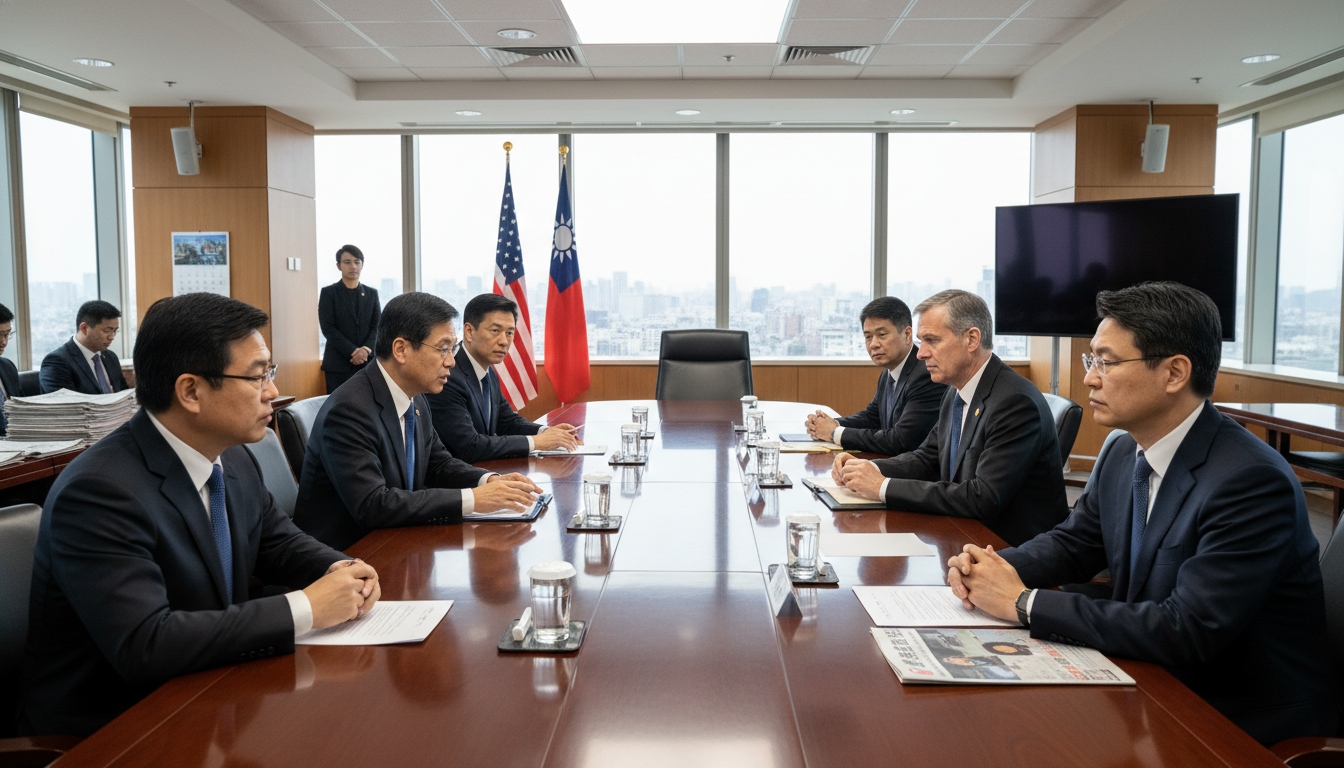
Taiwan tensions flare after debate over wording in Trump’s China visit
Debate over whether the U.S. “opposes Taiwan independence” after President Trump’s China trip deepens Taiwan tensions and prompts calls for clearer Washington policy.
When President Donald Trump visited China in mid-May and said the United States was “not looking to have somebody say, ‘Let’s go independent,’” the remark triggered an intense debate over wording that has renewed Taiwan tensions across capitals and Taipei’s domestic politics. The phrasing — whether Washington “opposes” Taiwan independence or merely “does not support” it — has taken on outsized strategic significance and prompted officials, analysts and party leaders to reassess what U.S. language signals to Beijing and Taipei.
Trump’s remark and the immediate controversy
The president’s comment, delivered during talks in China, was widely amplified because it touched a sensitive diplomatic line that underpins cross-strait relations. The explicit phrasing of U.S. policy has long been carefully calibrated to maintain strategic ambiguity while deterring unilateral moves toward formal independence.
Observers noted that a simple shift from “does not support” to “opposes” could be read as a firmer U.S. stance against independence, raising questions about the consistency of longstanding U.S. statements. That uncertainty has fed renewed Taiwan tensions because Beijing treats any perceived movement toward independence as a red line.
Differences in diplomatic language and legal implications
Terminology matters in diplomacy, and legal experts say the distinction between “not supporting” and “opposing” carries both rhetorical and potential policy implications. “Not supporting” is often interpreted as passive restraint, while “opposing” signals active resistance or preventative measures.
Under the U.S. framework that has guided cross-strait relations for decades, language has been deliberately ambiguous to balance support for Taiwan’s democratic institutions with avoidance of direct confrontation with Beijing. Any perceived hardening of language can therefore reshape expectations about U.S. responses to future crises.
Reactions in Taipei and the island’s political debate
In Taipei, the comments intensified debate between political factions and raised concerns among voters about security guarantees. Taiwan’s leadership, including President Lai Ching-te, has navigated a delicate path between asserting the island’s democratic identity and avoiding actions that could escalate tensions with China.
Political parties on the island reacted with caution, with some urging clarification from Washington and others warning against any interpretation that would embolden Beijing. For many Taiwanese, the core concern remains preserving peace while securing reliable international backing.
Washington’s strategic ambiguity and congressional voices
In Washington, diplomats and lawmakers stressed the need for clarity without abandoning strategic ambiguity entirely. Some members of Congress and policy analysts argued that clearer language could deter Beijing, while others warned that a more explicit “oppose” posture might limit Washington’s flexibility and risk provoking retaliation.
Officials familiar with U.S.-Asia policy emphasized that the practical effect of wording depends on follow-through in policy, diplomacy and defense cooperation rather than a single phrase. The episode has nonetheless spurred renewed calls in Capitol Hill hearings and policy circles for formal guidance on how the United States defines its position.
Beijing’s perception and regional security concerns
Beijing has long opposed any expression of Taiwanese independence and monitors changes in U.S. rhetoric closely. Chinese authorities view shifts in language as potential signals of changing intentions, which can prompt adjustments in military posture and diplomatic pressure on Taipei.
Regional security analysts warn that miscommunication or mixed signals heighten the risk of miscalculation in the Taiwan Strait, where rapid escalations could have wide-ranging economic and military consequences for East Asia. The interplay between words and actions, they say, has become a focal point of contemporary Taiwan tensions.
Practical implications for cross-strait stability
Beyond rhetoric, the debate has practical implications for crisis management, allied coordination and Taiwan’s own policy choices. Clearer U.S. language could reassure some audiences but might also constrain diplomatic maneuvering when rapid responses are required.
Allies in the region, including Japan and partners in Southeast Asia, watch developments closely because disruptions in cross-strait stability would affect trade, supply chains and security architectures. Policymakers now face the task of translating contested phrases into predictable behaviors that reduce rather than inflame Taiwan tensions.
As diplomatic exchanges continue, officials in Taipei, Washington and Beijing are likely to seek clarifications and calibrations to avoid unintended escalation. The controversy over a few words has underscored how fragile the balance in the Taiwan Strait remains and how carefully language must be matched with policy to sustain stability.

