
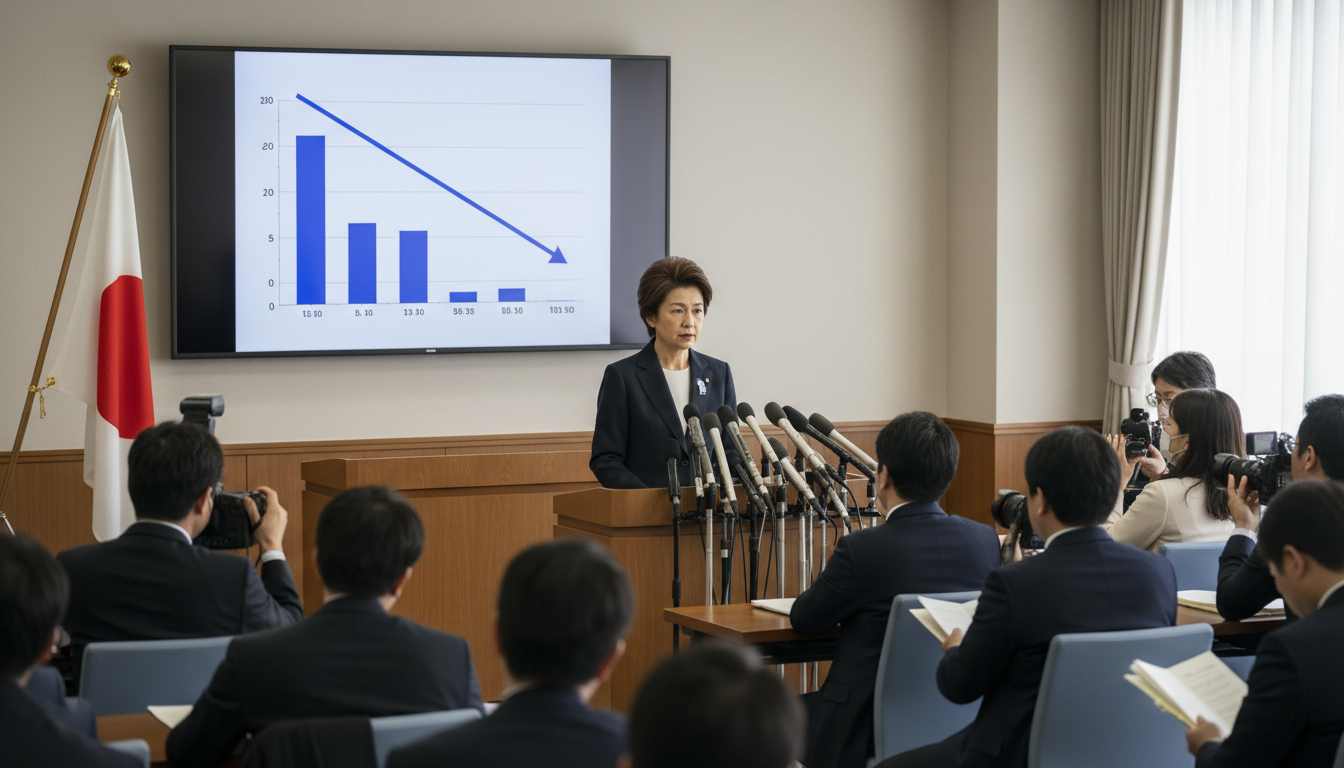
Takaichi Cabinet approval rating slips to 59.1% in April Jiji Press poll
Takaichi Cabinet approval rating at 59.1% in April Jiji Press poll; LDP backing slips as public is split over education minister Matsumoto, report says.
Prime Minister Sanae Takaichi’s Cabinet approval rating edged down to 59.1% in April, according to a monthly Jiji Press survey, marking a 0.2 percentage-point decline from March. The poll shows the Cabinet’s support at its lowest level for a second consecutive month, though it remains comparatively high against recent predecessors. Public responses also pointed to divided views on a controversy surrounding the education minister, underscoring mixed sentiment toward the new administration.
Monthly survey: small decline, sustained majority support
The Jiji Press interview poll found 59.1% of respondents expressing approval of the Takaichi Cabinet, a modest fall from the prior month. Dissent was limited: 19.2% said they did not support the Cabinet, a decrease of 1.1 points, while 21.7% remained undecided. Analysts say the numbers reflect steady baseline backing even as small fluctuations appear month to month.
Public approval has tapered slightly for two straight months, but the overall level still outpaces many recent cabinets at comparable points in their tenures. Observers note that early-term ratings often show volatility as new policies and personnel decisions are digested by the public. For the Takaichi administration, the current figures suggest a resilient base of support even amid emerging controversies.
Why supporters back the Cabinet
When asked to select reasons for backing the Takaichi Cabinet, respondents could give multiple answers, producing a mix of leadership and impression-based explanations. The leading reason cited was confidence in Takaichi’s leadership, chosen by 28.3% of supporters. Trust in the prime minister personally accounted for 20.2% of responses, while 16.4% pointed to a generally favorable view of the Cabinet’s performance.
Another notable factor was perceived lack of viable alternatives, with 13.5% of pro-Cabinet respondents saying there were no other suitable candidates for prime minister. These responses suggest that support is underpinned both by positive assessments of Takaichi and by comparative evaluations of opposition options. Political strategists say such mixed motivation can stabilize approval levels even when specific issues provoke criticism.
Party support and voter alignment
The ruling Liberal Democratic Party remained the most supported party in the survey, drawing 25.7% backing from those surveyed, down from 26.9% the previous month. The Democratic Party for the People trailed far behind at 2.9%, down from 3.8%. Other parties recorded single-digit support figures, including the Centrist Reform Alliance (2.5%) and the Japan Innovation Party, the coalition partner, at 2.2%.
Smaller parties registered lower shares: Sanseito 2.1%, Team Mirai 2.0%, Komeito 1.9%, the Japanese Communist Party 1.5% and the Constitutional Democratic Party of Japan 1.3%. The Conservative Party of Japan, Reiwa Shinsengumi and the Social Democratic Party logged minimal support. Notably, a majority plurality—51.5%—said they supported no particular party, reflecting a large pool of unaffiliated or undecided voters that could influence future electoral dynamics.
Effect of the Matsumoto report on public opinion
The survey also gauged reactions to a report in a weekly magazine alleging an extramarital affair involving Education Minister Yohei Matsumoto. Public reaction was split: 30.6% said Prime Minister Takaichi should remove him from the ministerial post, while 29.8% indicated she should not necessarily take that step. The rest were likely uncertain or had no opinion on the question.
The narrow margin between those favoring dismissal and those urging caution points to political risk without an overwhelming public mandate for action. Government officials and party figures have been monitoring public sentiment as they weigh personnel decisions, mindful that strong moves can both reassure critics and provoke backlash among supporters. The episode has underscored how single-issue scandals can influence perceptions of an otherwise stable approval picture.
Survey scope and methodology
Jiji Press conducted face-to-face interviews with 2,000 adults aged 18 and older across Japan over a four-day period concluding on Monday. The poll achieved a valid response rate of 58.8%, a level that pollsters consider reasonable for nationwide interview surveys. Month-to-month comparisons in approval and party support were calculated against responses gathered in the previous survey cycle.
While headline percentages provide a snapshot, pollsters caution that short-term changes of a few tenths of a point can fall within normal sampling variation. Still, the consistent methodology and sample size make the survey a useful barometer of public mood during the early months of the Takaichi administration.
The Jiji Press results present a portrait of a government maintaining broad public approval amid the normal ebb and flow of early-term politics. Debate over ministerial conduct and shifting party loyalties may shape future monthly readings as the administration moves forward with its policy agenda.

