
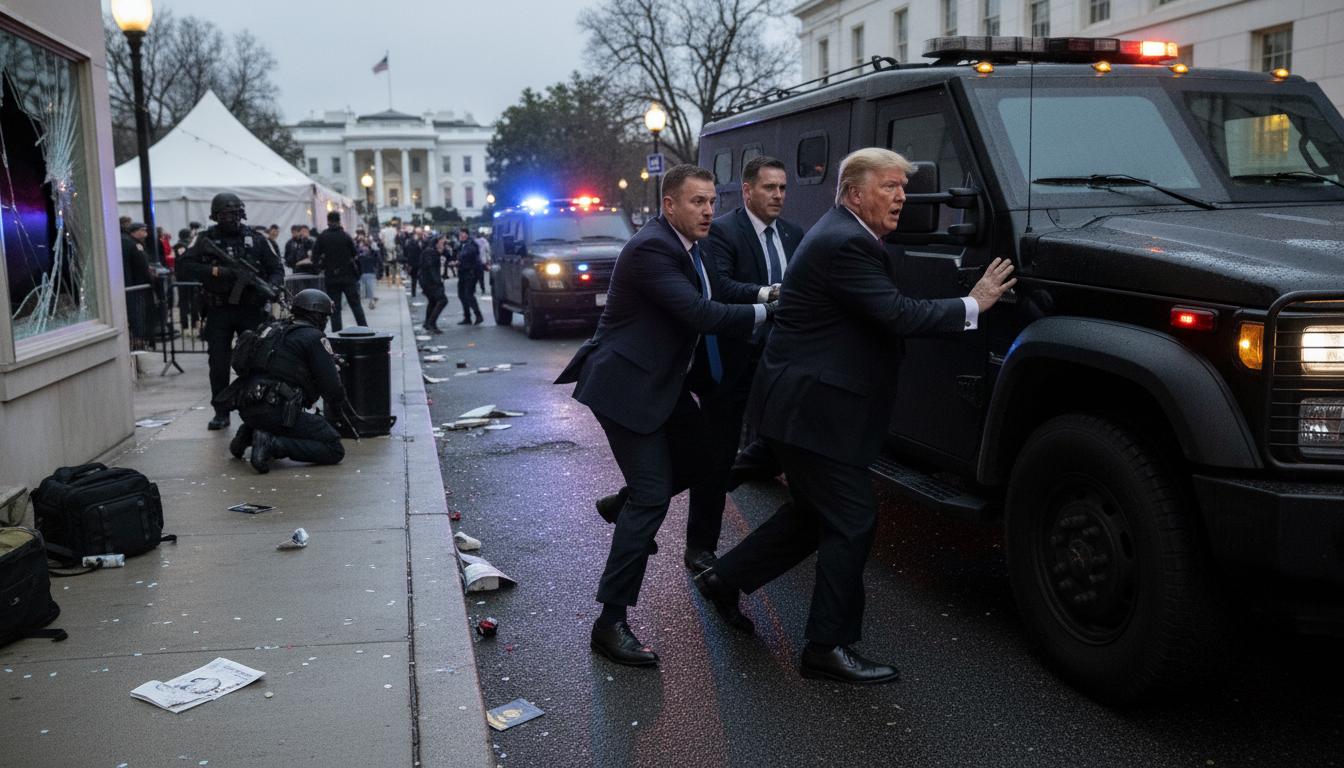
White House Correspondents’ Dinner shooting forces evacuation of President Trump in Washington
Shooting near the White House Correspondents’ Dinner in Washington on April 25, 2026 forced President Trump’s evacuation; authorities detained a suspect.
President Donald Trump was evacuated after a shooting broke out near the venue hosting the White House Correspondents’ Dinner in Washington on April 25, 2026, prompting immediate security action and a scramble by law enforcement. The White House Correspondents’ Dinner shooting left questions about motive and target as officials detained a suspect who is believed to be able to speak with investigators. Waseda University professor Mieko Nakabayashi, who has experience working in the U.S. Congress, cautioned that many details remain unclear and said the coming days should clarify whether the president was deliberately targeted.
Incident and immediate response
The shooting occurred in the vicinity of the dinner event on the evening of April 25, drawing rapid attention from local and federal law enforcement agencies. Attendees were escorted from the scene and the president was moved to a secure location before being brought briefly to the public for a statement. Multiple security units converged on the area and the suspect was taken into custody, according to accounts from officials present at the scene.
Witnesses reported confusion and a swift protective response by Secret Service agents and other security personnel assigned to the event. Organizers of the White House Correspondents’ Dinner halted programming as law enforcement assessed the perimeter and searched for additional threats. Authorities have not publicly released a full chronology of the shooting or detailed the number of shots fired as the investigation continues.
President Trump’s public remarks after evacuation
Shortly after the evacuation, President Trump appeared at a public briefing to assert his safety and to offer his initial remarks on the incident. In the briefing he suggested he might have been a target, invoking the historical example of President Abraham Lincoln to underscore the risks faced by high-profile political figures. His remarks blended reassurance with pointed commentary about the potential motivations behind attacks on public figures.
The president’s choice to appear publicly was framed by aides as an effort to demonstrate stability and calm after the shooting. Political allies emphasized the need for unity and warned against speculation while investigators work. Critics, however, cautioned that weaponizing public appearances could complicate investigative and security challenges.
Investigation status and suspect condition
Authorities have confirmed a suspect was detained at the scene and said the person is in a condition to be interviewed, according to sources close to the investigation. Investigators are focusing on the suspect’s movements, any weapons recovered, and possible links to broader networks or grievances. Law enforcement agencies indicated they will release more information as they verify facts and process evidence.
Professor Nakabayashi noted the investigative timeline is likely to yield significant new details within days, as forensic analysis and interviews proceed. She highlighted the importance of determining whether the suspect acted alone, whether there was a specific intent to target the president, and what, if any, manifestos or communications preceded the attack. Those findings will shape charging decisions and public understanding of the event.
Security implications for high-profile events
The White House Correspondents’ Dinner shooting has raised immediate concerns about security preparations for high-profile public gatherings in the U.S. The incident has put a spotlight on coordination among local police, the Secret Service, and event organizers when protecting senior officials and large crowds. Questions about checkpoints, screening of attendees, and the placement of protective details are expected to dominate reviews in the aftermath.
Security analysts predict agencies will conduct after-action reviews to identify gaps and strengthen procedures for future events. Organizers of political and media functions nationwide may face pressure to revise access controls and emergency protocols. The event also renewed debate about balancing public access to leaders and the press with the imperative of ensuring safety for all attendees.
Political fallout and national reaction
The shooting comes amid an already polarized political climate, and it immediately provoked commentary from lawmakers, media organizations, and civic groups. Some observers warned that the incident could intensify partisan rhetoric and threats; others urged restraint and stressed the need to let investigators complete their work. Professor Nakabayashi emphasized that, while emotions run high, jumping to conclusions about motive or blame risks exacerbating divisions.
Calls for measured responses have come from across the political spectrum, with an emphasis on protecting democratic institutions and the safety of public servants. Media groups also noted the chilling effect that violence near a press event could have on journalism and public discourse. The broader conversation will likely focus on preventing a cycle of retaliatory acts and ensuring that political disagreements do not translate into violence.
Federal and local authorities have pledged cooperation as they pursue leads and assemble evidence. The coming days are expected to bring a clearer account of the suspect’s background, any links to extremist rhetoric or groups, and the operational details of how the shooting unfolded. For now, the White House Correspondents’ Dinner shooting remains under active investigation, and officials continue to assess security implications for national events.
Investigators and security agencies have said they will provide updates as more information becomes available, while event organizers and political leaders prepare for heightened scrutiny of protective measures going forward.

