
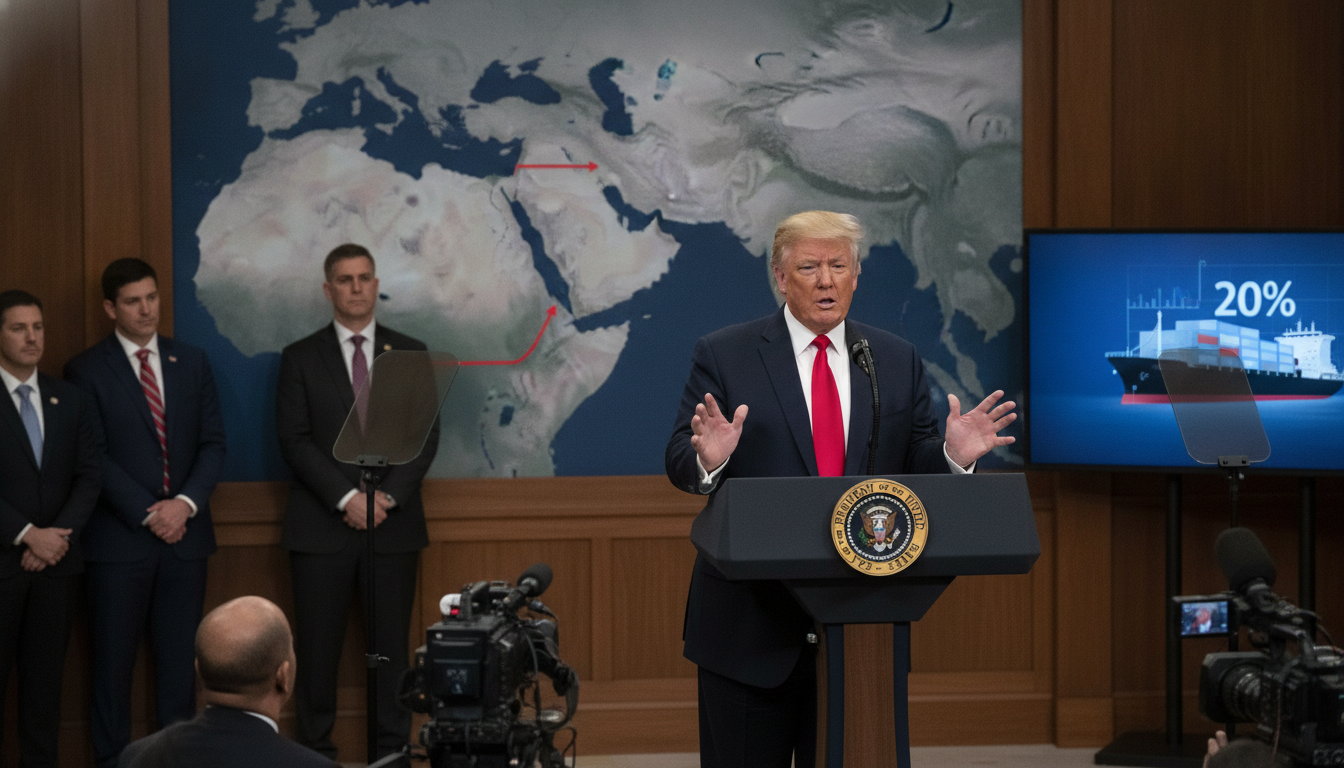
Trump Announces Restart of U.S. Maritime Blockade of Iran, Says Washington Will Take “20%” Fee
U.S. maritime blockade of Iran to resume, President Trump announced on July 13, 2026, claiming the United States will take 20% of transported cargo as a security fee.
Opening summary
On July 13, 2026, President Donald Trump declared via social media that the United States will resume a maritime blockade of Iran and asserted the U.S. will collect 20% of transported cargo as payment for security in the Strait of Hormuz.
The announcement comes as U.S. Central Command said a partial blockade would be reimposed and as U.S. forces continued strikes against Iranian targets in a renewed escalation of hostilities.
Trump’s public declaration and fee claim
President Trump posted that the Strait of Hormuz will remain open “with or without Iran” while saying the United States would be known as the waterway’s guardian.
He further asserted that the U.S. would receive a 20% fee on all cargo transiting the waterway to cover the costs of providing security, a claim that departs sharply from longstanding principles of free passage.
CENTCOM order and timing of blockade restart
U.S. Central Command announced on July 13, 2026, that a blockade on vessels entering and leaving Iranian ports would resume at 4:00 p.m. U.S. Eastern Time on July 14, 2026 — equivalent to 5:00 a.m. Japan Standard Time on July 15, 2026.
The command said navigation assistance for vessels not subject to the blockade would continue, but it also confirmed that strikes against Iranian targets had resumed on the same day.
Recent military actions and breakdown of the June memorandum
The resumption of the blockade follows a series of exchanges in which U.S. forces reported multiple strikes against Iranian territory between July 7 and July 13, 2026.
Those attacks, described by U.S. officials as responses to Iranian actions against commercial shipping, have effectively undermined a ceasefire memorandum signed on June 17, 2026, which had aimed to halt direct combat and ensure maritime passage.
Iran’s reaction and Revolutionary Guard moves
Iranian officials, including Foreign Minister Nasser Kan’ani’s predecessor or spokespersons, responded by sarcastically praising Trump’s remarks that those securing the strait should be compensated.
The Islamic Revolutionary Guard Corps declared on July 12, 2026, that Iran had the authority to re-seal the Strait of Hormuz, a step that would heighten risks to global energy flows and prompt immediate diplomatic and economic consequences.
Legal and congressional notification
U.S. political outlets reported that the administration formally notified Congress on July 10, 2026, of plans to resume strikes, a step that advisers say would permit military operations for up to 60 days without new congressional authorization.
That notification and subsequent military actions raise legal and political questions at home about the executive branch’s authority to renew operations that affect international commerce and could draw the United States deeper into prolonged confrontation.
Economic and international implications
Markets reacted quickly, with energy traders and shipping firms warning that any effective blockade of the Strait of Hormuz could spike oil prices and disrupt supply chains that rely on the narrow waterway.
For Japan and other import-dependent economies, extended disruption in the strait would threaten energy security and raise the cost of shipping for a wide range of goods, amplifying domestic political pressure on governments to seek de-escalation.
Regional and diplomatic fallout
Allies and regional partners now face intensified pressure to clarify whether they will support U.S. operations or pursue separate diplomatic channels to reopen the memorandum’s terms.
The breakdown of the June agreement and renewed military exchanges increase the chance of miscalculation at sea and complicate efforts to convene an internationally backed mechanism to guarantee free navigation without unilateral levies.
President Trump also signaled intentions to continue strikes, naming specific locations in central Iran as potential targets, and called the earlier memorandum a “test” of limited value.
Iran countered verbally, insisting it has historically acted as a guardian of the strait and rejecting the scale of the fee proposed by Washington, while signaling a willingness to negotiate “fair” terms only on its own conditions.
The U.S. move to reimpose a maritime blockade and the president’s public demand for a 20% security fee represent a dramatic shift in posture that elevates military, legal and economic stakes.
As forces on both sides maintain offensive operations, diplomatic channels face an urgent test to prevent broader regional escalation and to secure the flow of global commerce through one of the world’s most critical chokepoints.

