
USMCA Shift: U.S. Rejects Long-Term Renewal, Opts for Annual Reviews and Raises Trade Uncertainty
U.S. declines long-term renewal of USMCA, opting for annual reviews that could unsettle North American supply chains, automakers, farmers and investment.
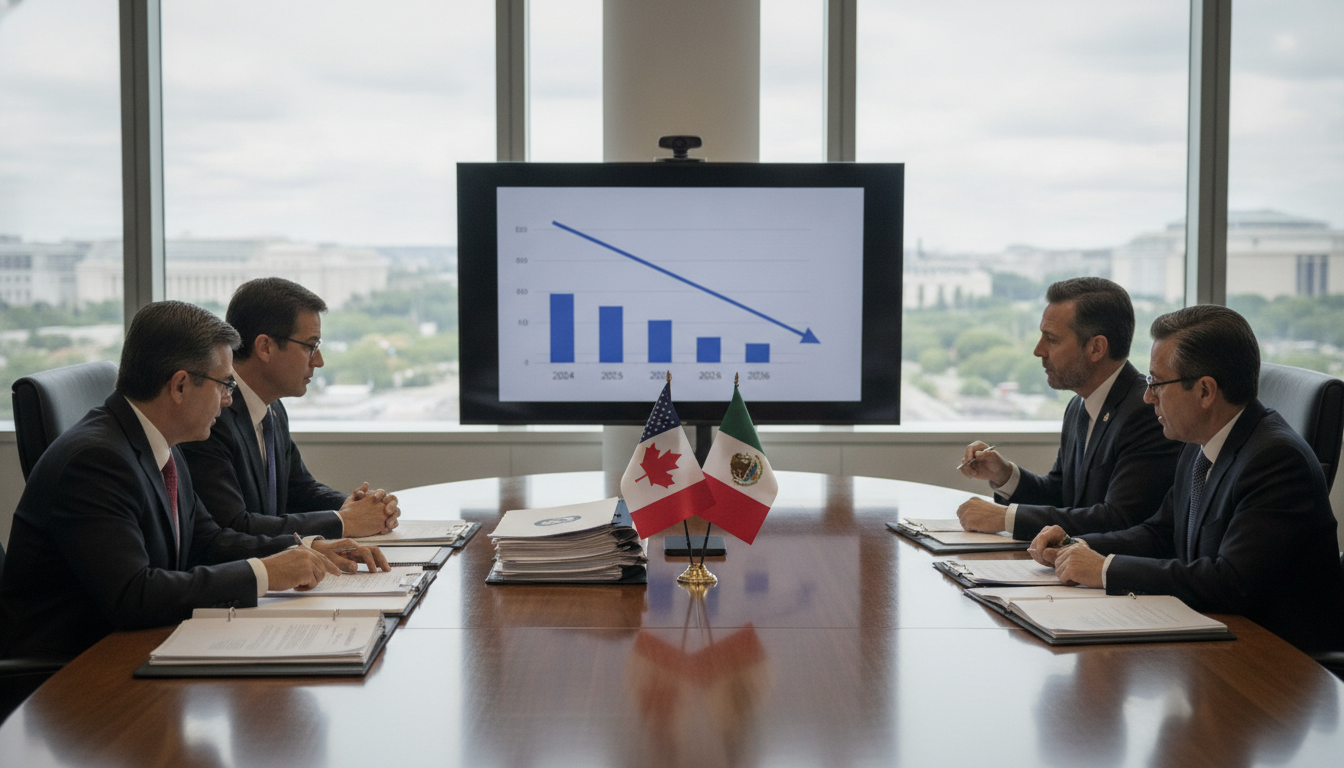
The United States announced it will not seek a long-term renewal of the U.S.-Mexico-Canada Agreement (USMCA), choosing instead to subject the pact to annual reviews that could stretch contentious talks over a decade. The decision, declared by U.S. trade officials, leaves the trilateral framework in place while opening the door to repeated negotiations and potential tariff leverage that industry groups warn could disrupt integrated North American supply chains. Companies that rely on stable, low-tariff trade across the three countries now face an extended period of regulatory uncertainty.
U.S. Decision and Official Rationale
U.S. Trade Representative Jamieson Greer said the administration is unwilling to simply “rubber stamp” the agreement and believes there are substantial issues that require ongoing attention. The administration framed the move as a tool to secure further concessions on rules of origin, enforcement and other provisions it views as needing improvement. Officials portrayed annual reviews as a mechanism to press partners without immediately withdrawing from the accord.
Economic Stakes for Manufacturers and Farmers
USMCA has supported rising intra‑North American commerce, with trade among the three countries surpassing $1.6 trillion in 2024, up from roughly $1 trillion when the pact took effect. Automakers, parts suppliers, agriculture exporters and retailers lean heavily on preferential treatment and clear rules of origin to keep production viable across borders. Industry groups warn that rolling negotiations and the risk of tariff escalation could delay investment decisions and slow manufacturing expansions that require long‑term certainty.
Political Context and Presidential Motives
The reversal is notable given President Donald Trump’s role in championing USMCA during his earlier term and his previous description of it as a major achievement. Behind the move are broader political priorities to reshore manufacturing and use trade leverage to address bilateral deficits, sources say. The administration’s posture signals an appetite to press Mexico and Canada on issues such as autos, metals and perceived imbalances, even while keeping the agreement technically active.
Responses from Ottawa, Mexico City and Business Groups
Canadian Trade Minister Dominic LeBlanc urged continued engagement and emphasized Canada’s interest in addressing tariffs on steel, aluminum, autos and lumber in follow‑up talks. Mexico’s Economy Minister Marcelo Ebrard downplayed the decision’s severity and said Mexico does not see irreconcilable differences among the partners. Major U.S. trade associations — from the U.S. Chamber of Commerce to the Alliance for Automotive Innovation — pressed leaders to preserve the treaty’s preferential rules, arguing that USMCA underpins billions in auto investments and thousands of manufacturing jobs.
Negotiation Timeline, Risks and Legal Mechanics
Under the new approach, the three countries will carry out annual reviews and may renegotiate aspects of the deal over a 10‑year period; if no consensus is reached, the agreement could expire in 2036. Experts warn the absence of a fixed renegotiation deadline creates a prolonged period without a “forcing function,” increasing uncertainty for firms planning long‑term supply chains. Observers also note that the U.S. retains the implicit leverage to threaten higher tariffs during reviews, a tactic that could influence concessions but also raise the risk of retaliatory measures.
Key Issues on the Table for Future Talks
U.S. negotiators plan to press for tougher rules of origin for autos and other industrial goods to limit the use of non‑North American inputs, particularly where Chinese components are suspected in supply chains. Talks may also cover aerospace, intellectual property protections and sectoral tariffs already levied on Canadian steel and aluminum. Labor groups and unions are urging stronger enforcement and higher labor standards, seeking measures that would discourage offshoring and protect workers across the three economies.
The shift to annual reviews follows a period in which exemptions and tariff measures have already altered trade dynamics, including increased use of USMCA certification by importers. Officials say negotiations with Mexico have formally commenced, while engagement with Canada has been more limited to date. That uneven rhythm of talks, combined with geopolitical concerns over foreign investment and transshipment risks, complicates any quick resolution.
Observers say the administration’s stance could produce mixed outcomes: it may extract incremental changes that tighten origin rules and enforcement, but the drawn‑out process risks chilling investment decisions that require multi‑decade horizons. Business lobbying has intensified on Capitol Hill, with U.S. firms urging maintenance of the trilateral framework and clarity on duty‑free treatment to preserve efficient supply chains.
While the pact remains active, the new approach fundamentally alters the predictability that helped integrate manufacturing across North America. Companies, unions and governments now face a decade of rolling scrutiny and bargaining that will shape trade patterns, investment flows and industrial planning across the continent.
Market participants and policymakers will watch the next formal round of talks, scheduled to focus on industrial rules of origin and several sectoral issues, to gauge whether annual reviews lead to substantive change or prolonged friction. The outcome will determine whether USMCA remains a stabilizing force for North American trade or becomes a vehicle for ongoing leverage and uncertainty.
The decision marks a significant shift in the management of the North American trade relationship and sets the stage for years of complex negotiations that will test the willingness of the United States, Canada and Mexico to balance sovereignty, competitiveness and regional cooperation.

