
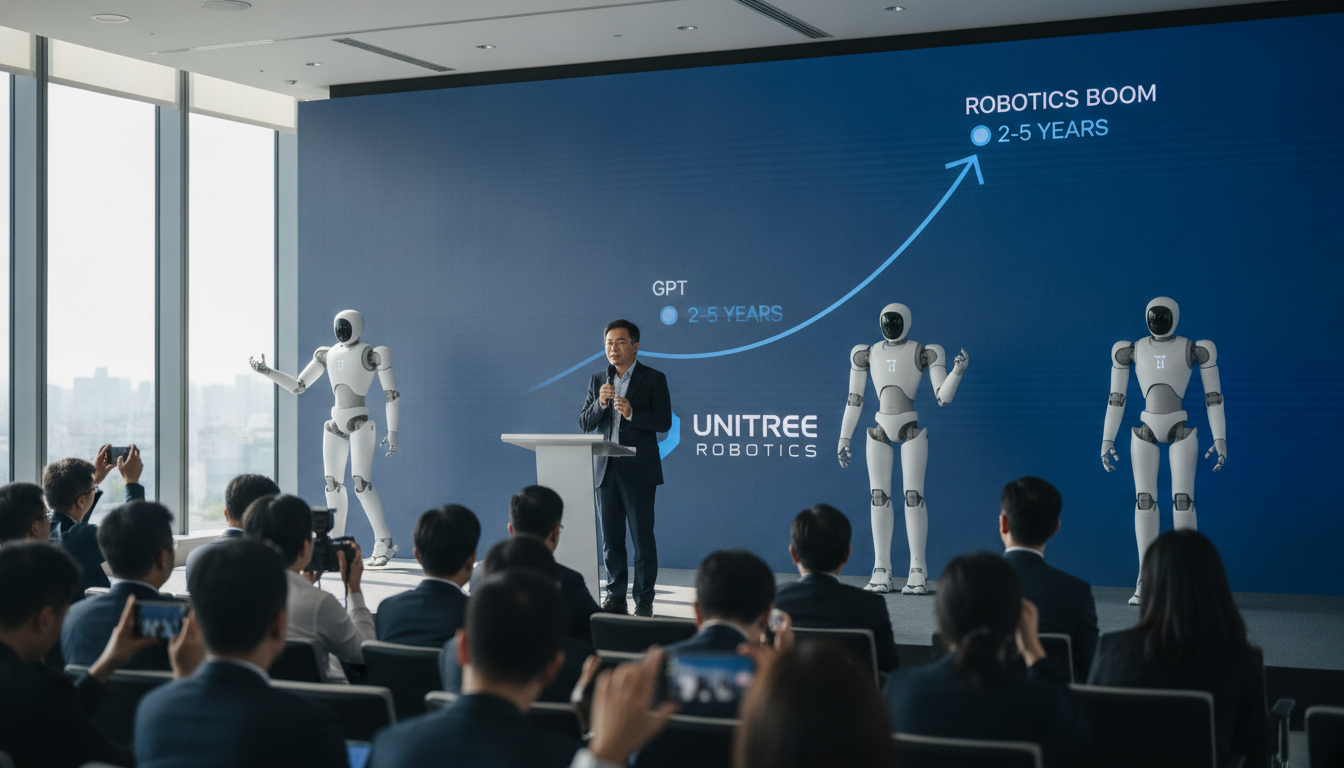
Robotics industry two to five years from a “GPT moment,” Unitree executive says
AI must gain reliable hardware control for a true “GPT moment” in robotics, Unitree Robotics warned on July 22, 2026.
TOKYO — A senior executive at Unitree Robotics said on Wednesday, July 22, 2026, that the robotics industry remains roughly two to five years away from experiencing a “GPT moment” comparable to ChatGPT’s breakthrough in generative AI. The executive stressed that achieving that watershed will require major improvements in AI’s ability to control hardware reliably across varied real-world environments. Unitree, a leading Chinese maker of humanoid and legged robots, identified control, safety and robustness as the principal barriers to a sudden leap in capability.
Unitree Robotics’ assessment
Unitree’s comments framed the debate around whether large-model advances will quickly translate to physical robots. The company argued that while perception and decision-making models have advanced rapidly, coupling those models to actuators and sensors in unpredictable environments is still a separate, difficult problem. Unitree highlighted the need for tighter integration between software models and robot hardware to handle more variables in field operation.
Control and the simulation-to-reality gap
Engineers point to the simulation-to-reality gap as a fundamental technical obstacle to a robotics GPT moment. Models trained in simulated settings often fail when faced with noise, unmodeled friction, sensor drift or novel obstacles in the physical world. Real-time control demands deterministic safety margins and low-latency responses that current large AI models are not designed to guarantee out of the box.
Perception, multimodality and sample efficiency
Beyond raw control, robots require robust multimodal perception—combining vision, force sensing, proprioception and sometimes audio—so that an AI can interpret and respond to complex scenes. Training such systems typically needs orders of magnitude more physical data than what generative language models consume, creating bottlenecks in sample efficiency and data collection. Researchers are experimenting with self-supervision, transfer learning and simulated pretraining to reduce the quantity of real-world trials needed.
Commercial use-cases and deployment realities
Industry sources say commercial gains are most visible in constrained industrial settings such as warehouses, logistics and inspection, where environments can be partially standardized. General-purpose humanoid robots remain farther from mass deployment because of cost, durability and the broad range of human-centric tasks they must master. Companies that can deliver reliable, task-specific solutions are likely to attract customers sooner than those promising broad generality.
Safety, regulation and public acceptance
Regulatory frameworks and safety standards will shape how quickly higher-capability robots enter public spaces. Certification regimes, liability rules and human-robot interaction protocols must be established and tested before operators can scale deployments. Public confidence will depend on predictable behavior, transparent fail-safes and demonstrable reductions in accident risk.
Investment and market implications
Investors are watching for demonstrable, repeatable demos that show sustained, autonomous performance in realistic settings. A gradual cadence of technical milestones—rather than a single instant—could reshape funding patterns, prompting consolidation among smaller startups and strategic bets by larger manufacturers. The companies that marry robust hardware engineering with adaptable AI will have a competitive edge as the market matures.
If Unitree’s two-to-five-year window proves accurate, the robotics industry could see landmark demonstrations and commercial shifts between 2028 and 2031. Observers say the defining indicators to watch are measurable improvements in low-latency control, reductions in required real-world training data, and certified safety performance in complex environments. Failure to achieve those advances will delay a true “GPT moment” in robotics, while steady progress could usher in a new phase of practical, widely deployed robotic capabilities.

