
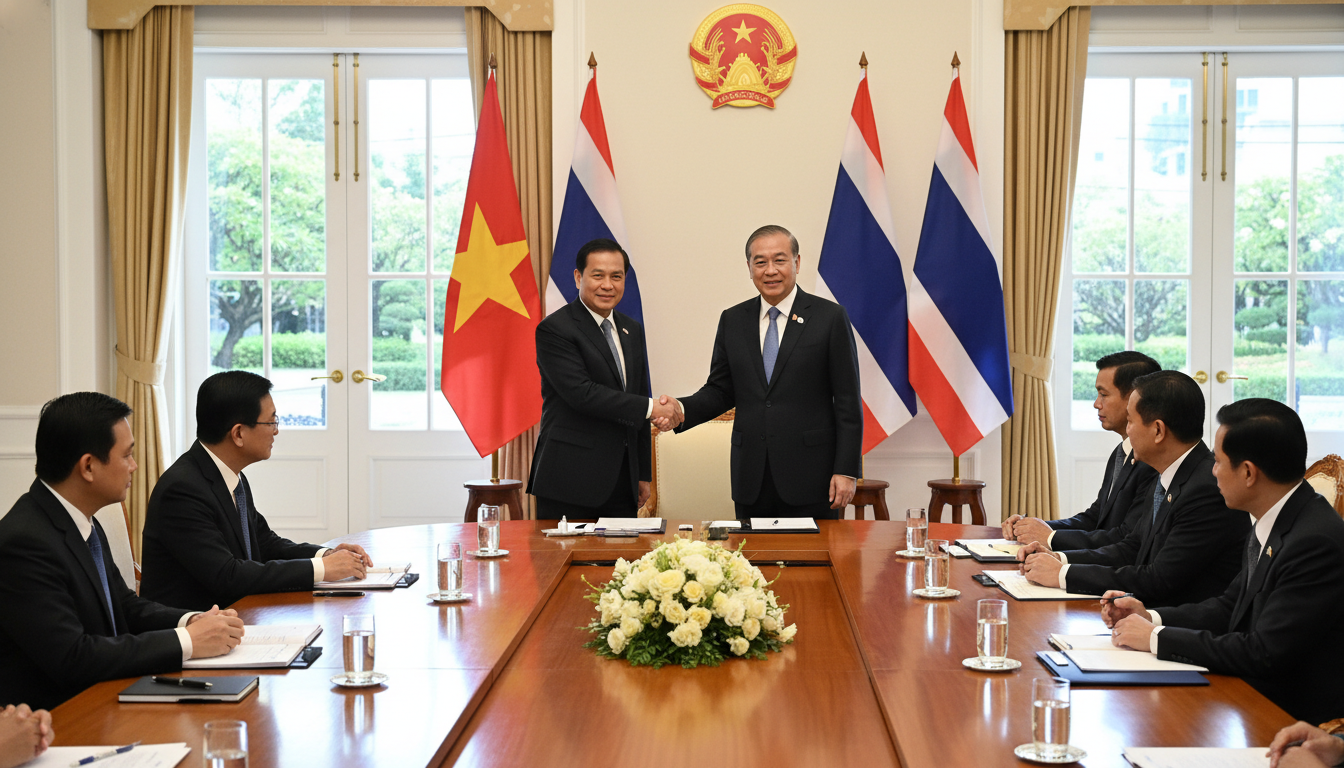
To Lam visit to Thailand aims to deepen strategic partnership and boost $25 billion trade target
Vietnam’s To Lam visits Thailand (May 27–29, 2026) to deepen a Comprehensive Strategic Partnership, spur supply‑chain links and pursue a $25 billion goal.
BANGKOK — Vietnam’s Party General Secretary and State President To Lam opened a three‑day official visit to Thailand on May 27, meeting Prime Minister Anutin Charnvirakul in a summit focused on economic integration and regional cooperation. The To Lam visit to Thailand centers on turning an upgraded Comprehensive Strategic Partnership into concrete trade and investment outcomes. (vietnamnews.vn)
Bangkok summit and bilateral talks
To Lam and Prime Minister Anutin held formal talks at Government House on May 28, where both sides emphasised a shared agenda of trade, technology and security cooperation. Officials described the meetings as the start of a concentrated push to operationalise the strategic partnership agreed last year. (nationthailand.com)
A joint news conference highlighted agreements to accelerate cooperation across ministries and to expand people‑to‑people exchanges as a means to underpin deeper state‑level ties. Delegations from both countries included senior economic and foreign affairs officials tasked with drafting the forthcoming action plan. (nationthailand.com)
Exchange of a 2026–2031 action plan and $25 billion trade target
During the visit Thailand and Vietnam formally exchanged a 2026–2031 roadmap intended to translate political trust into measurable economic results. The plan sets an ambitious bilateral trade target of US$25 billion per year and lays out sectoral priorities to reach that goal. (thestar.com.my)
Officials said the roadmap will include timelines for regulatory alignment, joint investment promotion and mechanisms to monitor progress through ministerial working groups. Both governments signalled readiness to mobilise public and private resources to hit the trade benchmark. (thestar.com.my)
Supply‑chain links, semiconductors and electric vehicles
A major element of discussions was supply‑chain integration, with Thailand and Vietnam seeking to reposition themselves as complementary nodes in regional manufacturing. Areas singled out for cooperation include semiconductors, electric vehicles, digital payments and green energy investment, reflecting wider industrial priorities across Southeast Asia. (nationthailand.com)
Thai ministers highlighted the potential for “Three Connects” initiatives — transport, customs facilitation and people‑to‑people links — to lower barriers for cross‑border production and investment. Vietnamese officials stressed that deeper integration would support Vietnam’s export growth while offering Thai manufacturers resilient input sources. (nationthailand.com)
Symbolic visits and cultural outreach
Beyond formal negotiations, To Lam’s itinerary included symbolic stops intended to reinforce historical and cultural bonds between the two nations. Media reports noted a planned visit to sites associated with Ho Chi Minh in Thailand’s northeast and a scheduled audience with Their Majesties the King and Queen, underscoring the ceremonial dimension of the state visit. (scmp.com)
Leaders from both countries emphasised people‑to‑people ties as a stabilising factor that complements economic accords, citing tourism, education exchanges and community networks as priorities for expanded cooperation. Cabinet ministers committed to joint programs aimed at strengthening subnational links and cultural diplomacy. (english.vov.vn)
Security cooperation and regional implications
Security and regional stability were also on the agenda as Bangkok and Hanoi navigated overlapping strategic concerns in the Indo‑Pacific. While economic issues dominated public statements, officials acknowledged the importance of closer coordination on transnational crime, cybersecurity and maritime safety. (nationthailand.com)
Analysts say closer Thailand‑Vietnam cooperation could shift regional dynamics by offering businesses alternative production hubs and by reinforcing ASEAN coherence on economic and security issues. Both capitals framed their steps as complementary to broader ASEAN priorities and existing ties with external partners. (english.vov.vn)
The To Lam visit to Thailand marks the latest phase in a rapidly deepening relationship between two of Southeast Asia’s largest economies. By combining symbolic diplomacy with a practical 2026–2031 action plan and a clear trade target, Bangkok and Hanoi aim to convert political goodwill into measurable economic gains and more resilient regional supply chains.

