
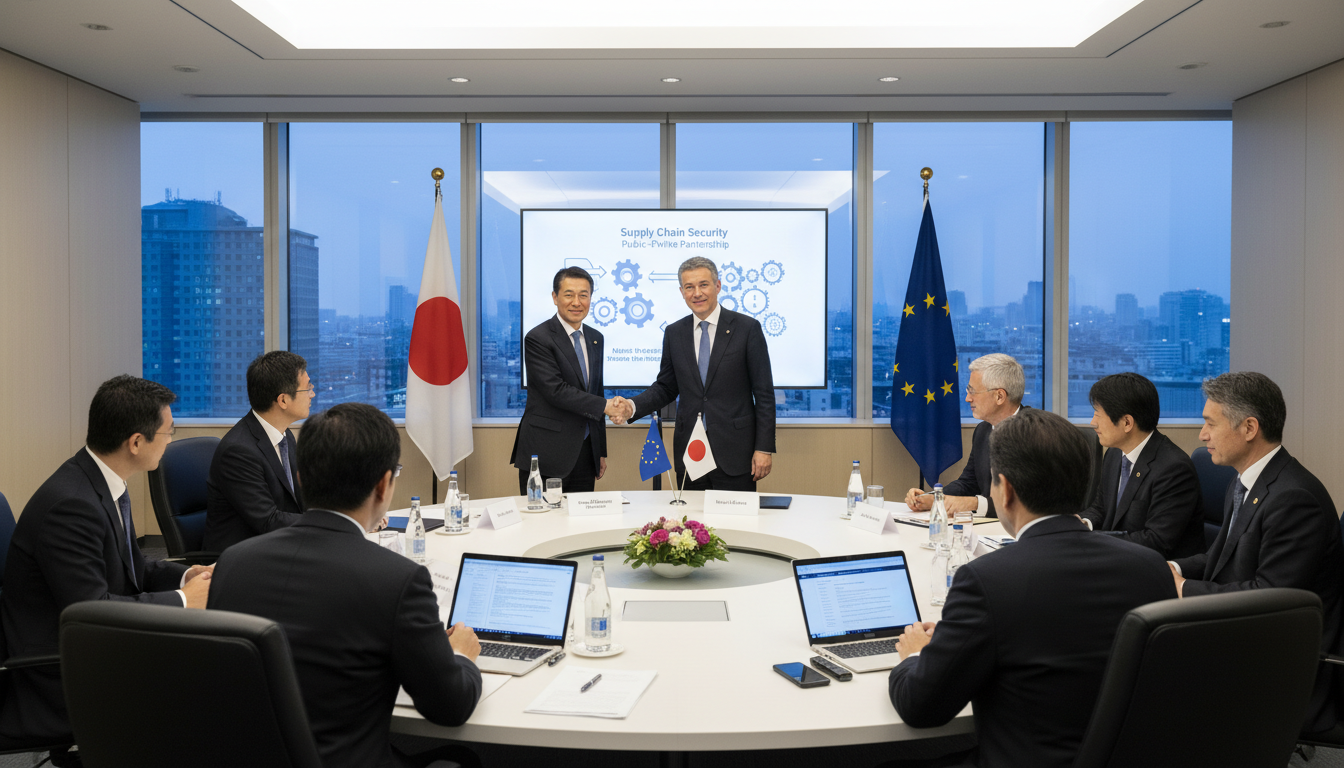
Japan-EU defense cooperation launches public-private framework to secure military supply chains
Japan and EU companies form a public-private defense cooperation to shore up military supply chains and industrial ties amid intensifying geopolitical risks.
Brussels — Japan-EU defense cooperation will formalize a new public-private framework aimed at strengthening military supply chains and industrial collaboration between Japanese and European firms. The initiative, announced in Brussels, brings together defence contractors and government agencies to reduce vulnerabilities exposed by rising geopolitical tensions. Companies from both sides will participate in joint efforts to map critical suppliers, harmonize standards and enhance resilience across key technology areas.
Companies Join Japan-EU Supply Chain Initiative
Several major defence and aerospace firms from Japan and the European Union have committed to the cooperation, signalling broad industrial support for the project. Participants include firms involved in fighter jet development, such as Italy’s Leonardo, which is already engaged with Japan on next-generation combat aircraft work. Industry sources say the roster is intended to combine European manufacturing scale with Japanese systems expertise to secure critical components and subsystems.
The list of participating companies is expected to grow as the framework moves from planning to operational phases. Officials emphasised that private-sector buy-in is essential for identifying single points of failure and for coordinating cross-border industrial responses to supply shocks. Companies will share assessments under confidentiality arrangements designed to protect sensitive technologies while improving overall supply chain visibility.
Public-Private Model and Objectives
The cooperation adopts a public-private model that combines government oversight with industry-led technical workstreams. Governments will set strategic priorities and provide regulatory and procurement levers, while companies will lead technical mapping, certification harmonization, and joint contingency planning. Organisers describe the arrangement as complementary to existing bilateral and multilateral defence partnerships rather than a replacement for them.
Key objectives include diversifying suppliers for critical components, shortening lead times through coordinated industrial planning, and creating interoperable standards to facilitate rapid cross-border sourcing. The framework also aims to establish mechanisms for rapid information-sharing during crises, allowing governments and firms to coordinate export controls, logistics, and production surges when needed.
Focus on Technology, Parts and Fighter Jet Programs
Advanced electronics, sensors, propulsion components and microprocessors are among the high-priority technology areas identified in preliminary discussions. Those technologies are central to modern military platforms, and their supply chains often span multiple countries with varying export regimes and industrial capacities. The cooperation will target choke points where a single supplier or region accounts for outsized risk.
Japan’s next-generation fighter program was cited as an immediate area of interest, with European partners already participating in design and systems work. The involvement of firms such as Leonardo underscores a practical dimension: cooperation can support national defence projects while creating reciprocal supply relationships that benefit both sides. Officials say lessons learned in fighter development can be transferred to naval, cyber and space-related industrial efforts.
Geopolitical Drivers and Risk Assessment
Rising tensions in multiple regions have prompted governments to reassess the resilience of defence industrial bases and logistics networks. The Japan-EU initiative is framed as a proactive response to those shifts, aiming to reduce dependency on single sources and to prepare for scenarios in which access to critical inputs may be restricted. Policymakers see industrial cooperation as a strategic hedge against supply disruptions that could impair operational readiness.
Risk assessments conducted by participating governments have highlighted dependencies in semiconductor manufacturing, rare-earth processing, and specialised electronic components. Addressing these dependencies will require targeted investments, joint procurement strategies, and in some cases, the relocation or duplication of production capacities. The framework is expected to include options for shared financing and incentives to encourage investments that improve mutual resilience.
Industrial and Diplomatic Implications
The cooperation carries both industrial and diplomatic consequences, potentially deepening defence ties between Japan and EU member states while reshaping global supplier relationships. For European defence firms, the framework offers access to Japanese technological expertise and procurement; for Japan, it opens pathways to diversified manufacturing networks and standardization that can lower program risk. The arrangement may also influence broader trade and export-control dialogues.
Observers note the delicate balance between expanding collaboration and managing sensitive technology transfers. Participating governments will need to reconcile national security restrictions with the operational benefits of shared supply chains. Transparency in governance and clear rules on information protection are expected to be central features of the framework to maintain trust among partners.
Japan-EU defense cooperation marks a shift toward more integrated industrial planning across continents, reflecting a recognition that resilience requires both policy alignment and private-sector engagement.
The next phase will focus on formalizing governance, identifying initial pilot projects, and setting timelines for shared threat assessments and supply-chain audits. Participants expect concrete workstreams to begin within months, with pilot projects potentially targeting electronics and aerospace components first. The success of the initiative will be measured by improved supplier diversification, reduced single-point failure risk, and the ability to coordinate rapid industrial responses when geopolitical events threaten defence supply continuity.

