
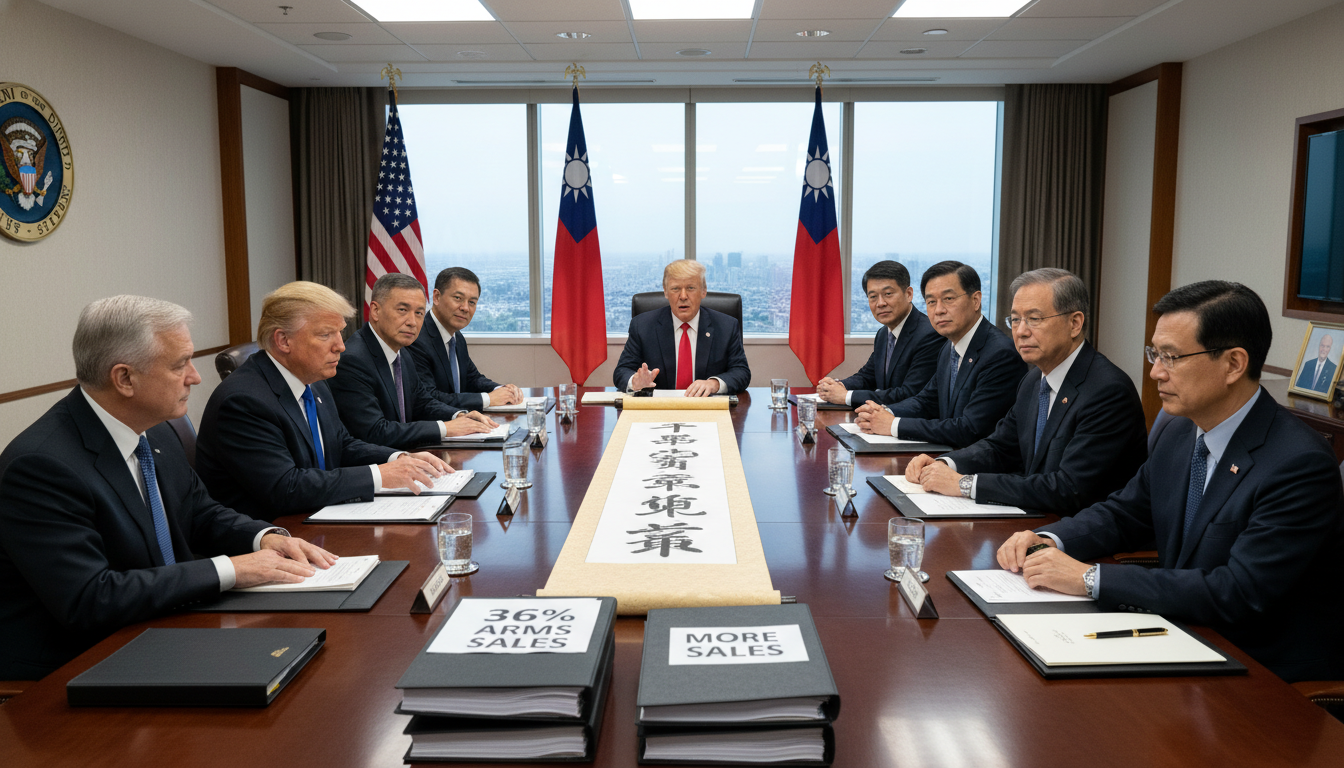
US arms sales to Taiwan surge: Trump approvals in first 18 months exceed Biden’s four-year total
U.S. arms sales to Taiwan have risen sharply under President Trump’s second administration, with approvals in the first 18 months outstripping the total value notified during Joe Biden’s full four-year term. This shift has intensified debate in Taipei, Washington and Beijing over delivery timetables and diplomatic trade-offs. (cna.com.tw)
Administration approvals top Biden-era totals
According to data compiled by the US-Taiwan Business Council and reported by regional news outlets, Washington approved roughly $11.4 billion in notifications for Taiwan during the first 18 months of President Trump’s second term, compared with about $8.4 billion notified during the entirety of the Biden presidency. The council’s tallies and government statements show the divergence has become a focal point in U.S.-Taiwan policy discussions. (us-taiwan.org)
Analysts note the comparison hinges on notification totals rather than deliveries, a distinction that matters for operational readiness and budget planning in Taipei. Notifications under the U.S. Foreign Military Sales framework notify Congress of proposed sales; actual transfers can take years and depend on production and logistics. (us-taiwan.org)
Major packages approved and pending
The Trump administration approved an $11 billion package for Taiwan late last year, a bundle described by U.S. officials as one of the largest such notifications in recent years. That approval accounts for much of the surge in notified value and has drawn attention in regional capitals and on Capitol Hill. (investing.com)
Beyond the December notification, multiple smaller Foreign Military Sales and direct commercial sales have been forwarded to Congress, increasing the aggregate value of proposed transfers. Industry sources and watchdog groups say the scale of notifications reflects a new administration priority on Taipei’s longer-term force modernization. (us-taiwan.org)
Diplomacy and the Trump–Xi conversations
President Trump acknowledged discussing Taiwan-related arms sales during talks with Chinese leader Xi Jinping, telling reporters he had raised the subject and would decide on additional cases “pretty soon.” Those comments prompted immediate scrutiny because U.S. policy traditionally eschews consulting Beijing on specific arms notifications. (marketscreener.com)
The public airing of those discussions has unsettled some U.S. lawmakers and Taiwan officials, who warned against treating arms approvals as a bargaining chip in high-level diplomacy. Critics argue that even the appearance of linkage could undermine U.S. credibility with Taipei and complicate procurement planning in Taiwan. (washingtonpost.com)
Taipei’s response and budgetary preparations
Taiwanese authorities have pushed for timely approvals and deliveries, arguing that notifications must translate into concrete capability enhancements as Chinese military pressure intensifies. Taipei’s government has signalled readiness to absorb large procurements and has advanced supplementary defense budgets to match expected deliveries. (investing.com)
Officials in Taipei say they have not been formally notified of pauses or cancellations in delivery schedules, even as Washington debates the diplomatic implications of new packages. Taiwan’s defense planners emphasize that procurement timelines are critical for training, infrastructure and integration of new systems. (marketscreener.com)
Congressional and regional concern over pauses and priority
Some U.S. legislators from both parties have warned the administration not to delay pending sales for diplomatic reasons, while others have pressed for accountability on how weapons inventories are being allocated amid competing global demands. U.S. military officials have, at times, cited operational needs elsewhere as grounds to re-prioritize certain transfers. (washingtonpost.com)
The possibility of pauses or rescheduling has fed fears in Taipei and among Washington allies that critical components and munitions could be diverted to other theaters. Those concerns have strengthened calls for clearer guidance from the Defense Security Cooperation Agency and regular briefings to Congress. (washingtonpost.com)
Wider regional implications for Japan and allies
Observers in Tokyo and other regional capitals are monitoring shifts in U.S. arms-notification patterns because changes in procurement and delivery timetables affect allied planning and burden-sharing. Japan, in particular, has accelerated its own defense policy debates in response to broader uncertainties over U.S. force posture and supply constraints. (investing.com)
Defense analysts caution that while larger notifications can bolster deterrence on paper, actual strategic effect depends on integration, training and interoperability with partner forces across the Indo-Pacific. The dynamic also raises questions about inventories, production lines and how allied industrial bases can mitigate bottlenecks. (scmp.com)
The acceleration in U.S. arms notifications to Taiwan has reshaped immediate policy conversations in Washington, Taipei and Beijing, touching procurement schedules, congressional oversight and the diplomatic calculus surrounding high-level summits. As proposed packages move from notification to execution, officials on all sides face a narrow window to balance deterrence needs with broader regional stability. (cna.com.tw)

