
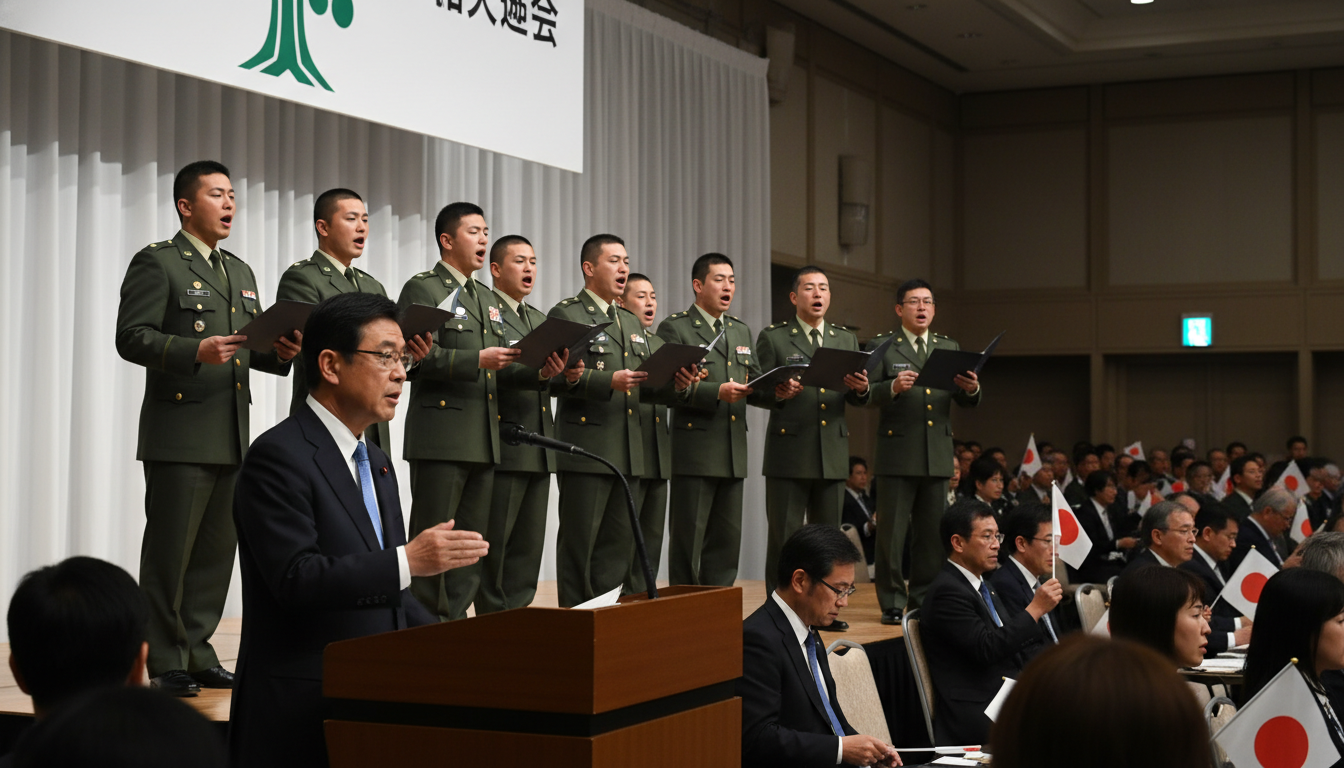
Kihara: Self-Defense Force member sang national anthem at LDP convention did not violate law, but government must "reflect"
Chief Cabinet Secretary Minoru Kihara said on April 15 that a Self-Defense Force member singing the national anthem at an LDP convention did not breach the SDF law, but the incident warrants reflection.
Japan’s Chief Cabinet Secretary Minoru Kihara told the House of Representatives’ Cabinet Committee on April 15 that a Japan Ground Self-Defense Force member’s appearance at a ruling Liberal Democratic Party (LDP) convention, where the national anthem was sung, did not violate the Self-Defense Forces Law. Kihara said the performance — which he said occurred while the member was on long leave and in a private capacity — posed a separate question about political perception and that the government should "properly reflect" on the matter.
Kihara’s testimony to the Diet
Kihara appeared before the Diet committee to answer questions from opposition lawmakers, including Akira Nagatsuma of the Centrist Reform Union. He reiterated the government’s legal interpretation that the SDF member’s attendance and singing did not amount to a political act prohibited by the Self-Defense Forces Law. At the same time, he distinguished legal permissibility from the possibility that the event could create political misunderstanding, saying the latter requires internal reflection.
Kihara explained the timeline of events in his committee statement, including how the party convention’s organizer sought guidance from the Ministry of Defense on whether the planned appearance would contravene the law. He said the ministry advised that it would not, and the member subsequently performed after being asked by event organizers.
Circumstances of the performance
According to Kihara’s account, the SDF member was on an extended leave of absence when asked by acquaintances involved with the LDP convention to sing the national anthem. The chief cabinet secretary described the appearance as carried out in the member’s private capacity rather than as an official act of the Self-Defense Forces. He framed the sequence as a private engagement based on a request and an internal check with the ministry.
Kihara emphasized that the ministry’s response to the event organizer informed the decision to proceed, indicating a formal check was made before the member took part. The government’s explanation underscores that the performance was not planned or executed as an official SDF activity, according to the administration’s current account.
Government stance and prime minister’s earlier comments
The government has maintained since the episode emerged that the appearance did not constitute a prohibited political act under the Self-Defense Forces Law. Prime Minister Sanae Takaichi previously stated that the participation raised no legal issues. Kihara’s testimony on April 15 reaffirmed that legal position while adding a separate judgment about optics and political neutrality.
By reiterating the legal view and combining it with a call for reflection, Kihara signaled a nuanced stance: compliance with the law does not automatically remove concerns about the perception of the Self-Defense Forces’ political neutrality. That distinction has become central in the public and parliamentary debate surrounding the incident.
Opposition concerns over neutrality
Opposition parties have voiced concern that a Self-Defense Force member’s visible participation at a ruling party event could undermine public confidence in the forces’ political neutrality. Critics asked why safeguards did not prevent the appearance and whether internal guidance and communication between the ministry and political actors were sufficient. Nagatsuma and other lawmakers pressed for clearer safeguards to prevent similar incidents in the future.
The opposition’s line of questioning focused on whether existing rules and internal checks adequately protect the nonpartisan posture expected of uniformed personnel. Lawmakers suggested that even actions taken during leave can carry symbolic weight when tied to partisan gatherings.
Information-sharing and internal judgment
Kihara also told the committee that had political leaders — the government’s political vice-ministers and ministerial leaders often referred to as the “three political executives” — been briefed beforehand, a different judgment might have been reached. His remark implied that broader information-sharing within the government could have altered the handling of the request or the member’s participation.
That point raises questions about administrative processes for evaluating requests involving current or former SDF personnel at political events. The chief cabinet secretary’s comment suggested an internal review of communication channels could be forthcoming to ensure better coordination in future cases.
Legal distinction versus political perception
Legal experts and government officials often draw a line between actions that breach the Self-Defense Forces Law and activities that merely create doubts about political impartiality. Kihara’s testimony reiterated that distinction, underscoring that legality and political perception do not always align. He urged the parties involved to reflect seriously on the political implications, despite the ministry’s legal assessment.
The incident has prompted renewed attention to how the SDF’s rules are interpreted and applied in practice, especially when personnel appear at high-profile political events. The government’s promise of reflection signals awareness that public trust hinges not only on compliance with statute but also on avoiding situations that could be construed as compromising neutrality.
The case is likely to remain under scrutiny in the Diet as opposition parties continue to press for clearer standards and accountability mechanisms to prevent perceived politicization of Self-Defense Force personnel.

