
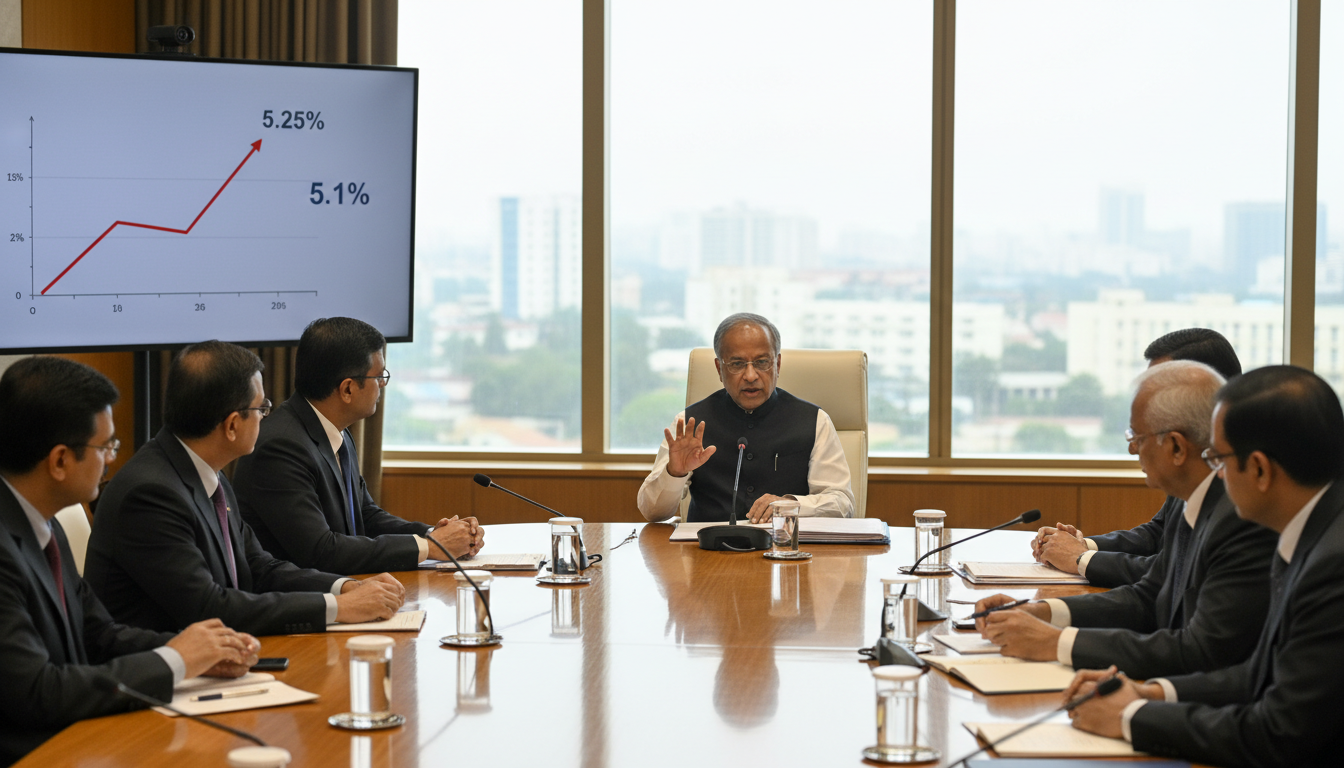
Reserve Bank of India holds rate at 5.25%, raises inflation forecast to 5.1% for FY2027
Reserve Bank of India holds policy rate at a four-year low of 5.25% and lifts its inflation forecast to 5.1% for the year through March 2027, citing energy shocks ahead of global data.
The Reserve Bank of India on June 5, 2026, left its key policy rate unchanged at 5.25%, marking a continued pause at a four-year low as policymakers waited for clearer signs of spillovers from an energy shock affecting major oil importers. The central bank raised its consumer price inflation projection by 0.5 percentage point to 5.1% for the fiscal year ending March 31, 2027, while trimming its outlook for economic growth.
The decision reflects the RBI’s assessment that headline inflation, which stood at 3.48% in April and remained below the 4% target, could face upward pressure from volatile global energy prices. Authorities said they preferred to assess incoming data before altering monetary settings, underscoring a cautious stance amid external uncertainty.
RBI keeps policy rate at 5.25%
The Monetary Policy Committee opted to maintain the repo rate at 5.25%, citing the need for more information on the magnitude and persistence of recent energy price movements. Committee members emphasized data dependence, signaling that any future adjustment would hinge on domestic price trends and imported inflationary pressures.
Governor commentary accompanying the statement framed the hold as temporary and conditional, driven by uncertainty rather than a change in the inflation control mandate. The central bank reiterated its commitment to the inflation target while balancing support for growth.
Inflation forecast revised upward to 5.1%
The RBI raised its inflation projection for fiscal 2026–27 to 5.1%, up half a percentage point from its previous estimate, reflecting a reassessment of global oil market developments. The bank highlighted that while core inflation trends remained moderate, pass-through from higher energy costs and supply disruptions posed upside risks.
Despite the upward revision, recent monthly data showed consumer price inflation at 3.48% in April, a figure comfortably below the 4% target and supportive of a patient policy stance. The central bank noted that base effects and favorable food price movements have so far helped contain headline inflation.
Growth outlook trimmed amid external headwinds
Alongside the inflation revision, the RBI revised down its economic growth forecast, citing the dampening effects of higher energy import bills and slowing external demand. The central bank pointed to narrower domestic momentum in investment and exports as factors that could weigh on activity in the near term.
Policymakers stressed that while underlying domestic demand remains resilient, the net effect of higher input costs for manufacturers and reduced real incomes from energy inflation could temper private consumption and business sentiment. The updated growth projection signals a cautious view on near-term expansion.
Policy deliberations shaped by energy shock and external risks
RBI officials said the decision was driven in part by an “energy shock” affecting oil importers worldwide, which could raise import bills and widen the current account deficit. The statement identified uncertainty over the duration and transmission of higher global energy prices as a key reason to await further readings before changing the policy rate.
The committee underscored the importance of monitoring external indicators, including oil benchmarks and global demand, and domestic indicators such as wage growth and core inflation. This emphasis on cross-border risks marks a shift toward greater sensitivity to international price dynamics in domestic policy formulation.
Market response and implications for the rupee and bonds
Financial markets responded with modest volatility as traders digested the RBI’s cautious tone and the lifted inflation projection. Short-term money markets repriced the probability of a rate move slightly, while government bond yields experienced selective upward pressure on the front end of the curve.
Currency markets reflected concerns about higher import costs, placing limited downward pressure on the rupee versus major peers. Market analysts noted that sustained energy-driven inflation could prompt a reassessment of fiscal and monetary coordination if pressures persist.
Looking ahead: data and policy calendar to watch
Investors and analysts are now focused on a sequence of domestic and global indicators that will shape the RBI’s next moves, including monthly consumer price figures, industrial production, and incoming oil price developments. The central bank’s emphasis on data dependence means each release will be scrutinized for signs of persistent inflationary transmission.
The RBI’s future stance will also consider supply-side developments, government policy on fuel subsidies and taxation, and the trajectory of real incomes. Policymakers have signaled readiness to act if inflation expectations become unanchored, but for now they are keeping options open while monitoring evolving risks.
The Reserve Bank of India’s June 5, 2026 decision reflects a balancing act between containing potential inflationary spillovers from a volatile energy market and supporting an economy facing softer external demand. Observers say the next few months of data will be decisive in determining whether the central bank returns to easing, holds, or pivots toward tightening.

