
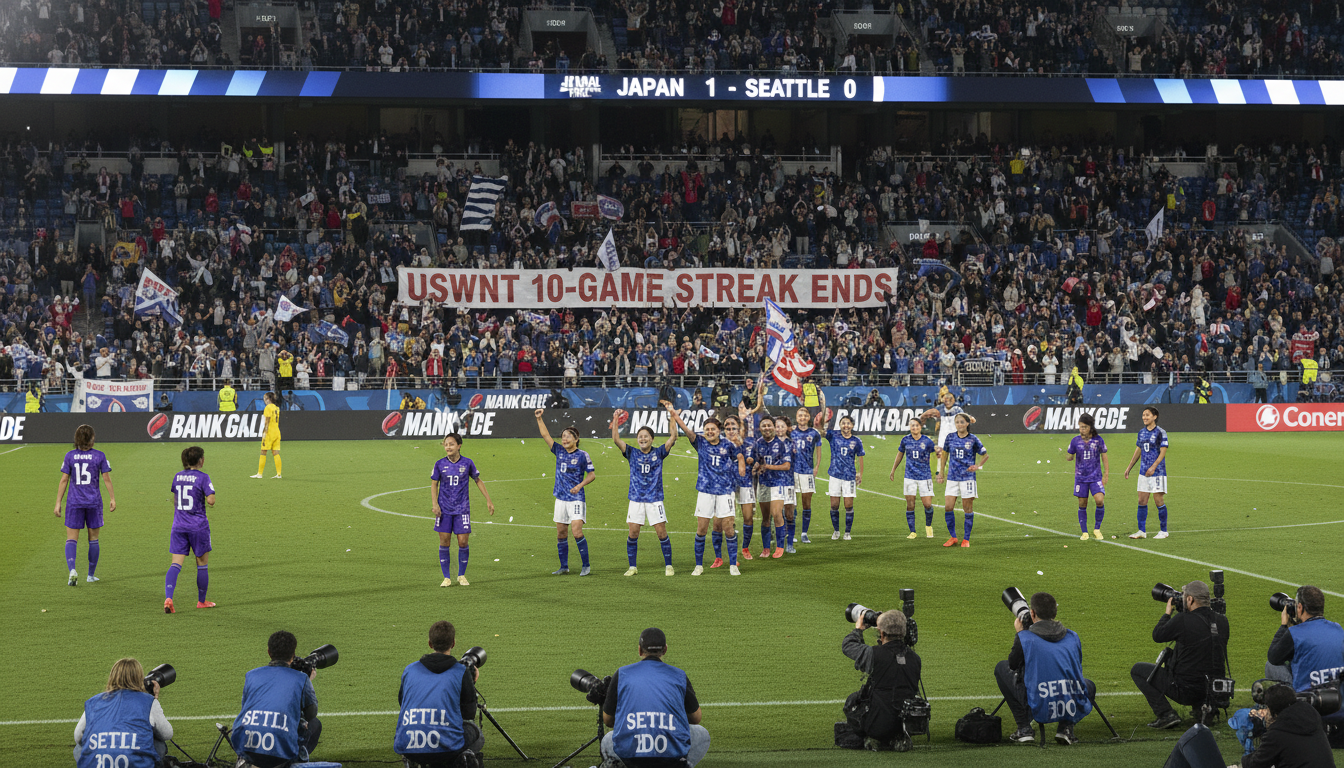
Japan Defeats United States 1-0 in Seattle as Hamano Strike Snaps USWNT’s 10-Match Win Run
Japan defeats United States 1-0 in Seattle — Maika Hamano’s early goal and Akane Okuma’s five saves end the USWNT’s 10-match winning streak in a friendly on Tuesday.
Japan defeats United States 1-0 in Seattle, with Maika Hamano’s first-half strike and goalkeeper Akane Okuma’s five saves handing the visitors a narrow victory and halting the USWNT’s 10-match winning streak. The friendly, played in Seattle, was the second fixture of a three-match series between the sides and delivered a rare defensive display against the four-time World Cup champions. Japan’s 2011 World Cup-winning pedigree was on display as the visitors combined a compact defensive setup with a decisive attacking moment to secure the result.
Hamano nets decisive goal early in the first half
Maika Hamano opened the scoring just after the midpoint of the first half, converting a chance that proved to be the match-winner. The goal arrived after a sustained period of pressure by Japan, who found space behind the U.S. defensive line and finished clinically. Hamano’s strike was the defining moment in a low-scoring contest where clear opportunities were at a premium.
The finish showcased Japan’s ability to capitalize on a brief lapse in the hosts’ organization, and it remained the only goal despite the remainder of the first half and the entire second half featuring end-to-end moments. Japan defended the lead with discipline, forcing the U.S. to probe for openings that did not materialize into goals.
Akane Okuma records five saves and a rare shutout
Japan goalkeeper Akane Okuma produced a composed performance, registering five saves to preserve the clean sheet for the visitors. Okuma became the first goalkeeper to keep the U.S. scoreless since the Americans’ goalless draw with England on Nov. 30, 2024. Her interventions ranged from routine stops to more critical reflex saves that prevented clear scoring chances.
Okuma’s composure under pressure allowed Japan to absorb extended U.S. possession without conceding, and her distribution helped initiate several counterattacks. The shutout was a notable individual and team achievement given the sustained quality of the U.S. attack over recent months.
USWNT’s 10-match winning streak comes to an end
The United States entered the match on a 10-match winning run that dates to a series of successful fixtures across the past year. Tuesday’s defeat halts that sequence and hands Japan a signature result in a friendly environment against a traditionally dominant opponent. Prior to this game, the last team to top the USWNT was Portugal, which recorded a 2-1 friendly victory last October.
The result is likely to prompt internal review within the U.S. program as the coaching staff assesses finishing, chance creation, and defensive reliability. For Japan, the victory offers a boost in confidence and a timely demonstration of how effective organization and opportunism can yield results against high-level opposition.
Series context: second of three friendlies in seven days
The match in Seattle was the second of three friendlies scheduled between the United States and Japan within a seven-day period. The compact series layout has given both teams an opportunity to rotate personnel, test tactical plans, and evaluate depth ahead of upcoming competitions. With one game remaining in the sequence, coaches from both sides will make adjustments based on learnings from Tuesday’s encounter.
Such short turnaround series are frequently used to expand player exposure and to experiment with structures that might be deployed in competitive tournaments. The remaining fixture will offer an immediate chance for the U.S. to respond and for Japan to consolidate the tactical principles that produced the shutout.
Tactical themes and key moments from the match
Japan’s defensive shape emphasized compactness through midfield and swift transitions on the break, a balance that allowed them to control the tempo without dominating possession. The visitors disrupted U.S. passing lanes and relied on quick vertical movement to create the opportunity for Hamano’s goal. When out of possession, Japan congested central areas, forcing the U.S. to attempt more circuitous routes to goal.
The U.S. generated possession advantage in spells and produced several promising sequences, but they were often stifled by Japan’s organized defending or by Okuma’s saves. Set-piece opportunities and late crosses tested both defenses, but neither side could convert after the breakthrough early in the match.
Implications for selection and upcoming fixtures
Coaches from both national teams will use this result to inform selection decisions and tactical tweaks ahead of forthcoming matches and tournaments. Japan’s staff can point to the shutout and efficient finishing as positives, while the U.S. coaching team will likely prioritize sharpening the final third and generating higher-quality chances. Individual performances, particularly from Hamano and Okuma, will figure into rotation discussions for the remaining friendly and beyond.
The outcome also provides a window into how each team handles high-intensity friendlies within a short series, with implications for player management and strategic experimentation as both federations prepare for competitive calendars ahead.
Japan’s victory in Seattle delivered a compact, professionally managed performance that combined a decisive attacking moment with disciplined defending. The result breaks the USWNT’s recent run of victories and sets up a concluding fixture in the series where adjustments and responses from both sides will be closely watched.

