
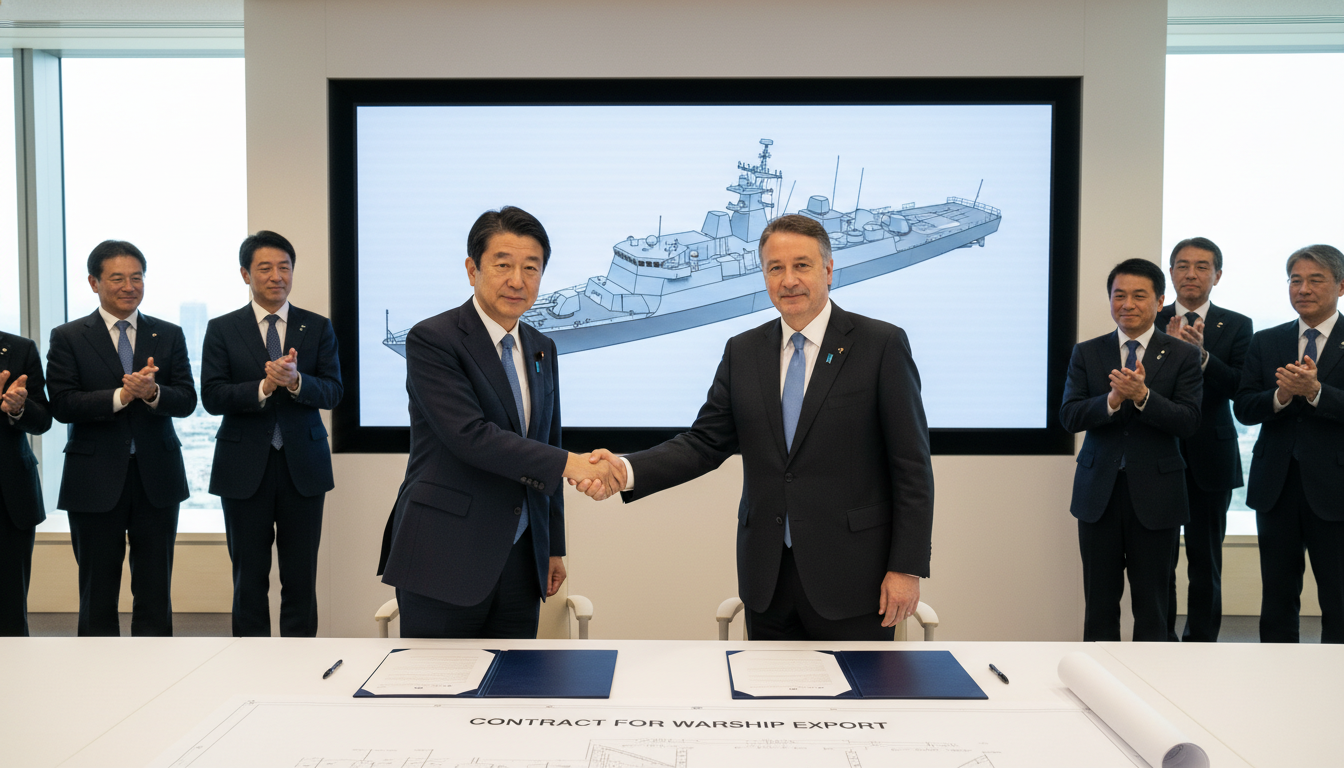
Japan warship export advances as Mitsubishi wins A$20bn frigate contract for Australia
Japan warship export advances as Mitsubishi Heavy Industries wins A$20bn deal to build three general-purpose frigates for Australia, reinforcing defence ties.
Australia and Japan on Saturday announced the signing of a landmark contract under which Mitsubishi Heavy Industries will build the first three of Australia’s new general-purpose frigates, a program valued at about A$20 billion. The agreement marks a milestone for Japan warship export policy and represents one of the largest defence-industry links between the two countries. Officials described the deal as both an industrial partnership and a strategic deepening of bilateral defence cooperation.
Contract Signed in Canberra
Australian and Japanese ministers formalised the contract in a bilateral ceremony that followed months of competition and negotiation. Mitsubishi Heavy Industries secured the initial phase, taking responsibility for constructing the first three hulls and delivering core systems. Canberra said the award will underpin a long-term fleet modernisation effort while Tokyo framed the sale as a first for its defence shipbuilding industry on the international market.
Scope and Cost of the Frigate Program
The contract covers design finalisation, construction of the first three general-purpose frigates and associated support equipment, with a headline value reported at roughly A$20 billion. The program is expected to include sustainment, training and logistics packages that extend beyond physical shipbuilding to ensure operational readiness. Australian officials emphasised value-for-money and lifecycle support as central criteria in advancing the programme.
Design and Technology Foundations
The frigates draw on Japan’s contemporary warship design knowledge, combining stealth, sensor integration and multi-mission flexibility suited to regional maritime security needs. Sources familiar with the design say the ships will incorporate technologies developed for Japan’s Mogami-class and related platforms, adapted to meet Australian operational requirements. Defence planners expect the vessels to host modular systems allowing future upgrades as new sensors and weapons emerge.
Australian Shipbuilding and Local Content Commitments
While Mitsubishi will deliver the first three ships, the programme framework envisions substantial Australian industry participation over the life of the programme. Canberra has highlighted plans for local supply chains, subcontracting and workforce development to ensure jobs and skills growth in Australian shipyards and defence suppliers. Australian industry ministers described the contract as a stimulus for domestic maritime capability and a pathway to higher local content in subsequent production phases.
Strategic and Diplomatic Implications
Analysts said the contract signals a deepening of Japan-Australia strategic alignment at a time of heightened regional security competition. The sale strengthens interoperability between the two navies and broadens Tokyo’s security footprint through defence-industrial collaboration rather than permanent basing or troop deployments. The agreement may also prompt closer trilateral consultations with partners that share maritime security interests in the Indo-Pacific.
Oversight, Export Controls and Political Debate
Tokyo’s decision to permit the sale required careful navigation of Japan’s postwar defence export policies and domestic political scrutiny. Lawmakers and defence officials in both countries framed the transaction as consistent with Japan’s evolving security posture and Canberra’s requirement for transparent safeguards on sensitive technologies. Parliamentary committees and defence oversight bodies will monitor implementation, procurement milestones and technology transfer arrangements as construction progresses.
Timeline and Next Steps
Under the contractual framework, detailed design work and initial procurement activities will begin promptly, followed by keel-laying and block fabrication for the lead ships. The agreement sets the procurement baseline for further negotiation on production locations, workforce planning and sustainment arrangements for the follow-on vessels. Both governments said they will publish additional timelines and contractual milestones as the programme advances from design into serial construction.
The deal represents a significant step in Japan’s emergence as an exporter of advanced maritime platforms and in Australia’s pursuit of a domestically sustained surface fleet. By coupling Japanese design expertise with Australian industry participation, the programme aims to deliver capability, jobs and closer strategic ties that reflect shifting defence priorities across the Indo-Pacific.

