
Blue Origin Reuses New Glenn Booster in Landmark Recovery
Blue Origin reused and recovered a New Glenn booster, proving reusable heavy‑lift capability that may accelerate launch cadence and raise competition with SpaceX.
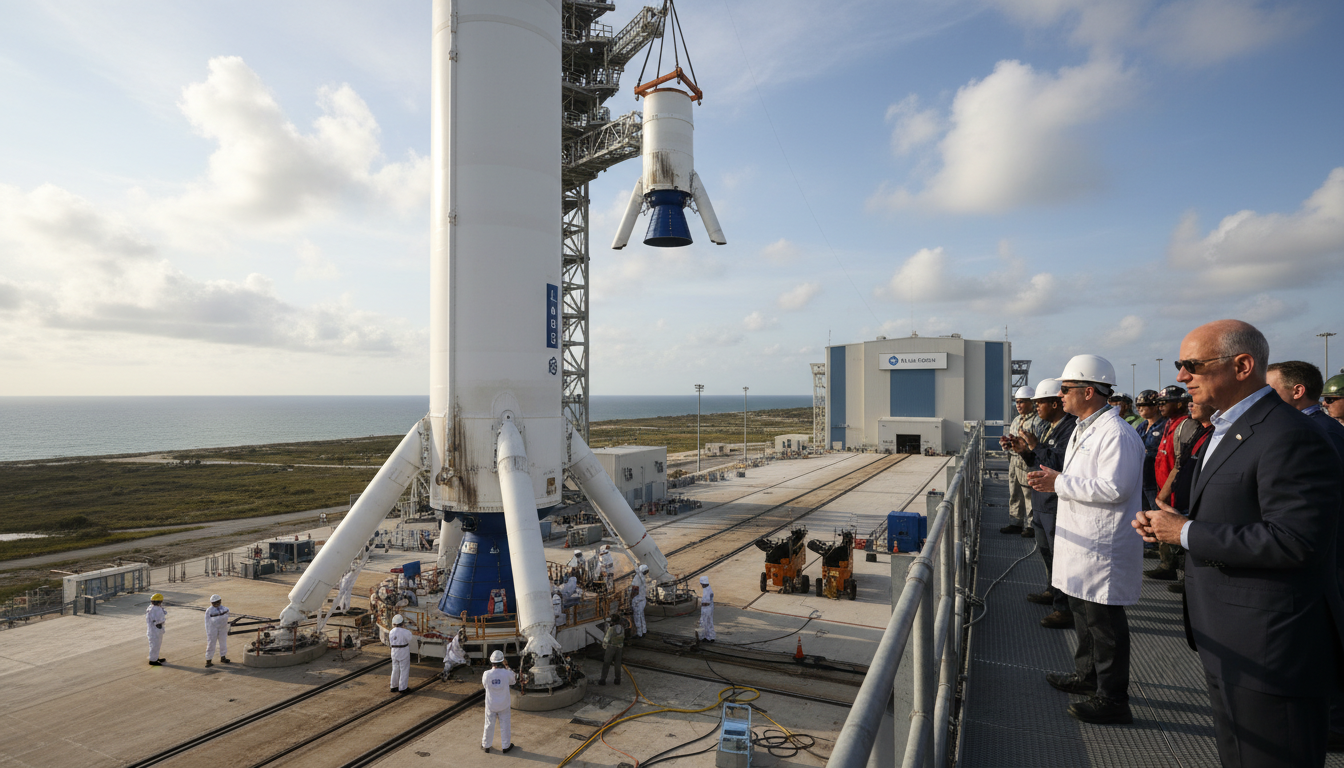
Washington — Blue Origin successfully reused and recovered a booster for its New Glenn rocket on Sunday, a significant advance in Blue Origin booster reuse that could speed the company’s launch tempo and reshape competition in the commercial launch sector.
The recovery marks the first time the New Glenn heavy‑lift vehicle has flown with and returned a previously launched booster, after two earlier New Glenn launches used new first stages.
The company has previously demonstrated reused hardware on its suborbital New Shepard vehicle, but New Glenn reuse represents a more complex engineering and operational achievement.
New Glenn recovery confirmed after Sunday launch
Blue Origin said recovery teams secured the booster following the vehicle’s return, completing a sequence of descent and landing operations designed for the New Glenn first stage.
The company described the operation as a controlled recovery intended to preserve the booster for inspection and potential refurbishment.
Officials noted the maneuver required precise guidance, thermal protection and structural margins to withstand orbital reentry conditions and a propulsive landing profile.
Mission profile and hardware distinctions
New Glenn is a heavy‑lift orbital rocket distinct from Blue Origin’s suborbital New Shepard system in size, velocity and recovery demands.
The booster must survive much higher speeds and heating on the way back from orbital trajectories than New Shepard components, which return from suborbital hops.
Engineers adapted recovery systems and flight controls to the New Glenn architecture to enable reuse without compromising payload performance on the ascent phase.
Technical hurdles overcome for booster reuse
Recovering a first stage from an orbital launch requires solving complex issues in materials, guidance and engine restarts during high‑stress reentry sequences.
Blue Origin engineers focused on aerodynamic stability, heat‑shield resilience and reliable reignition of main engines for the controlled descent and landing burn.
Testing and data from prior New Glenn flights and New Shepard operations informed iterative upgrades that the company says contributed to Sunday’s successful recovery.
Commercial implications for launch cadence and costs
Reusing a New Glenn booster could reduce per‑launch costs and shorten turnaround time between heavy‑lift flights if refurbishment proves rapid and reliable.
Blue Origin has argued that recoverability and reuse are key to raising launch cadence for missions such as commercial satellite deployment and government contracts.
A reusable heavy‑lift capability may allow the company to pursue more frequent missions and attract customers seeking lower-cost orbital access.
Competitive dynamics with SpaceX and industry impact
The recovery intensifies a commercial rivalry with SpaceX, which pioneered rapid booster reuse on its Falcon class and has set aggressive cadence benchmarks in the market.
Analysts say Blue Origin’s demonstration narrows a technical gap and gives satellite operators more choice in procuring reusable heavy‑lift services.
Market observers emphasize that long‑term competitiveness will depend on demonstrated refurbishment timelines, reliability, pricing and the cadence Blue Origin can sustain.
Next steps for testing, inspection and flight planning
Blue Origin will subject the recovered booster to detailed inspections and tests to assess structural integrity and systems performance after reentry.
The pace and scope of any planned refurbishment will determine when the booster could fly again and how many reuse cycles Blue Origin can achieve with New Glenn hardware.
Company officials have indicated that future launches will build on this recovery to validate repeated reuse and to refine operations for commercial customers.
The successful recovery of a New Glenn booster on Sunday is a clear technical milestone for Blue Origin and a visible signal that reusable heavy‑lift operations are expanding beyond earlier suborbital demonstrations.
How quickly the company converts that technical success into a routine, cost‑effective service will shape its role in the crowded launch market and affect customers evaluating options for orbital launch.

