
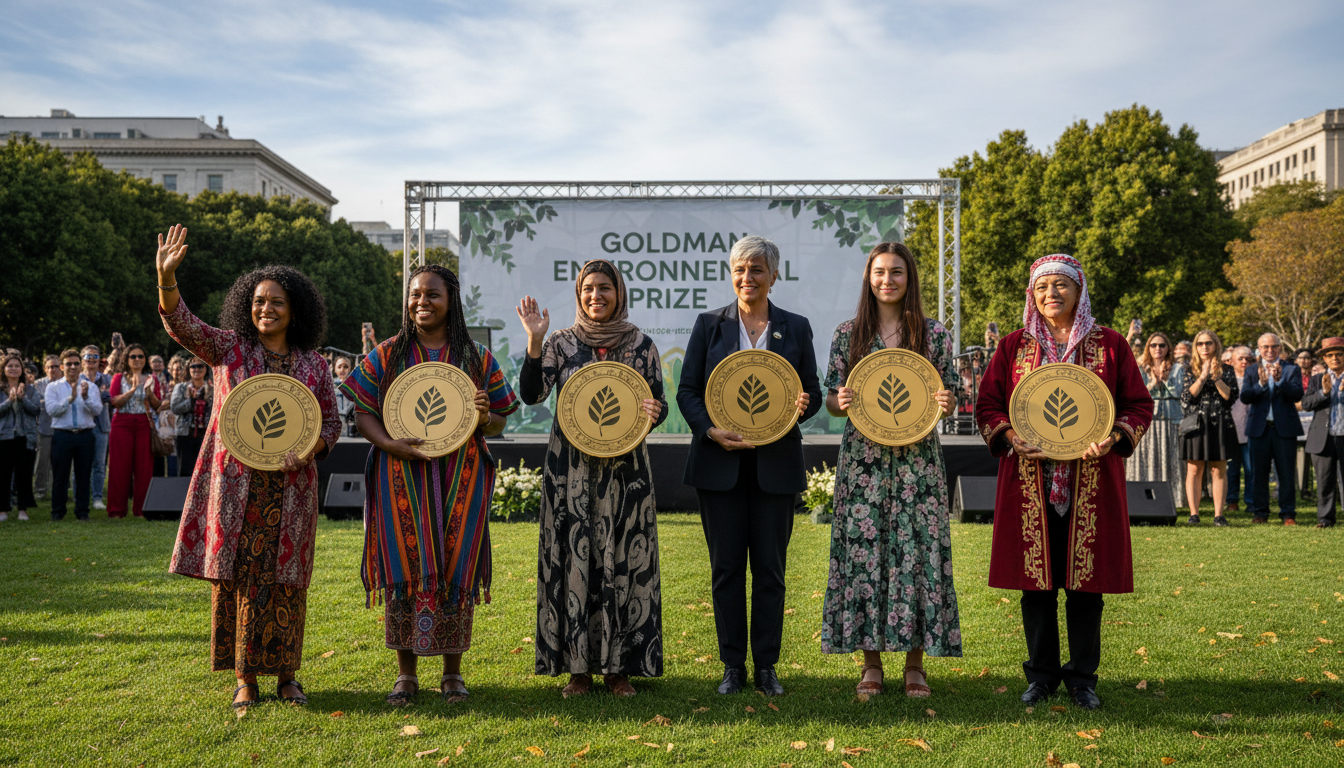
Goldman Environmental Prize 2026 Awards First-Ever All-Women Cohort of Grassroots Environmentalists
Six grassroots activists win the 2026 Goldman Environmental Prize in the first all-women cohort, for stopping fossil fuel projects and protecting biodiversity.
Six winners announced in first all-women cohort
The 2026 Goldman Environmental Prize has been awarded to six grassroots environmental leaders, marking the first time all recipients are women since the award began in 1989. Winners represent Colombia, Nigeria, Papua New Guinea, South Korea, the United Kingdom and the United States, each selected as the top activist from one of six global regions. The recipients will each receive a $200,000 prize intended to support further community-driven environmental work. Organizers described the selection as recognition of sustained local leadership that has produced legal, political and conservation outcomes.
South American campaign halts commercial fracking in Colombia
Yuvelis Morales Blanco, the South and Central America winner, led a coastal and riverine community campaign that successfully blocked the introduction of commercial fracking in Colombia. Raised along the Magdalena River in an Afro-Colombian fishing community, she mobilized residents after a major 2018 oil spill that displaced families and devastated wildlife. Her organizing faced intimidation and temporary relocation, yet it helped elevate fracking as a national electoral issue in 2022 and stalled proposed projects. The award highlights the role of youth-led community resistance against fossil fuel expansion.
Young South Korean legal victory sets continental precedent
Borim Kim, representing Asia, built a youth climate movement and pursued litigation that won a landmark ruling from South Korea’s Constitutional Court. The court found that government climate policy breached the rights of future generations, a decision regarded as the continent’s first successful youth-led climate suit of this kind. Kim’s case underscores the increasing use of constitutional and human rights law to press governments for stronger climate action. The ruling is expected to inspire similar legal strategies across the region.
UK campaign secures Supreme Court climate consideration
Sarah Finch, the Europe winner, spent more than a decade with community allies contesting oil drilling proposals in southeastern England and won a decisive legal outcome at the UK Supreme Court. The judgment, often referred to in activist circles as the Finch ruling, requires that authorities consider projects’ global climate impacts before approving fossil fuel extraction. Finch has said she will use prize funds to continue opposing new fossil fuel developments and to support local resistance efforts. Her case reflects a broader trend of courts requiring climate impacts to be weighed in permitting decisions.
Pacific and Indigenous campaigns force mining accountability
The winners for Islands and Island Nations and for North America won major victories linked to mining accountability and Indigenous rights. The Papua New Guinea recipient, Theonila Roka Matbob, led a campaign that compelled a major mining company to address long-standing environmental and social damage from the Panguna copper mine decades after its closure. In the United States, Alannah Acaq Hurley worked with 15 tribal nations to halt a large copper and gold proposal that threatened Alaska’s Bristol Bay ecosystem and some of the world’s largest wild salmon runs. Both campaigns combined legal action, community organising and international pressure to secure remediation and protection measures.
Nigerian conservationist rescues endangered bat refuge
Iroro Tanshi, awarded for Africa, is credited with the rediscovery of the endangered short-tailed roundleaf bat and for galvanizing efforts to protect its remaining refuge. Her work has focused on the Afi Mountain Wildlife Sanctuary and on reducing human-caused fires that have degraded key habitat. By documenting the species and mobilizing local and national stakeholders, Tanshi has advanced targeted conservation measures and raised public awareness of lesser-known but ecologically important species. Her achievement highlights the critical link between species recovery and on-the-ground protection of habitats.
Prize structure and wider significance of the awards
Often likened to a Green Nobel, the Goldman Environmental Prize recognises one grassroots leader from each of six world regions and provides a substantial unrestricted grant to support continued activism. Founded by Richard and Rhoda Goldman, the prize aims to spotlight community-based campaigns that deliver measurable environmental protection and justice gains. This year’s all-women slate underscores shifting dynamics in environmental leadership, where youth, Indigenous communities and frontline residents are increasingly driving legal and political breakthroughs. Organizers say the awards are intended to amplify locally rooted strategies that can scale or set precedents elsewhere.
The 2026 Goldman Environmental Prize winners reflect a wave of grassroots campaigns achieving durable results against powerful interests and entrenched policies, from court victories and halted fossil fuel developments to corporate commitments to repair past harms. Their work demonstrates how local organising, strategic litigation and Indigenous stewardship can intersect to protect biodiversity and community livelihoods. As each recipient applies prize resources to sustain and expand their efforts, observers say the recognition may strengthen transnational networks advocating for stronger climate policy and environmental justice.

