
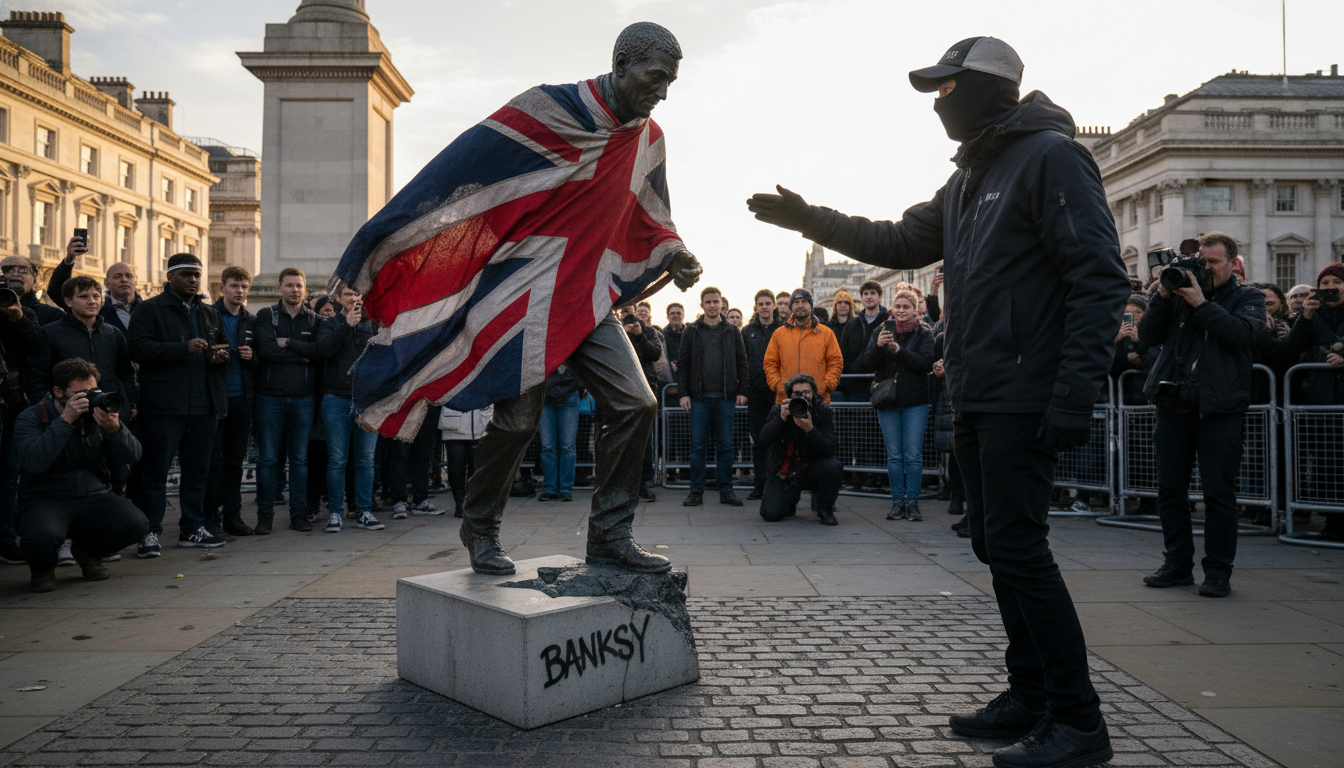
Banksy sculpture unveiled in Waterloo Place shows figure stepping off plinth with flag-covered face
Banksy sculpture appears overnight in Waterloo Place, London on May 1, 2026. A video reveal shows a figure stepping off a plinth with his face hidden by a flag.
A new Banksy sculpture appeared overnight in Waterloo Place, central London, on May 1, 2026, drawing immediate attention from residents, visitors and online audiences. The Banksy sculpture, shown in a video posted by the artist, depicts a man stepping off a stone plinth while his face is obscured by a flag. The work continues the anonymous artist’s pattern of politically charged public pieces that provoke debate and interpretation.
New Sculpture Appears in Waterloo Place
The sculpture was discovered on the plinth in Waterloo Place, a prominent site near central London thoroughfares, where it replaced the usual emptiness of the stone base. Observers described a life-sized figure caught mid-step, carved or cast with realistic contours that contrast with the stark, symbolic flag covering the face. The placement and posture suggest a staged act rather than a simple statue, reinforcing the artist’s habit of combining location and form for immediate visual impact.
The overnight nature of the installation followed Banksy’s familiar approach of surprise reveals that rely on public spaces as a gallery. The artist accompanied the unveiling with a short video, which recorded the work in situ and supplied the primary documentation of the reveal. That video is already circulating online and has been central to public discussion about the piece’s meaning and intent.
Video Release and Presentation
The video shared by the artist presents the sculpture from multiple angles, emphasizing the contrast between the static plinth and the forward motion of the figure. It provides little explicit explanation, allowing the imagery to stand on its own and encouraging viewers to bring their own interpretations. The minimalist presentation aligns with Banksy’s previous releases, where context and ambiguity are used to fuel commentary rather than deliver a single message.
Visual details in the clip highlight the flag as the dominant visual element, obscuring identity and drawing the eye away from facial expression to symbolism. The video’s framing and pacing create a narrative suggestion — a departure, a forced step, or a staged protest — while stopping short of declaring a fixed reading. That ambiguity is a hallmark of the artist’s practice and has been instrumental in generating sustained public debate.
Public Reaction and Footfall
Word of the installation spread quickly, and by morning small groups of onlookers and fans had gathered at Waterloo Place to view the sculpture in person. Photographs and short videos taken by passersby were shared rapidly across social platforms, amplifying interest beyond the immediate neighborhood. The piece’s visibility in a busy urban setting means it was photographed repeatedly and will likely be preserved in the online record even if the physical work is moved.
Reactions among those who saw the sculpture in situ ranged from enthusiastic appreciation to puzzled curiosity. Some praised the technical execution and theatrical placement, while others debated the political connotations of a face hidden by a national symbol. Such mixed response is common with works by the anonymous artist, which are often designed to prompt conversation among diverse audiences.
Imagery and Political Resonance
The most striking element of the work is the flag obscuring the figure’s face, a device that invites readings related to identity, nationalism, censorship and displacement. Art critics and commentators have previously linked Banksy’s public pieces to topical issues, and observers in this instance noted the flag as a powerful visual shorthand capable of multiple meanings. The sculpture therefore functions as both a formal object and a provocation intended to engage viewers in cultural and political reflection.
At the same time, the absence of an explicit statement from the artist leaves the precise target of the commentary unresolved. This openness has been a deliberate strategy in past works, allowing the piece to operate as a mirror that reflects current debates back onto the public. The result is a work that participates in civic conversation without prescribing a single reading.
Conservation, Ownership and Public Space
The sudden appearance of sculpture on a public plinth raises practical questions about conservation, ownership and the future of the work. Public authorities, land managers or heritage bodies typically assess newly installed works in public places to determine whether they can remain and how they should be preserved. It was not immediately clear on publication whether any formal notice had been issued or whether arrangements for removal or protection had been initiated.
Banksy’s works have in the past prompted negotiations between local councils, private owners and art institutions over preservation or sale, sometimes involving legal and insurance considerations. The installation’s location on a traditional plinth in a central city setting complicates those choices, as any decision will need to balance public access, historical context and safety.
Market Interest and Cultural Impact
Even when placed anonymously in the street, works attributed to Banksy have economic and cultural ripple effects that extend into auction houses, galleries and tourism. The artist’s public installations frequently draw collectors’ interest and spur debates about commodification of street art. While this sculpture currently functions as a public intervention, its presence will likely attract attention from the art market and from cultural commentators assessing its place in the artist’s broader canon.
For local businesses and visitors, the new installation may also create a short-term boost in foot traffic, as people come specifically to see and photograph the piece. Over the longer term, the work’s resonance will depend on both official responses and the degree to which the public sustains discussion around the image and its possible meanings.
The unveiling of this Banksy sculpture in Waterloo Place on May 1, 2026, is the latest entry in the artist’s evolving public practice and will likely continue to draw attention as officials, critics and the public weigh in on its interpretation and fate.

