
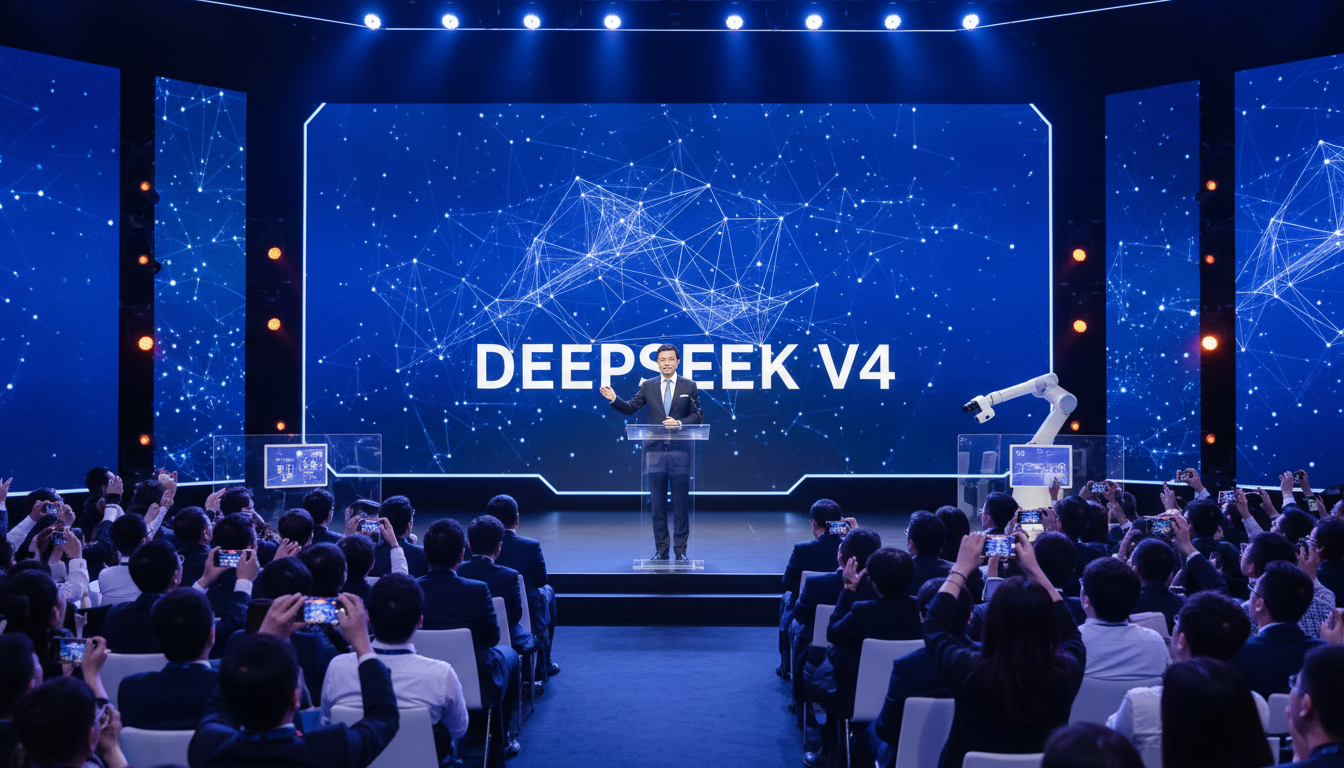
DeepSeek V4 launch escalates competition in generative AI
DeepSeek unveils V4 model on April 24, 2026, intensifying rivalry in foundation models and challenging established U.S. firms in generative AI.
DeepSeek V4 was publicly released on April 24, 2026, marking a major step for the Chinese startup that has rapidly emerged as a challenger in the global AI market. The company said the new model advances its capabilities across language, code and multimodal tasks, a development that immediately drew attention from investors and competitors alike.
DeepSeek’s announcement follows months of anticipation and delay, and the V4 launch places the company squarely in the center of competition between Chinese startups and established U.S. providers. Market watchers noted the timing and technical claims could reshape buying decisions among enterprise and cloud customers.
DeepSeek unveils V4 model
DeepSeek described the V4 release as a generational upgrade intended to improve accuracy, reasoning and multimodal integration. The company highlighted larger training runs and architecture refinements it said were tuned for commercial deployment.
The firm did not disclose all technical details publicly, but officials emphasized improvements in inference efficiency and support for industry workflows. Corporate messaging framed V4 as optimized for enterprise adoption in areas such as finance, healthcare and industrial applications.
Technical gains and claimed performance
DeepSeek said V4 offers enhanced reasoning and contextual understanding compared with its previous iterations, using a mix of supervised and unsupervised training signals. Engineers quoted by the company pointed to better parameter utilization and cross-modal alignment as key gains.
Independent benchmark results cited by analysts were limited at launch, and several industry observers stressed that real-world performance depends on deployment conditions. Early adopters will likely test V4 on domain-specific tasks to validate claims about accuracy and latency.
Investor response and market dynamics
The V4 announcement prompted immediate market scrutiny, with investors reassessing the competitive landscape for foundational models. Shares and private valuations of several AI-related companies saw short-term volatility as traders digested DeepSeek’s potential to capture enterprise contracts.
Analysts said the most significant effects will come if DeepSeek secures cloud partnerships or large corporate customers that commit to model hosting and managed services. The company’s path to commercial scale will depend on cloud capacity, sales pipelines and compliance frameworks for international customers.
Impact on U.S. AI firms and Nvidia
DeepSeek’s launch adds pressure on U.S. model developers competing for global enterprise customers and talent. Executives in the U.S. industry have repeatedly noted that competitive pricing, localized data services and integration with domestic clouds are strategic levers for Chinese providers.
The V4 release also feeds into ongoing conversations about chip demand and ecosystem balance, as model sophistication can influence hardware purchasing patterns. Market participants caution that the full competitive effect will only be visible after broader enterprise trials and public evaluations.
Regulatory and security considerations
Regulatory authorities in multiple jurisdictions are watching advanced-model deployments closely, and DeepSeek’s V4 will face scrutiny regarding data handling, export controls and security vetting. Governments that review AI systems for dual-use risks and content moderation practices may require additional disclosures before widespread adoption.
Compliance with international standards and transparency around training data will be important for any provider aiming to serve regulated industries. DeepSeek’s ability to meet these requirements could determine its access to global markets and partnerships.
Implications for Asia and Japanese enterprises
For companies in Japan and across Asia, the V4 launch presents both opportunities and questions about vendor choice. Local firms evaluating generative AI will weigh model performance against supply chain security, data residency and integration costs.
Japanese enterprises with existing cloud commitments may run parallel trials to compare DeepSeek V4 with Western models in production scenarios. Procurement teams will likely prioritize proofs of concept that demonstrate regulatory compliance and predictable total cost of ownership.
The DeepSeek V4 launch represents a clear escalation in the race to build commercially viable foundation models. While the company’s claims set high expectations, independent testing and enterprise deployments will determine how much market share it can win from established rivals.
Broadly, the release will accelerate strategic decisions across industry, government and cloud providers as stakeholders assess performance, security and supply-chain implications. The next months of trials, partnerships and regulatory reviews will clarify whether DeepSeek’s V4 changes the balance in global generative AI.

