
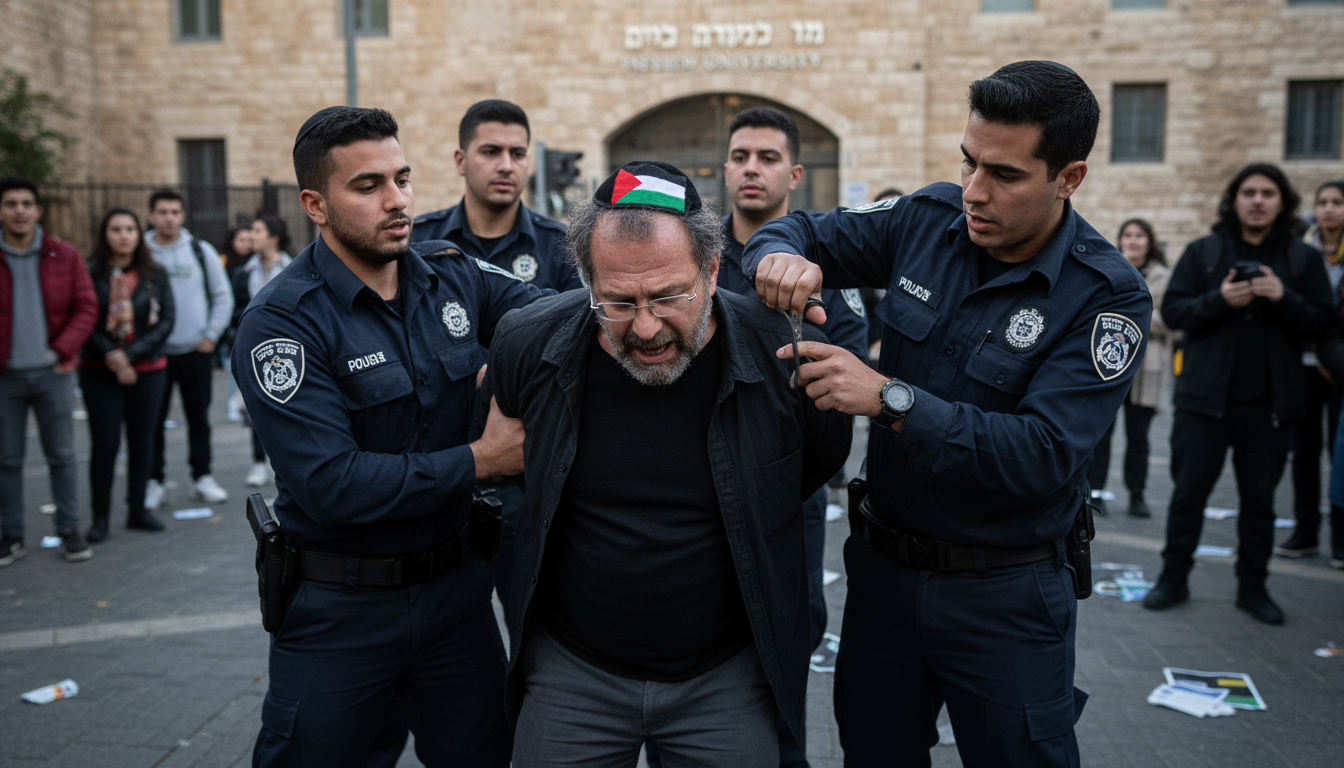
Israeli police cut Palestinian flag from lecturer’s kippah during Modi’in detention
Israeli police detained a Hebrew University lecturer in Modi’in and removed the Palestinian flag from his kippah, triggering calls for investigation and criticism from rights groups.
A lecturer at the Hebrew University said he was detained in Modi’in after a civilian complaint over a kippah bearing both Israeli and Palestinian flags, and that officers returned the head covering with the Palestinian emblem cut out. The incident, which the lecturer described on social media, has prompted demands for an internal police inquiry and renewed debate over restrictions on Palestinian symbols in public spaces.
Incident in Modi’in
A lecturer identified as Alex Sinclair said the episode began while he was working in a local cafe when a passerby objected to his kippah with Palestinian flag imagery. The passerby reportedly called police after a verbal exchange, and officers arrived within minutes to question Sinclair.
Sinclair says he was frisked and taken to a police cell for roughly 20 minutes before being released without his kippah. When he requested the head covering later, he says an officer returned it after cutting out the portion bearing the Palestinian flag.
Lecturer’s account and reaction
Sinclair told followers he has worn the kippah with both Israeli and Palestinian flags for about two decades as a personal statement of identity and coexistence. He posted before-and-after photographs showing the kippah damaged and described feeling "shaken, angry and depressed" following the encounter.
He framed the action as an attack on religious expression and civil liberties, saying the seizure and mutilation of a religious object crossed a line for him personally. Sinclair also warned the incident reflected a broader climate in which symbols associated with Palestinians face increasing prohibition.
Police response and complaint lodged
Israel Police confirmed that a complaint had been filed with the Police Internal Investigations Department but declined further public comment on the specifics of the case. The department ordinarily reviews complaints about officer conduct and can recommend criminal or disciplinary proceedings if warranted.
Officials did not immediately indicate under which law the officers acted when confiscating or altering the kippah, and it remains unclear whether the initial civilian complaint alleged a specific offense. Legal experts say the circumstances and any search or seizure procedures will be central to determining if police action was lawful.
Political context and ministerial directives
The episode comes amid broader tensions over the display of Palestinian flags and symbols since the current government took office in 2022. National Security Minister Itamar Ben Gvir has for months directed police to limit public displays of Palestinian flags, a policy that has drawn both support and criticism.
Opposition Knesset member Gilad Kariv condemned the incident on social media, arguing the actions of the officers indicated institutional failure and called for a criminal investigation and civil remedies. Kariv said that similar treatment of religious objects in other democracies would provoke immediate public outrage.
Civil rights groups call for probe
The Association for Civil Rights in Israel (ACRI) urged a full and transparent investigation, saying the police action amounted to a serious violation of freedom of expression and religion. ACRI described the removal and destruction of a religiously significant object as unlawful and aligned with a political agenda that restricts Palestinian symbols.
Other legal and human rights observers have pointed out that there is no blanket legal prohibition on displaying the Palestinian flag in private or public spaces, making the justification for altering a religious garment legally tenuous. Calls from rights groups now focus on accountability, documentation of the officers involved, and clarification of police rules governing symbolic speech.
Broader implications for civil liberties
Legal analysts say this incident illustrates the friction between public order directives and individual rights, particularly around politically sensitive symbols. The case may test the boundaries of how police interpret ministerial orders and the protections afforded to religious items under Israeli law.
Observers warn that even isolated encounters can have an outsized chilling effect on free expression when citizens fear punitive responses for wearing or displaying contested symbols. The outcome of any internal inquiry or legal challenge is likely to shape both police practice and public debate over the limits of symbolic expression.
The matter remains under review by police authorities, and rights groups and opposition lawmakers have signalled they will press for clarity and remedies if the investigation does not lead to accountability.

