
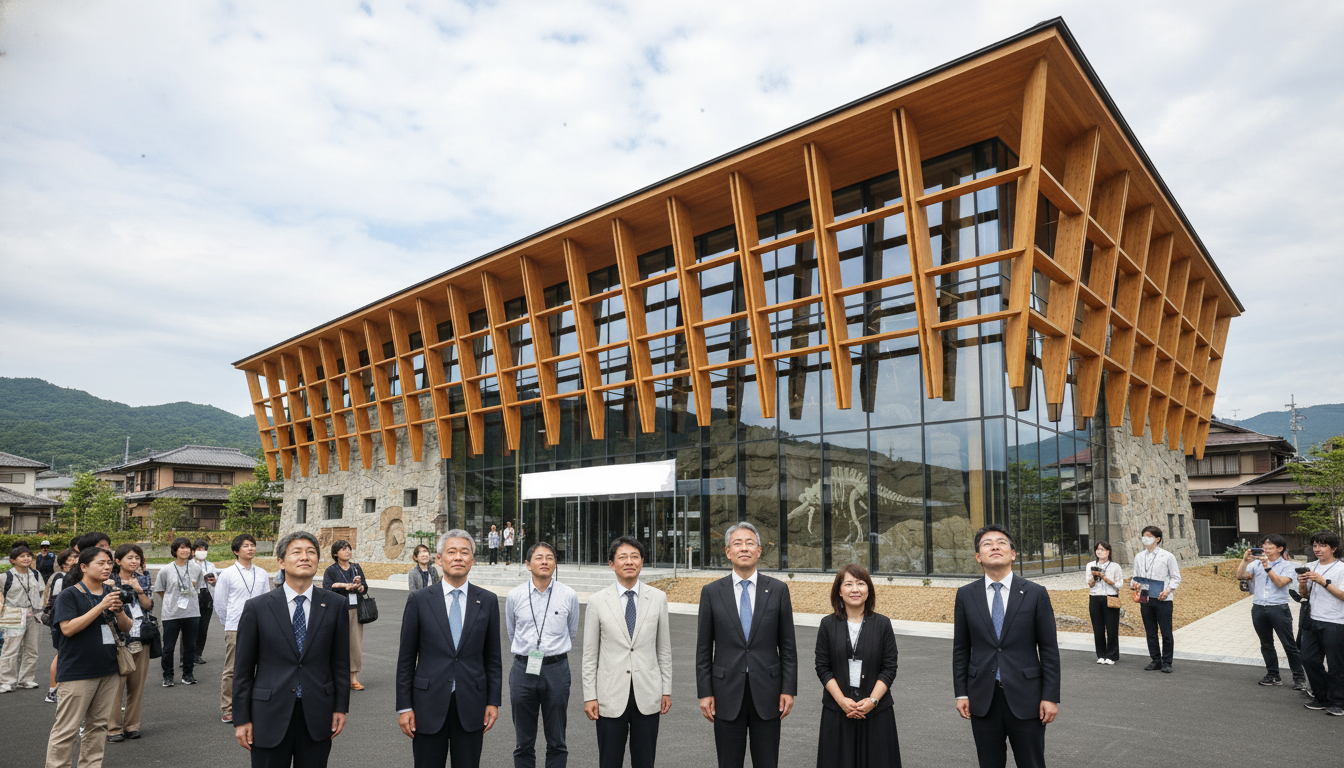
Fukui Prefectural University Faculty of Dinosaur Paleontology Building Completed on Katsuyama Campus
Fukui Prefectural University’s Dinosaur Paleontology building, designed by Kengo Kuma, is completed in Katsuyama with labs, Abdominal Hall and museum ties.
Fukui Prefectural University’s Faculty of Dinosaur Paleontology building has been completed on the institution’s new Katsuyama campus in Fukui Prefecture. The three-story concrete facility, designed by architect Kengo Kuma, aims to integrate education, research and public outreach for vertebrate paleontology. University officials say the structure will house advanced laboratories, teaching spaces and direct links with the nearby Fukui Prefectural Dinosaur Museum.
Kengo Kuma-designed three-story concrete building completed
The new building occupies a prominent position on the Katsuyama campus and consists of three reinforced-concrete floors arranged around a dramatic central volume. Its exterior features horizontal banding intended to echo the layered geological strata where many dinosaur fossils are discovered. The project’s completion marks a key milestone for the faculty, which began accepting students in April of last year.
The architectural design deliberately balances functional research needs with an expressive civic presence aimed at visitors and collaborators. Finishes and circulation routes were planned to facilitate both laboratory workflows and public viewing where appropriate. The result is a building meant to serve scientists, students and the community concurrently.
Design draws on geological strata and dinosaur anatomy
The façade’s horizontal stripes reference sedimentary layers and local outcrops that have yielded significant fossil finds in Fukui Prefecture. Inside, the lobby gives way to a three-story atrium called Abdominal Hall, a volume conceived to evoke the interior cavity of a dinosaur skeleton. Materials and lighting within the atrium are intended to create a visceral spatial experience while maintaining clarity for navigation and study.
Kuma’s approach connects the building’s formal language to the university’s academic focus, using architectural metaphor to reinforce research identity. The design also aims to foster curiosity, making the building itself an interpretive element for students and visitors exploring paleontology.
First-floor conservation and scanning laboratories equipped for large fossils
The first floor accommodates specialized facilities for fossil preparation and analysis, including a fossil cleaning room outfitted with 20 sets of preparation equipment. A dedicated laboratory houses a CT scanner capable of imaging specimens longer than one meter, enabling detailed internal study without destructive sampling. A library and adjacent support spaces provide reference materials and workspace for students and researchers.
These capabilities position the faculty to undertake both hands-on conservation and modern analytical workflows that are essential in contemporary paleontology. The availability of a large-format CT scanner, in particular, is expected to expand research on internal bone structures and pathologies for regional and visiting specimens.
Upper floors contain teaching spaces, faculty offices and research labs
The second and third floors are organized around teaching and research programs, with lecture halls, laboratories and faculty offices arranged to encourage collaboration between instructors and students. Laboratory suites are designed to support wet and dry research techniques as well as specimen storage and preparation processes. Lecture spaces are sized to accommodate the faculty’s current enrollment while allowing for growth.
Faculty members will be able to integrate field and laboratory instruction through proximate circulation and shared resources. The spatial layout also facilitates interdisciplinary work with neighboring institutions and museum staff.
Student pathway links Eiheiji campus and Fukui Prefectural Dinosaur Museum
Students admitted to the Faculty of Dinosaur Paleontology follow a staged academic pathway that begins at the university’s Eiheiji campus for their first year before transferring to the Katsuyama campus. The inaugural intake, which began study in April of last year, comprised 34 students who will use the new building for advanced coursework and hands-on training. The curriculum is structured to combine classroom instruction with practical experience at the adjacent Fukui Prefectural Dinosaur Museum.
Close cooperation with the museum will allow students to participate in specimen preparation, exhibition planning and fieldwork, reinforcing applied training objectives. The proximity between the faculty building and the museum is expected to strengthen ties between higher education and public paleontological outreach in the region.
Regional research hub and future academic ambitions
University officials describe the facility as part of a broader strategy to consolidate Fukui Prefectural University’s role in dinosaur science and related disciplines. By concentrating laboratory resources, specialized equipment and museum partnerships on the Katsuyama campus, the university aims to attract researchers and foster collaborative projects. The building is also positioned to support community engagement through exhibitions, public lectures and cooperative programs with local schools.
Planners indicate that the new facility may enable expanded research programs, grant applications and international collaboration, although specific initiatives will be announced as projects develop. For now, the completed building provides an operational base for instruction, conservation and scientific inquiry.
The completed Fukui Prefectural University Faculty of Dinosaur Paleontology building brings architectural ambition together with targeted research capacity, creating a dedicated campus hub for training the next generation of paleontologists and deepening the university’s partnership with the Fukui Prefectural Dinosaur Museum.

