
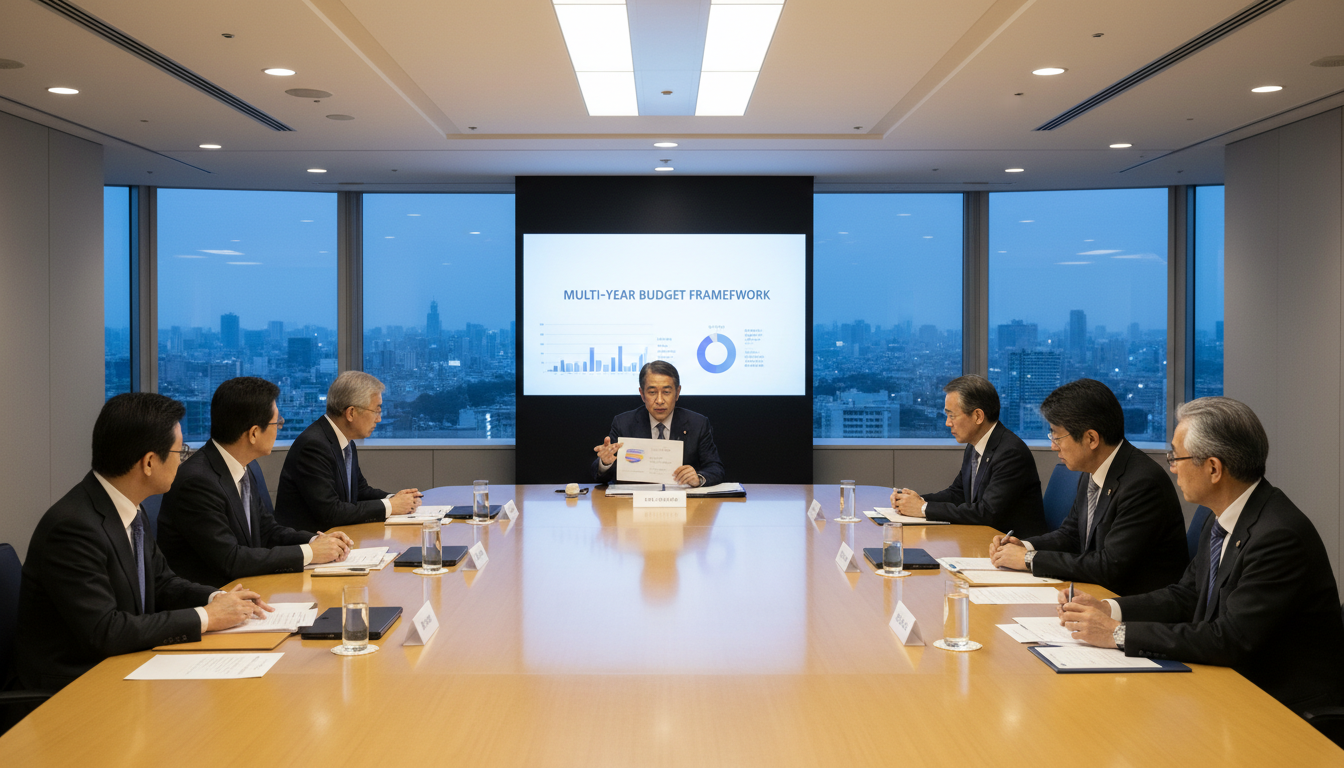
Japan proposes multi-year budget framework to spur long-term investment
Japan moves toward a multi-year budget framework to fund long-term projects while safeguarding fiscal discipline amid rising interest costs and mounting debt.
Japan’s government has unveiled plans to overhaul its budget process by introducing a multi-year budget framework aimed at accelerating private and public investment in strategic sectors. The proposal, which Prime Minister Sanae Takaichi has framed as part of “responsible and proactive public finances,” seeks to give businesses and agencies clearer visibility on funding over several fiscal years. Officials say the move is intended to boost growth by channeling steady resources into areas such as semiconductors, energy and defense without abandoning fiscal consolidation.
Government outlines multi-year budget framework plan
The Cabinet is preparing to finalize its “Basic Policy on Economic and Fiscal Management and Reform” this summer, setting out the new approach to budget formulation. Under the plan, the central government would allocate funds for designated investment projects across multiple fiscal years rather than relying solely on annual appropriations. Proponents argue that a predictable funding horizon will encourage firms to make larger, longer-term investments and strengthen national resilience to economic or security shocks.
Constitutional single-year budgeting remains the rule
Japan’s Constitution, through Article 86, requires the Cabinet to submit a budget for each fiscal year, embedding single-year budgeting as a democratic safeguard. Lawmakers and legal scholars caution that any multi-year fiscal mechanism must preserve the Diet’s right to scrutinize and approve spending annually. Observers note that the existing annual system prevents unreviewed carryovers of public funds, but it also creates pressures that can lead to wasteful end-of-year spending.
Long-term investment needs in chips, energy and defense
Policymakers point to a rising need for large, sustained investments in semiconductors, energy infrastructure and defense capabilities as a key rationale for reform. Those sectors often require capital outlays and capacity-building that extend beyond a single fiscal term, complicating planning under the current framework. The government has increasingly relied on supplementary budgets to meet such needs, a practice officials say is inefficient and unpredictable for private investors.
Measures to safeguard fiscal discipline and oversight
While promoting multi-year funding, the government emphasizes that fiscal discipline will remain central to the reform. Proposals under discussion include strict eligibility criteria for multiyear projects, binding caps on the aggregate scale of multi-year commitments and transparent reporting on project progress. Lawmakers from across parties have signaled they will demand robust evaluation mechanisms and regular Diet reviews to prevent the framework from becoming a vehicle for unchecked spending.
Debt-to-GDP reduction prioritized over single-year primary balance
The Cabinet plans to prioritize a steady reduction in the ratio of outstanding government debt to gross domestic product as the primary fiscal goal, rather than targeting a single-year primary balance surplus. Officials argue that sustained economic growth will help shrink the debt-to-GDP ratio over time, creating fiscal space for investment. At the same time, Finance Ministry projections warn of rising interest costs: interest payments on government debt are estimated to climb to about ¥45 trillion by fiscal 2035, more than three times the level in fiscal 2026, underscoring the exposure to higher rates.
Timeline and parliamentary hurdles for budget reform
The government aims to formalize the new budget policy this summer, but any legislative or regulatory changes to implement a multi-year budget framework will require detailed drafting and Diet approval. Opposition parties and some fiscal watchdogs are expected to press for safeguards, including sunset clauses and third-party audits of large programs. Implementation will also hinge on convincing municipalities and ministries to adopt new accounting and project-evaluation practices, a logistical hurdle that could slow the rollout.
The debate over a multi-year budget framework reflects a broader tension in Japan’s fiscal policy: how to unlock growth-enabling investment while preventing long-term fiscal imbalances. Policymakers must design rules that permit sustained funding for strategic projects, yet retain strong parliamentary oversight and rigorous cost-benefit assessment. The choices made in the coming months will determine whether Japan can reconcile immediate investment needs with the imperative of fiscal sustainability.

