
Israeli Demolitions in Southern Lebanon Intensify as Troops Target Villages
Israeli demolitions in southern Lebanon intensify as troops carry out systematic destruction of villages, displacing thousands and damaging homes and infrastructure. (160 characters)
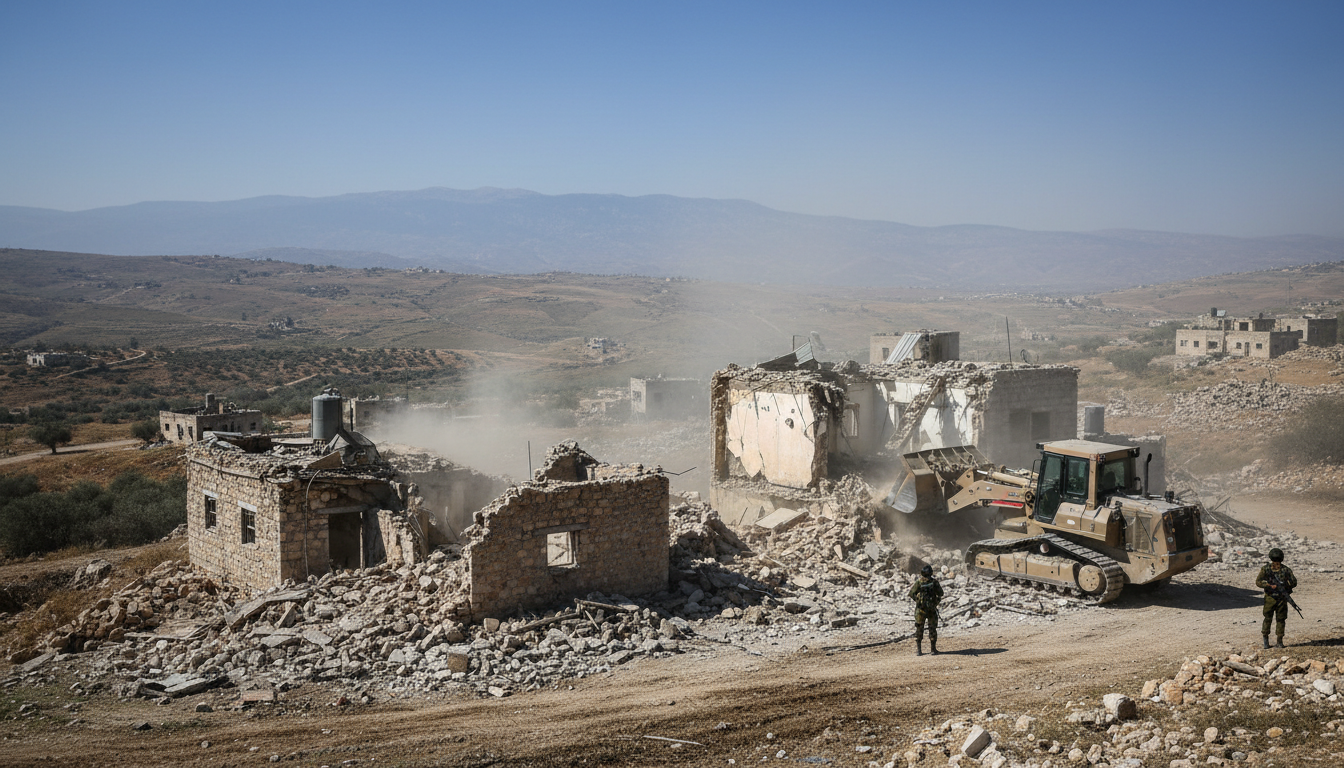
The Israeli military has shifted its operational focus in southern Lebanon toward what officers describe as the systematic demolition of residential areas, according to reporting by Haaretz. Israeli demolitions in southern Lebanon are being carried out under plans that, officers say, aim to render villages uninhabitable and prevent residents from returning. Commanders and soldiers interviewed by the outlet described daily quotas and a singular emphasis on destruction rather than traditional combat tasks.
Military Focus Shifts to Systematic Demolitions
Haaretz reported that units operating south of the Litani River have been assigned designated demolition zones and ordered to tally the buildings they remove each day. One commander is quoted as saying the operation’s primary objective is to “continue the destruction,” signaling a departure from missions framed chiefly as counter‑terrorism strikes.
Other officers contradicted public statements from the military that the campaign targets only terrorist infrastructure, telling reporters that many civilian structures are being razed. The internal disagreement among personnel highlights tensions between official justifications and on‑the‑ground practices.
Assigned Quotas and Private Contractors
Soldiers described the use of private contractors to carry out much of the physical demolition, with payments reportedly tied to the scale of destruction. According to those interviewed, companies received compensation based on the number of houses demolished, while military personnel provided perimeter security during operations.
Those arrangements, the soldiers said, placed troops in exposed positions as they guarded demolition teams against drone and other attacks. The contracting model has raised questions about incentives and oversight amid a campaign that has already produced extensive damage.
Scale of Damage and Displacement
Lebanon’s National Council for Scientific Research has estimated that roughly 40,000 housing units were partially or completely destroyed since the beginning of March, with some days seeing more than 1,000 homes damaged or flattened. Entire neighborhoods have been reduced to rubble, and drone footage circulated online shows villages being rigged and demolished in controlled explosions.
The Lebanese health ministry reports heavy human costs: since 2 March, at least 2,290 people have been killed and 7,544 wounded, figures that include rescue workers and healthcare personnel. The intensified destruction has contributed to a displacement crisis, with about 1.2 million people uprooted across the country.
Military Justifications Disputed by Officers
Within the ranks, some officers defended the operations as pragmatic measures focused on underground tunnels, weapons caches and surveillance systems. These spokespeople say demolition is being conducted according to operational need and targeted at assets linked to armed groups.
Yet other officers disputed this account, asserting that many of the demolished structures bear no obvious military value and that the scope of destruction exceeds efforts to remove specific threats. Those dissenting assessments were central to Haaretz’s depiction of a campaign driven more by widespread clearance than surgical strikes.
Drone Footage and Civilian Impact
Video footage and images shared on social media and in news outlets have shown scenes of entire villages prepared for controlled detonations and then levelled. Observers say the visual record underscores the scale and method of the demolitions and has become a focal point for humanitarian and legal scrutiny.
Civilians remaining in affected areas face cascading hardships as homes, basic services and community infrastructure are damaged or destroyed. The loss of shelter has compounded difficulties for families already displaced by earlier rounds of fighting.
Frontline Risks and Continued Cross‑Border Fighting
Soldiers on demolition duty reported heightened exposure to Hezbollah drone activity and intermittent strikes, which they say complicate security arrangements during operations. Some units remain stationed up to roughly 10 kilometers inside Lebanese territory, according to local reports, maintaining positions while demolition work proceeds.
Although a truce announced by the United States in mid‑April sought to reduce hostilities, Israeli strikes on Lebanon have continued and exchanges with Hezbollah resumed in several areas. The persistence of strikes and ground operations has kept pressure on civilians and aid responders in the south.
The unfolding campaign in southern Lebanon raises questions about the balance between declared military objectives and the observable impact on civilian communities. With large numbers of housing units destroyed, thousands displaced and disputed internal accounts of mission goals, the situation presents an urgent set of humanitarian and legal issues that will likely draw continued international attention.

