
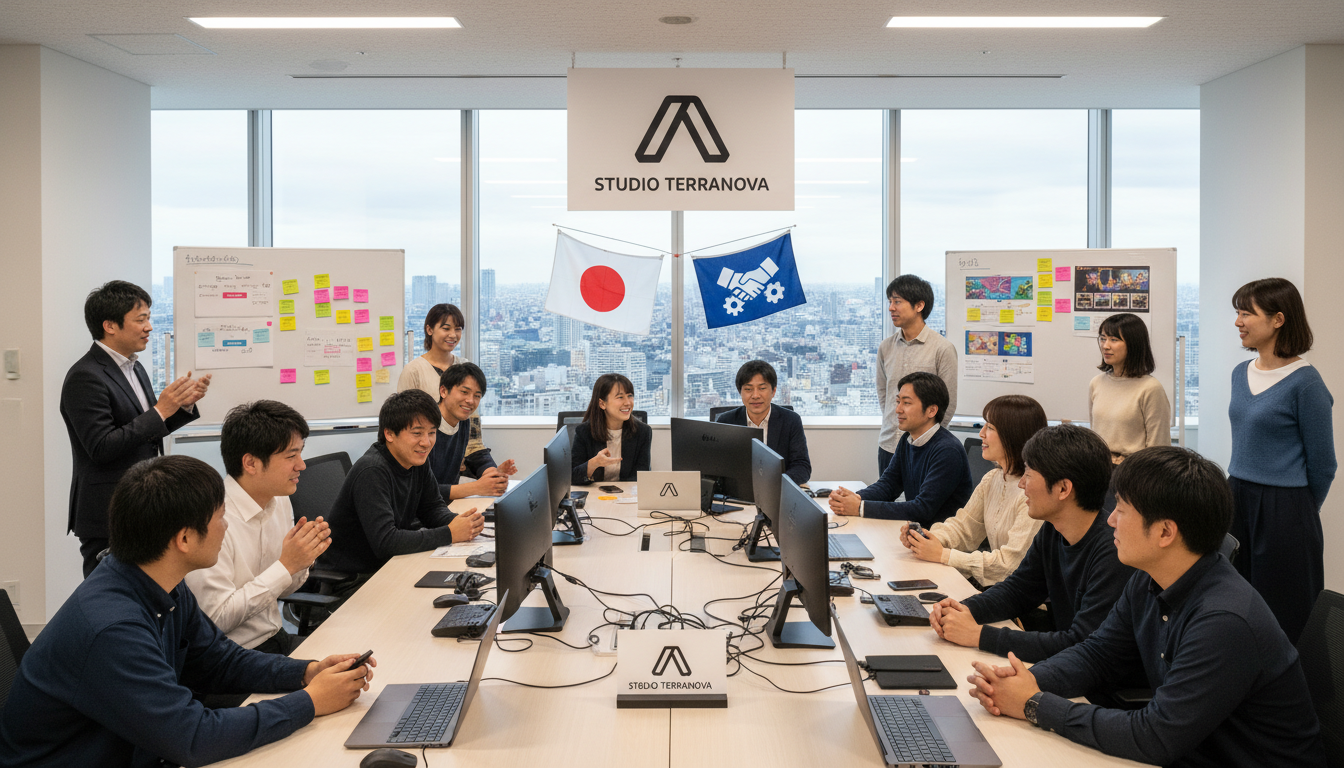
Studio Terranova: How a Worker-Owned Game Studio Found Its Home in Tokyo
Studio Terranova, a worker-owned creative studio in Tokyo blending design, user research and narrative development, traces its roots from a 2017 move to Japan to the company’s formal founding in 2024.
Early influences and the decision to move to Japan
CJ Hostetter’s interest in Japan began with literature and matured into professional ambitions that shaped his career trajectory. A high school encounter with Natsume Sōseki’s Kokoro and later university study at International Christian University seeded a long-term interest that would eventually lead him back to Tokyo. After building a portfolio in the United States and exploring opportunities such as English teaching programs, CJ reconnected with Tokyo through professional contacts at an international conference in 2017, prompting him and Matt Kaemmerer to consider relocation for a UX design position.
The move was gradual and pragmatic rather than instantaneous. Conversations and six months of planning preceded their relocation, and what began as a tentative plan to stay for a few years evolved into a long-term commitment to living and working in Japan. Permanent residency, granted in 2021, later expanded their options and provided the stability needed to consider entrepreneurship on Japanese soil.
From an indie game to a studio: Terranova’s creative origins
The creative partnership that became Studio Terranova grew out of independent game development and collaborative practice. In 2022 the pair released their first game, Terranova, an effort that proved both creatively fulfilling and commercially encouraging. The title’s reception emboldened them to pursue more projects and to formalize operations to serve clients and ship additional games.
By 2024 the team had established Studio Terranova as a formal entity, structuring the company as a worker-owned cooperative to reflect the founders’ values. The studio’s work sits at the intersection of product design, user research, and storytelling, enabling it to take briefs from corporate clients as well as to develop original interactive experiences. That dual approach—commercial projects alongside self-directed games—has become a core element of the studio’s sustainability strategy.
Setting up a business in Japan: legal and tax realities
Registering a company in Japan required practical navigation of local corporate structures and taxation rules. Studio Terranova was established as a gōdō kaisha (GK), a common form for smaller enterprises that carries corporate tax obligations similar to those of larger firms. The founders emphasize that the administrative burden is real: corporate, local, and other statutory taxes all apply, and compliance has required them to learn international and Japanese tax considerations.
Practical advice from the founders underlines the necessity of professional support. Their initial search involved consultations with multiple tax accountants before selecting one whose communication style and approach matched the founders’ needs—even when that advisor did not speak English. Likewise, legal counsel with immigration and business expertise proved valuable. For foreign founders, CJ and Matt recommend securing both a competent lawyer and a reliable tax accountant early in the process.
Bilingual advantage and market positioning in Tokyo’s creative tech scene
Studio Terranova positions itself where language capability meets cultural fluency, an advantage in a market that often relies on overseas agencies. The founders note that many foreign agencies lack Japanese fluency, creating inefficiencies and misunderstandings when collaborating with local clients. A bilingual offering enables smoother stakeholder communication and can reduce cost barriers for Japanese companies that might otherwise look to Western vendors.
That positioning has practical implications for competitiveness. By being locally based and bilingual, the studio can offer a blend of design practice familiar to global clients along with cultural nuance that eases project delivery in Japan. This combination has helped the studio to win work against larger, higher-cost international agencies and to carve out relationships with bilingual clients and Japanese businesses alike.
Language learning, professional practice, and the role of cultural literacy
The studio’s founders treat language competence as a professional asset rather than an optional skill. For CJ, high-level Japanese is essential in design work where complex concepts and nuanced stakeholder conversations are routine. He highlights how certain professional ideas—such as the design practice of “sense-making,” the structuring of messy research into usable insight—do not always map neatly onto single-word Japanese equivalents, making fluency and cultural literacy critical for effective explanation and collaboration.
Their approach to ongoing study combines formal tutoring, practical reading, and immersive day-to-day use. CJ recommends resources that go beyond basic grammar, including books like Otona no Kotoba Tsukai, which focuses on honorific and situational language useful for professionals. He also integrates Japanese-language design texts and games into his study regimen to maintain both linguistic growth and domain relevance.
Networking, conferences and practical advice for creatives moving to Japan
Studio Terranova’s founders stress the value of selective, high-quality networking and recommend specific events and meetups where creative professionals can connect. Conferences such as Design Matters, Spectrum, DDX, and Designship are cited as hubs for designers and researchers, while organizations like MusubiTech and Venture Café Tokyo provide additional community touchpoints. Event platforms such as Peatix and Conpass are recommended as practical tools for discovering relevant local gatherings.
At the same time, the founders advise pragmatism about cost and return on investment. Some events can be expensive, and many meaningful relationships are formed over low-cost meetups or simply buying someone a coffee. For internationals seeking entry into Tokyo’s creative tech ecosystem, a mix of academic pathways, short exploratory visits, and focused in-person networking can all be viable strategies depending on career stage and resources.
Values-driven work, cooperative governance and creative sustainability
Studio Terranova’s worker-owned model shapes both client selection and internal culture. The founders report that being transparent about values helps attract aligned collaborators and discourages mismatches early in the relationship. They describe worker ownership not just as a legal arrangement but as a deliberate stance toward how decisions are made and how creative labor is valued within the studio.
This values-first approach extends to how the team manages workload and creative energy. While they acknowledge the realities of deadline-driven crunch, the founders emphasize intentional practices to sustain long-term productivity and wellbeing. They prefer sustainable rhythms and clear boundaries where possible, reflecting a broader commitment to designing work systems that respect creative capacity.
Daily practice, personal projects and maintaining creative balance
Running a small, home-based business with a partner means work and life frequently converge, but the founders argue that intentionality can preserve balance. Both describe rhythms that include dedicated rest and creative pursuits outside of screens: CJ’s glass-blowing is one example of a hands-on discipline that complements digital work. He notes that crafts like glass-blowing teach acceptance of failure and the value of physical practice, lessons that transfer back to iterative creative processes in game and interface design.
The studio also leverages this personal creative energy in its professional output. Small-scale projects, experimental game prototypes, and participation in events like the Global Game Jam keep the team’s skills sharp and contribute to a culture of continuous learning. That combination of client work and side projects helps maintain motivation while also expanding the studio’s portfolio.
A closing note on practical steps for newcomers
For creatives considering a move to Japan, the founders’ path combines preparation with openness: cultivate a professional network before you relocate, be selective about events that deliver meaningful connections, and invest early in reliable legal and tax advice. Language study matters for client-facing roles, and permanent residency or other long-term visas can change the range of possibilities available to you.
Studio Terranova’s story demonstrates how an international duo translated personal interests and complementary skills into a formally registered, worker-owned studio in Tokyo. Their trajectory—from literary curiosity and study abroad to game releases in 2022 and company registration in 2024—shows how cultural engagement, professional discipline, and careful navigation of Japan’s regulatory landscape can combine into a sustainable creative practice.

