
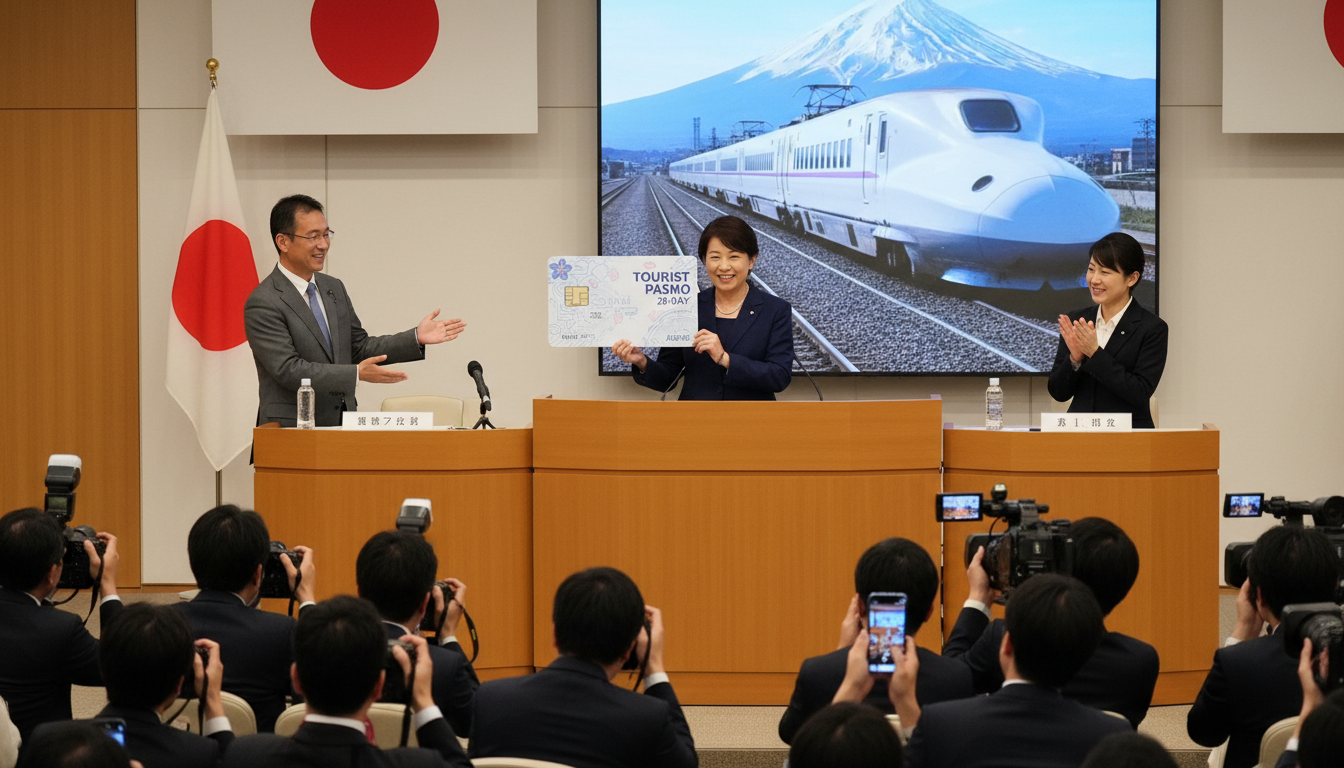
Tourist Pasmo to debut in May 2026, offering souvenir-ready IC cards for international visitors
Tourist Pasmo launches May 2026: a souvenir-friendly IC transport card for international visitors sold at Narita and Haneda, valid 28 days; preloaded credit.
The Tourist Pasmo, a new prepaid IC transport card tailored for short-term international visitors, is set to launch in May 2026 and will be available at major arrival points such as Narita and Haneda airports. The card is designed to simplify travel for tourists by combining nationwide transit compatibility with cashless purchases, and it is explicitly marketed to be kept as a memento after a trip. Priced competitively against existing short-term options, Tourist Pasmo includes preloaded balances with no deposit and a fixed 28-day validity period from issuance. Officials and transport operators say the product aims to reduce confusion at ticket machines while offering a straightforward, souvenir-friendly alternative to conventional IC cards.
Launch date and official rollout plan
The Tourist Pasmo will begin distribution in May 2026 at select airport and station sales points aimed at arriving international travelers. Initial sales outlets confirmed for the rollout include counters and vending kiosks at Narita and Haneda airports, with limited availability planned at some station locations to accommodate inbound tourists arriving by air and rail. The card carries a 28-day validity window from the day of issue, making it expressly suitable for short visits and typical tourist itineraries across Japan. Transport operators emphasize that the rollout is intended to streamline first-time travel in the country and reduce the time visitors spend choosing individual tickets.
The launch strategy targets inbound tourists who prefer an out-of-the-box travel payment option with no deposit to return, and with a design intended for retention as a keepsake. Promotional materials emphasize ease of use: purchase on arrival, tap through gates, and use the same card for transit and purchases at shops and vending machines. The limited validity period is positioned as a feature for short stays rather than a restriction for longer-term residents, and the card’s souvenir-oriented design—based on a kanji motif for “travel”—is meant to appeal to visitors looking for a practical memento. Transport agencies expect the card to sit alongside existing short-term IC products rather than replace them.
How the Tourist Pasmo works at airports and stations
Operation of the Tourist Pasmo mirrors the convenience of standard IC cards: visitors buy the card, the chosen prepaid amount is loaded at the time of purchase, and users tap to pass through train and bus gates without needing to consult fare maps or purchase single tickets. The card is compatible with IC-enabled trains, subways, and buses across Japan, meaning it can be used on most urban and regional public transport services that accept electronic fare payment. In addition to transit uses, the Tourist Pasmo functions as a cashless payment tool at participating retail outlets and vending machines, allowing visitors to make small purchases without handling coins or cash. This dual-use capability is intended to make short trips simpler and more efficient for newcomers to Japan’s transit ecosystem.
Buyers should note that the card’s preloaded balance is non-refundable and that the 28-day validity applies to the card’s activation period rather than to the duration of stored credit. Once issued, the card operates like a typical prepaid IC: fares are deducted as journeys are made, and purchases reduce the remaining balance. Travelers should plan their purchase amount with care because unused funds cannot be returned as cash at the end of the validity period. The Tourist Pasmo’s primary user experience goal is to remove the initial barrier of figuring out which fares or tickets to purchase at arrival and to offer a ready-to-use payment method that works nationwide on IC-compatible services.
Pricing tiers and point-of-sale options
Pricing for the Tourist Pasmo differs by point of sale and comes with the full purchase amount loaded onto the card, meaning there is no separate deposit to collect or refund. At Narita Airport the Tourist Pasmo will be sold for ¥2,000 with the entire ¥2,000 available as usable credit upon purchase. At Haneda Airport, purchasers will be able to select from multiple preloaded denominations — ¥1,000, ¥2,000, ¥3,000, ¥4,000, ¥5,000 and ¥10,000 — each loaded in full at the time of sale. This structure is intended to provide flexibility for travelers arriving at different airports and with varying budgets or itinerary lengths.
Sales points will include airport kiosks and specific station vendors designated for tourist services, allowing travelers to acquire a card immediately after luggage claim and immigration where possible. Because the Tourist Pasmo carries no deposit, buyers pay only for the usable balance they want to carry, simplifying the purchase decision for those who do not intend to return a card. The lack of a deposit also reduces administrative handling at departure points and supports the card’s positioning as a take-home item. Travelers are advised to check sales hours for airport kiosks and to purchase on arrival to maximize the card’s 28-day window.
Differences from regular Pasmo and refund considerations
The Tourist Pasmo is marketed specifically for short-term visitors and differs from the regular Pasmo card in its intended lifecycle and refund rules. Unlike standard Pasmo cards, which typically include a refundable deposit and are designed for longer-term use and reloading, the Tourist Pasmo is sold without a deposit and is meant to be retained by the purchaser as a keepsake. That design choice is reinforced by its visual branding, which uses a kanji-inspired motif linked to travel; the card’s aesthetic and marketing encourage travelers to keep it as a souvenir rather than return it for a deposit or balance refund.
A principal trade-off of this approach is that any remaining balance at the end of the 28-day validity period is not eligible for refund. Purchasers should therefore take care to estimate their likely transit and incidental purchase needs before selecting a purchase denomination. For travelers who expect to use transit over a longer period or who prefer the option of reclaiming unspent deposits, a regular Pasmo or a different short-term product with refund options may be more appropriate. The Tourist Pasmo aims to prioritize convenience and a straightforward purchase experience over after-sale recovery of unused funds.
Comparison with Welcome Suica and interoperability across networks
Functionally, the Tourist Pasmo is closely aligned with the existing Welcome Suica product, which has been offered by JR East as a short-term, no-deposit IC card option for inbound visitors. Both Tourist Pasmo and Welcome Suica are prepaid, work across trains, subways, buses and retail outlets nationwide that accept IC cards, expire after 28 days, and do not refund remaining balances. Welcome Suica also offers purchase options at airport vending machines and select JR East service centers, along with a digital version for compatible smartphones; Tourist Pasmo is positioned as a parallel product from the Pasmo system aimed at the same visitor segment.
Interoperability is a central feature of Japan’s IC system, and the Tourist Pasmo is designed to operate across the same network of IC-compatible services as existing cards, ensuring travelers can move across regions without needing separate fare cards. That nationwide compatibility means a visitor arriving in Tokyo can use the Tourist Pasmo for local travel in Tokyo, regional trips, and purchases at participating merchants elsewhere in Japan that accept IC payments. Transport operators and travel advisors say this cross-network compatibility is a crucial convenience for visitors who plan to move between multiple cities during a short stay.
Practical advice for travelers considering Tourist Pasmo
Visitors planning to use Tourist Pasmo should calculate likely transit and incidental expenses in advance to minimize unused balance at the end of their stay, since refunds will not be available. Smaller denominations at Haneda allow for a conservative purchase if a traveler expects only light local transit use, while higher denominations suit travelers with longer itineraries or anticipated multiple short trips between cities. Because the card’s balance is non-refundable and the validity period is fixed at 28 days, those with uncertain schedules or longer stays may prefer reloadable or refundable card options to avoid losing funds.
To check and manage balances, travelers can use station fare machines and retail points that display remaining credit for IC cards, and they should watch for signage that indicates acceptance of IC payments for retail purchases and vending machines. Keep the card accessible for gate taps and retail transactions, and store it with travel documents to avoid misplacing the souvenir card. When planning to use Tourist Pasmo as a primary payment method, include modest buffer amounts for incidental purchases and unexpected transfers, since the card combines transit and retail functionality and can make small transactions faster and simpler.
Anticipated effects on tourist mobility and station operations
Transport administrators expect the Tourist Pasmo to reduce queueing and confusion at airport ticket counters and machine banks by offering a clear, all-in-one product tailored for incoming visitors. By simplifying the initial payment decision into a single purchase with a preloaded amount, the card aims to smooth the arrival experience and speed passenger flow through stations. Operators also anticipate modest operational benefits from not processing deposit refunds and from reducing inquiries about fare selection at arrival points, though they will monitor feedback to refine sales staffing and machine placement during the initial rollout.
From a broader tourism perspective, the Tourist Pasmo could support more spontaneous travel among short-term visitors by lowering friction in making small purchases and transfers, and by removing the immediate need to consult fare maps or unfamiliar ticket interfaces. The souvenir angle may also increase brand recognition of the Pasmo system internationally and encourage positive visitor recollections of transit convenience. Transport authorities and tourism officials have indicated that they will evaluate usage patterns and uptake rates after launch to determine whether additional sales points, designs, or digital complements should be introduced to better serve visitor needs.
The Tourist Pasmo’s introduction in May 2026 offers a new, simplified IC card option for international visitors arriving at Japan’s major airports. With full preloaded balances, no deposit, and a 28-day validity, the product is pitched as a convenient, souvenir-friendly way to navigate trains, buses, and retail transactions across the country. Travelers should weigh the non-refundable nature of remaining balances when choosing denominations and consider their itinerary length before purchase. For short-term visitors seeking an easy entry to Japan’s transport network, Tourist Pasmo presents a practical and memorable alternative to existing cards.

