
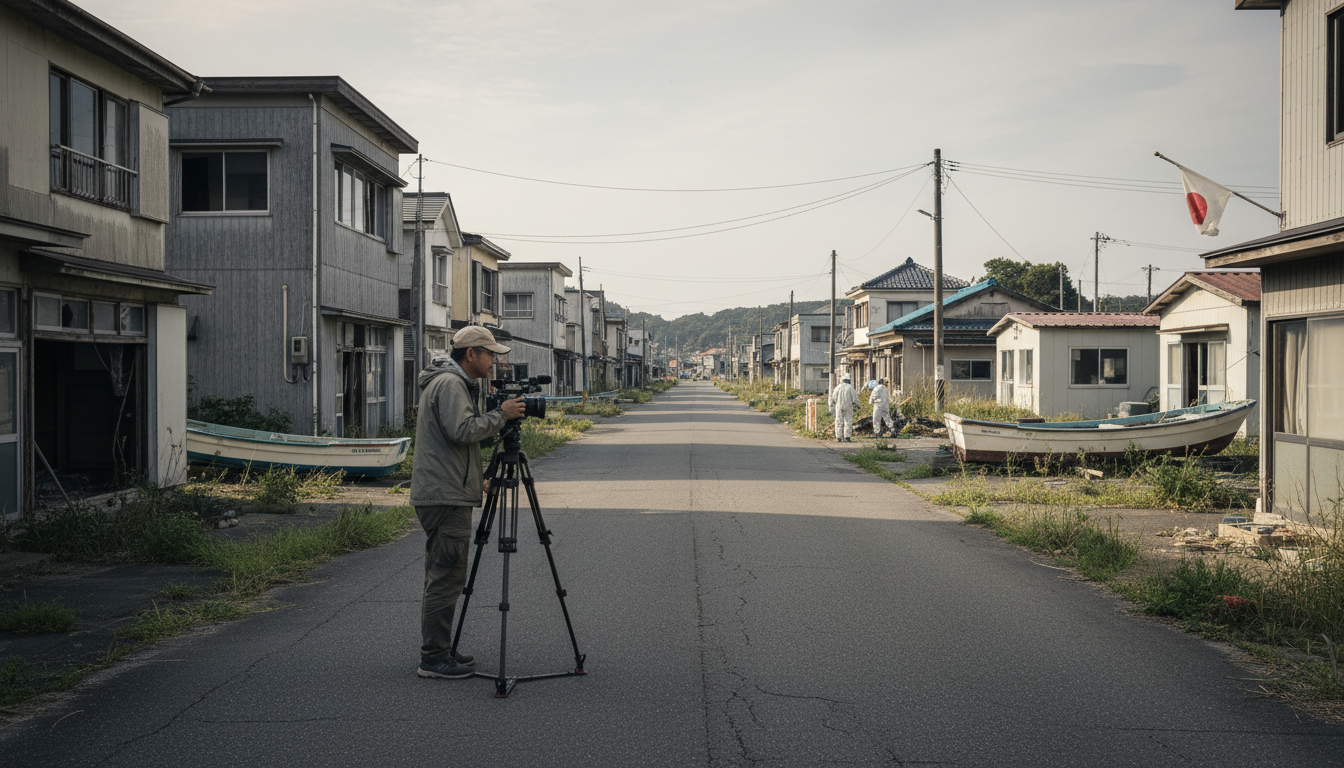
Filmmaker Toru Yamada Documents Eerie Silence and Repatriation Struggles in Namie, Fukushima
Toru Yamada’s new film examines the eerie quiet and complex repatriation issues facing Namie, Fukushima, as residents consider returning after evacuation orders were lifted. The documentary follows the filmmaker’s 2017 visit to the town and the choices confronting families displaced since the 2011 nuclear meltdowns.
A director’s return to Namie after evacuation orders were lifted
Yamada visited Namie in 2017 shortly after authorities relaxed evacuation restrictions that followed the 2011 Fukushima Daiichi meltdowns. He found a town divided between visible reconstruction work and an overwhelming sense of absence when daylight faded.
During the day, demolition crews and construction vehicles moved through the streets, but Yamada said the nights were marked by an almost complete stillness. Those contrasts became the central image around which he built his film, using place and silence to probe the human cost of displacement.
Encounter with the Watanabe family highlights personal uncertainty
On that trip Yamada met the Watanabe family, who personify the dilemma facing many evacuees from Namie. The family includes Tetsu Watanabe, then 99 and the founder of a decades-old local printing business, her son Takemasa, 75, and his wife Shigeko, also 75.
Forced to leave Namie for the inland city of Iwaki after the nuclear accident, the three had not settled on a permanent home by the time Yamada filmed them. Their situation illustrates how elderly households in particular must weigh practical needs, community ties and memories of home when deciding whether to return.
Daytime reconstruction contrasts with nighttime emptiness
Yamada’s footage captures the sounds of machinery and the sight of houses being dismantled, signaling active efforts to rebuild infrastructure. Yet as night fell, traffic lights continued to blink and entire neighborhoods emptied of human activity, underscoring a lingering void.
The filmmaker juxtaposed the visible signs of recovery with the long-term demographic shock to Namie, which had a pre-disaster population of roughly 21,000 that dropped to near zero at the height of evacuations. That steep decline informs the film’s central question: will people come back to a place that has been, for years, depopulated?
Repatriation decisions shaped by services, memories and age
For many former residents, the choice to return is not only emotional but also practical, driven by access to healthcare, transportation and basic services. Older inhabitants face particular hurdles, including continuity of medical care and the physical demands of maintaining property that may have deteriorated.
Beyond logistics, social and cultural factors weigh heavily: the loss of neighbors, schools and local businesses changes the fabric of daily life. Yamada’s film frames those lived realities through intimate scenes with the Watanabe family, revealing how attachment to place competes with concerns about isolation and safety.
Film as a record of change and a prompt for public debate
The documentary serves both as a historical record of a town in transition and as a catalyst for discussion about national recovery policy. By focusing on small, human-scale moments, the film invites viewers to consider how state decisions intersect with individual lives.
Yamada’s work also raises broader questions about how communities rebuild identity after catastrophe and what measures are needed to support sustainable return. The filmmaker’s observational approach aims to preserve testimony at a moment when policy and personal choice determine the future of Namie.
Portrait of an ageing town confronting an uncertain future
Through the Watanabes and other local scenes, the film paints a picture of an ageing population grappling with whether to re-root their lives in Namie. That portrait highlights the urgency of tailored support for elderly returnees and the social consequences if services are inadequate.
At the same time, the documentary captures small acts of resilience: the decision by some to restore shops, the gradual reopening of municipal facilities, and the conversations between neighbors about shared history. These moments suggest that repopulation is neither straightforward nor solely measurable by numbers.
The film’s attention to silence and absence makes Namie, Fukushima more than a backdrop; it becomes a living subject whose future depends on the intersecting choices of residents, officials and communities beyond the town. As audiences respond to Yamada’s work, the questions it raises about memory, recovery and belonging are likely to shape ongoing debate about how Japan remembers and rebuilds after 2011.

