
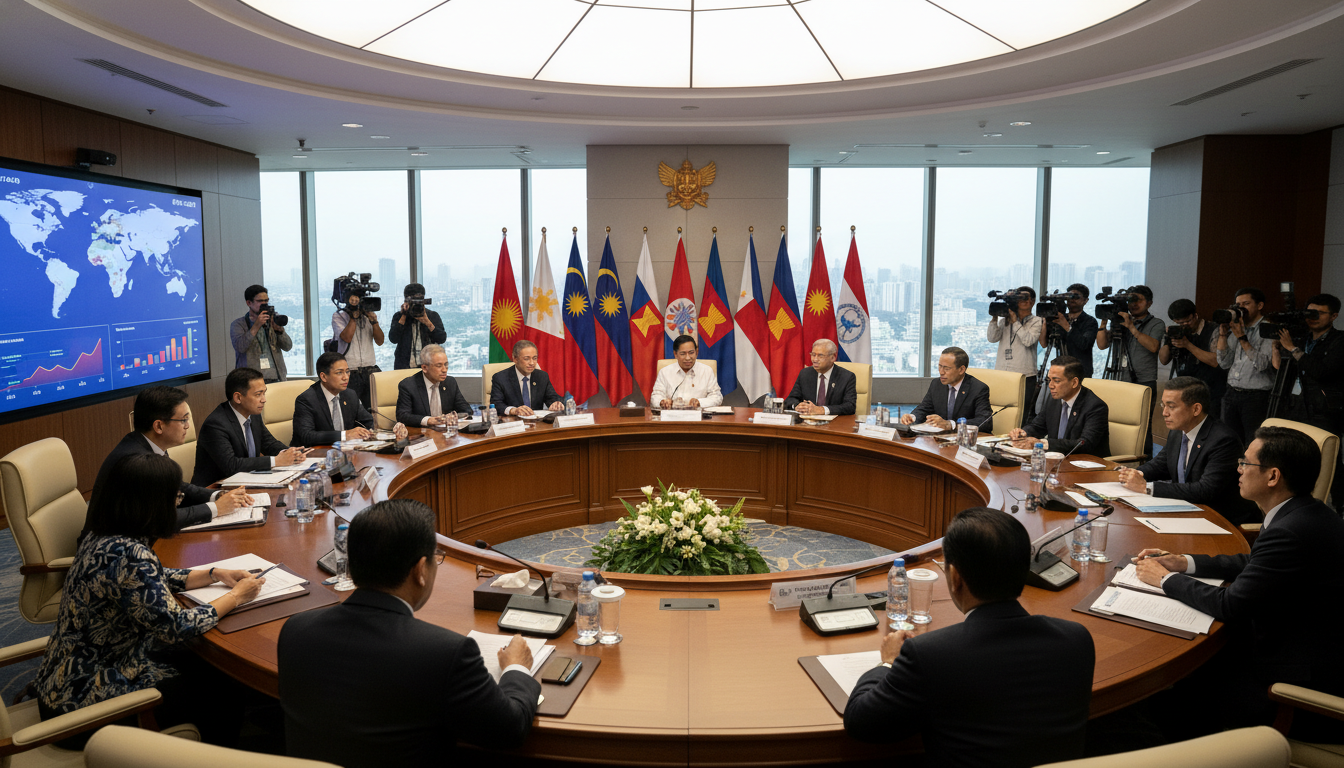
ASEAN Summit in Cebu to Focus on Iran War Fallout, Food Prices, Myanmar and South China Sea
At the ASEAN Summit in Cebu, leaders will confront the economic fallout from the Iran war while weighing responses to surging food prices, the crisis in Myanmar and a South China Sea code of conduct.
The summit brings together Southeast Asian heads of government amid growing concern that the Iran war is reshaping energy markets, shipping routes and inflation across the region. Officials said the agenda will prioritize steps to shield economies and households from rising costs and supply disruptions. Delegates will also press ahead with negotiations on a South China Sea code of conduct and examine ways to address the humanitarian and political fallout in Myanmar.
Leaders converge in Cebu for high-stakes talks
Government delegations from all 10 ASEAN members have gathered in Cebu to pursue a coordinated regional response to a complex set of security and economic challenges. The agenda was set by senior officials to balance immediate economic measures with longer-term strategic diplomacy. Observers say the compact schedule reflects urgency among capitals to manage spillovers from global tensions without derailing domestic priorities.
Summit coordinators have signaled an emphasis on consensus language, seeking a joint communique that can be acceptable to member states with divergent ties to external powers. Diplomats described closed-door sessions and bilateral meetings as key venues for ironing out sensitive clauses on maritime conduct and crisis management. Economists expect communique wording to focus on practical steps rather than detailed prescriptions.
Iran war’s economic ripple felt across Southeast Asia
Policy makers at the ASEAN Summit are zeroing in on the Iran war’s knock-on effects on oil prices, insurance premiums for shipping and investor sentiment. Even modest increases in fuel and freight costs can pass quickly into higher retail prices for food and consumer goods across the region. Central banks and finance ministries are wrestling with how to limit inflationary shocks while supporting growth.
The conflict’s wider impact includes concerns over remittance flows, energy security and the stability of supply chains that link manufacturers in Southeast Asia to markets in the Middle East and beyond. Analysts warn that prolonged volatility would complicate recovery plans for economies still coping with pandemic-era disruptions. ASEAN finance ministers are expected to coordinate monitoring and contingency measures to limit economic contagion.
Rising food prices and household strain take center stage
Soaring prices for basic goods have become an acute political concern for many member states, especially those with large low-income populations. Market vendors and consumers in urban centres have reported higher costs for vegetables, rice and cooking fuel, prompting talks on subsidies, strategic reserves and market inspections. Leaders are under pressure to deliver visible relief while avoiding fiscal strains that could worsen public debt.
Delegates are discussing regional mechanisms to stabilise food supplies, including joint purchases, logistics support and information-sharing on crop forecasts. Some governments are exploring short-term cash transfers and targeted subsidies to shield vulnerable households. Economists at the summit cautioned that such measures should be temporary and accompanied by policies to boost agricultural productivity and reduce post-harvest losses.
Myanmar crisis to be raised by multiple delegations
The situation in Myanmar remains a recurring item on ASEAN’s collective agenda, with humanitarian concerns and the stagnation of political dialogue drawing renewed attention. Several member states are expected to press for increased humanitarian access and confidence-building measures to reduce violence and displacement. ASEAN envoys have long sought an ASEAN-led approach that encourages dialogue without precipitating further instability.
Humanitarian agencies told delegates that access to affected populations remains constrained and that cross-border support needs clearer coordination. Some capitals advocate for a stepped-up diplomatic push that combines quiet mediation with stronger regional monitoring. The diversity of member approaches, however, makes unified operational responses challenging.
South China Sea code of conduct negotiations inch toward agreement
One of the summit’s key diplomatic items is the ongoing effort to finalise a code of conduct for the South China Sea, a document designed to manage maritime tensions and prevent incidents at sea. Negotiators have reported progress on technical clauses related to conduct between vessels and mechanisms for consultation. But hardline positions on sovereignty and enforcement remain sticking points for some parties.
A completed code could offer a framework for de‑escalation and confidence-building, benefitting shipping, fishing communities and offshore resource planning. ASEAN ministers are likely to tout steps forward while acknowledging remaining differences that will require further rounds of diplomacy. External partners watching the process emphasise the code’s potential to stabilise a vital trade corridor.
Coordinated responses and economic measures under consideration
Against the twin pressures of geopolitical tension and domestic strain, ASEAN leaders are exploring a mix of policy tools to bolster resilience. Proposals on the table include pooled strategic reserves, emergency financial facilities, enhanced trade facilitation and joint risk assessments. Officials said they would also discuss deeper cooperation on energy diversification and logistics to reduce vulnerability to external shocks.
The summit provides an opportunity for ASEAN to signal its preference for dialogue and pragmatic cooperation amid a shifting global environment. While member states differ in external alignments, there is common interest in preserving trade flows, protecting vulnerable populations and preventing conflict spillovers.
Leaders left Cebu with an expectation that concrete steps, rather than sweeping declarations, will define the summit’s legacy, and officials indicated follow-up mechanisms would be activated to monitor implementation of agreed measures.

