
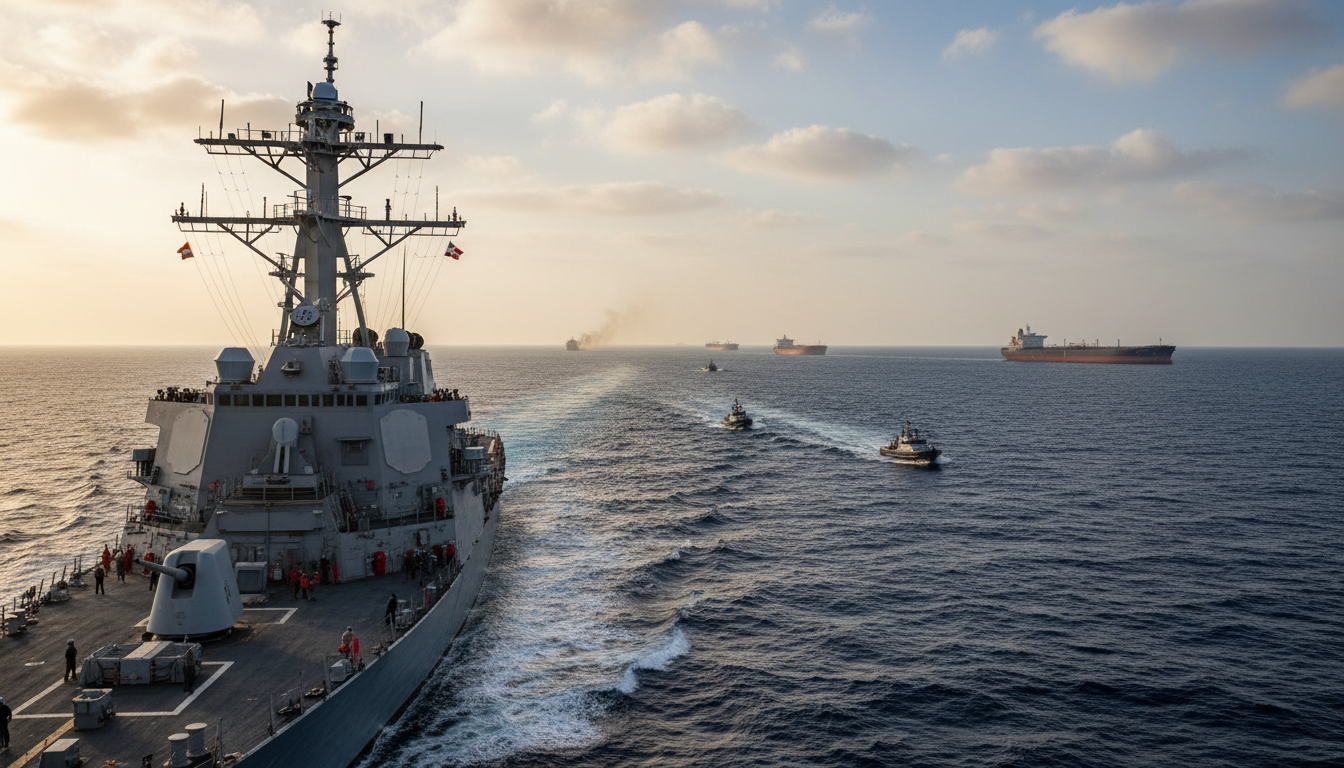
Strait of Hormuz Remains in Crisis as U.S. and Iran Maintain Dual Blockades
U.S.-Iran standoff over the Strait of Hormuz has left the key oil corridor effectively closed, with Tehran’s de facto blockade and a U.S. naval interdiction disrupting global energy flows and shipping.
The Strait of Hormuz, a narrow maritime chokepoint linking the Persian Gulf and the Gulf of Oman, has been the focus of an escalating confrontation between the United States and Iran. Tehran’s moves to obstruct passage have trapped hundreds of commercial vessels, and the United States has responded by imposing a naval blockade on ships entering or leaving Iranian ports, creating what officials describe as a “dual blockade.” (centcom.mil)
Why the Strait of Hormuz Matters
The Strait of Hormuz is one of the world’s most critical energy arteries, carrying tens of millions of barrels of crude oil and petroleum products each day from Gulf producers to global markets. International energy agencies estimate average flows around 20 million barrels per day in recent years, making disruptions here visible in global markets. (iea.org)
Strategically, the waterway is constrained: at its narrowest the channel is roughly 21 nautical miles (about 39 km), placing much of the transit within coastal states’ territorial seas while it nonetheless qualifies as an international strait under the law of the sea. Navigational and security risks are therefore amplified by geography. (chathamhouse.org)
How Iran Has Imposed a De Facto Blockade
Iran’s restrictions began after the outbreak of hostilities in late February and have taken multiple forms, including missile and drone strikes on vessels, threats to vessels transiting the strait, and controls on ship movements tied to alleged security inspections. These measures have effectively stalled many commercial transits and left a backlog of vessels waiting outside the Gulf. (aljazeera.com)
Tehran has also asserted varying legal and security rationales for its actions, citing self-defence and the need to regulate traffic near its coast and islands. Analysts note, however, that the operational effect has been to choke routine commerce and raise insurance and routing costs for shippers worldwide. (internationallaw.blog)
U.S. Naval Blockade and Maritime Measures
In mid-April the U.S. Central Command announced measures to interdict vessels entering or exiting Iranian ports, directing naval units to stop traffic deemed to be supporting Iranian maritime activity. U.S. officials framed the moves as necessary to maintain freedom of navigation and to prevent Iran from profiting from or militarily exploiting trapped shipping. (centcom.mil)
Operational enforcement has included bridge-to-bridge communications, Notices to Mariners, and active patrols; officials say the blockade is intended to be selective, targeting vessels linked to Iran while allowing neutral traffic where practicable. Observers warn, however, that any naval interdiction in such a confined space raises risks of miscalculation and escalation. (centcom.mil)
Legal Debate Over Closing an International Strait
International-law experts and institutions have debated whether a coastal state may lawfully suspend transit through an international strait used for navigation. Under the United Nations Convention on the Law of the Sea (UNCLOS), transit passage should remain unimpeded, but coastal-state sovereignty and the law of armed conflict complicate the picture in times of hostilities. (chathamhouse.org)
Several legal commentators argue that a blanket, unilateral closure of the Strait of Hormuz would be difficult to justify under established treaty and customary rules, while others note that claims of self-defence and security can be invoked in active conflict to restrict passage. International institutions have called for restraint and clarity to protect civilian shipping. (hormuzmonitor.com)
Economic and Energy Impacts, Including Japan
Disruption in Hormuz has immediate consequences for global energy markets: with a major share of seaborne oil and LNG moving through the strait, sustained blockage tightens supply, raises freight and insurance costs, and pressures prices. Energy agencies have flagged the strait as a principal chokepoint whose instability can ripple through markets. (iea.org)
Japan, like other Asian importers, is particularly exposed because much of its crude oil and petroleum products are sourced from Gulf states and transited through Hormuz. Japanese energy policy documents and white papers emphasise the nation’s reliance on Middle East supplies and the strategic consequences of a prolonged disruption to sea lanes. (enecho.meti.go.jp)
Diplomatic Moves and International Responses
At the United Nations and among maritime agencies, calls have risen for measures to secure safe passage for merchant shipping and to condemn attacks or extortionate demands linked to the strait. A U.S.-backed proposal at the UN signalled possible sanctions if Tehran does not halt actions that impede navigation or disclose hazardous obstructions such as mines. (apnews.com)
Other states and regional actors have pursued parallel diplomatic channels to restore commercial traffic, including offers to escort ships, proposals for multilateral management frameworks, and emergency routing arrangements. Yet analysts caution that any long-term solution will require durable political agreements alongside operational safeguards. (axios.com)
The Strait of Hormuz crisis underscores how local actions can reverberate through global supply chains and geopolitics; with naval forces in close proximity and legal disputes unresolved, commercial operators and governments face a precarious balance between military measures and diplomatic engagement to reopen the corridor safely.

