
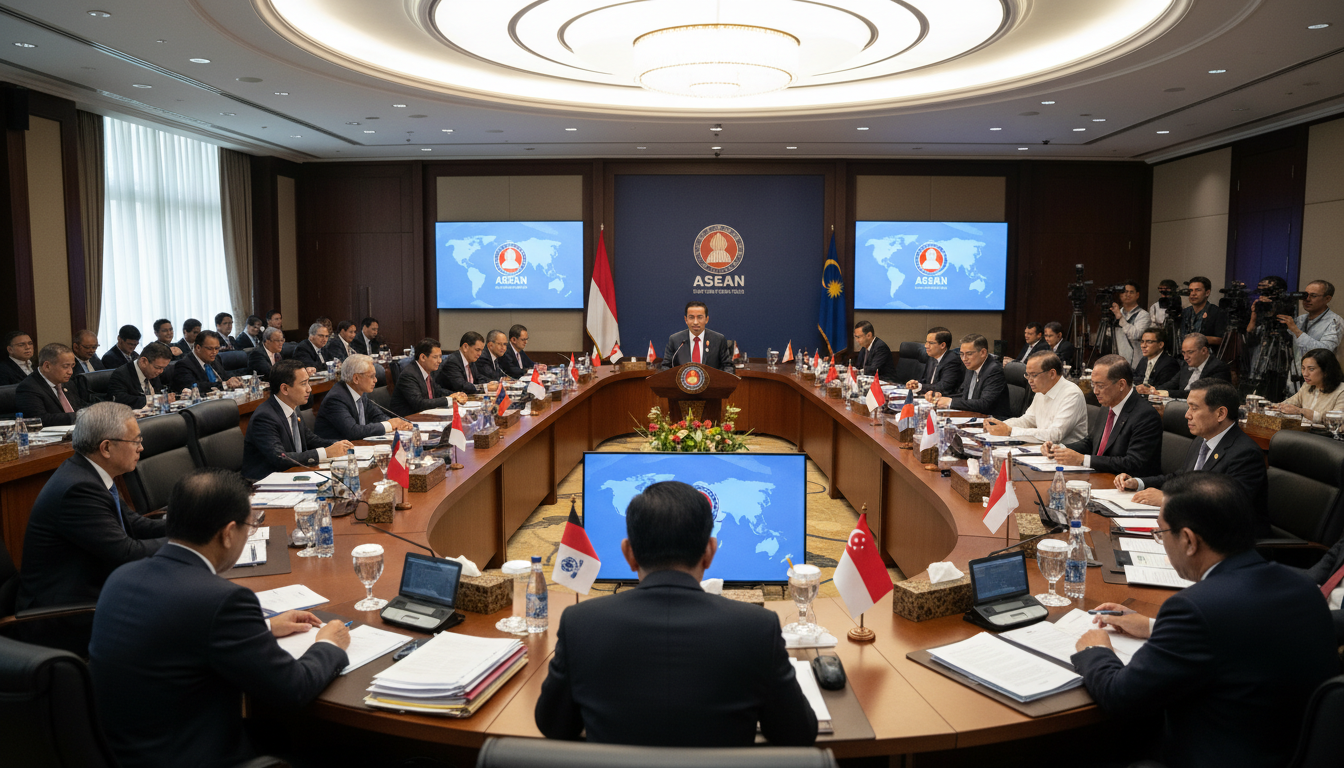
ASEAN summit in Cebu refocuses on Iran war fallout as leaders prepare joint response
ASEAN summit in Cebu will center on the Iran war’s economic fallout, energy and food security, Myanmar and South China Sea negotiations as leaders meet.
The 48th ASEAN summit in Cebu has been refashioned into a crisis-management meeting as leaders prepare to confront the economic and security ripple effects of the Iran war across Southeast Asia. Delegations gathered in the Philippine host city will prioritize energy and food security, assess inflationary pressures and seek coordinated measures to shield national economies from supply shocks at the two-day leaders’ meeting. (philstar.com)
Iran conflict’s economic pressure on Southeast Asia
The Iran war has transmitted rapid price shocks through global energy markets, amplifying fuel and food costs that many ASEAN economies are only beginning to absorb. Analysts and officials warn that transport and fertiliser price rises are feeding into food inflation and heavier import bills for commodity-dependent members. (en.wikipedia.org)
Governments across the region have reported higher consumer prices and strains on fiscal buffers, prompting central banks and finance ministries to consider mitigating steps. The immediate concern for leaders in Cebu is stabilising supplies and preventing temporary price spikes from becoming entrenched inflation. (en.wikipedia.org)
Philippine chair refocuses agenda on energy and food security
As ASEAN chair for 2026, the Philippines has reshaped the summit agenda to prioritize energy and food security measures, responding to disruptions tied to the Middle East conflict. Presidential officials say the move was driven by mounting domestic concerns over rising costs and supply vulnerability ahead of the May 7–9 leaders’ sessions. (gmanetwork.com)
Manila’s chairmanship has pushed for practical cooperation, from contingency fuel-sharing frameworks to emergency food reserve mechanisms, reflecting a desire to produce concrete, short-term deliverables. Officials describe the summit as a moment for face-to-face diplomacy to translate those proposals into coordinated regional action. (gmanetwork.com)
Myanmar crisis to be raised amid constraints on engagement
The political and humanitarian crisis in Myanmar remains on the summit docket, with ASEAN members expected to review the bloc’s approach despite longstanding friction over engagement with the country’s junta. Delegations will press for progress on humanitarian access and the welfare of displaced civilians while navigating the limits of consensus-based diplomacy. (iseas.edu.sg)
Past ASEAN practice of restricting contact with Myanmar’s military leadership complicates efforts to secure commitments or swift action, but diplomats say the humanitarian dimension and regional spillovers make frank discussions unavoidable. The summit offers the most senior forum this year for leaders to calibrate a collective stance. (iseas.edu.sg)
Negotiations advance on South China Sea code of conduct
Negotiators report “encouraging progress” on the long-running Code of Conduct (COC) talks for the South China Sea, and the summit is expected to review efforts to accelerate completion by the Philippines’ 2026 target. ASEAN and Chinese officials have increased meeting frequency and explored focused strategies to resolve several milestone issues, raising cautious optimism in Manila. (gmanetwork.com)
Beyond text-based negotiations, Manila has also promoted practical maritime cooperation initiatives, including a proposed ASEAN coast guard framework and a regional maritime centre intended to bolster confidence-building and reduce the risk of incidents at sea. Leaders may use the Cebu meeting to seek consensus on those operational proposals. (pna.gov.ph)
Leaders weigh coordinated regional responses and contingency plans
Delegations are expected to discuss an array of coordinated measures that could include emergency fuel swaps, joint stockpiles, harmonised customs facilitation for essential goods, and stepped-up maritime coordination to keep trade lanes open. Officials say such measures are designed to be flexible and nonbinding, allowing individual states to adopt approaches suited to their domestic conditions. (pna.gov.ph)
Attendance lists signal broad political participation, with heads of state and government from across Southeast Asia arriving to map a collective response that balances security, economic stability and diplomatic relations. The summit’s outcomes will be closely watched by markets and trading partners for signs of concrete policy steps. (nationthailand.com)
Regional leaders acknowledge that immediate measures will not erase the wider geopolitical drivers of the crisis, but they insist that a coordinated ASEAN approach can blunt the worst economic effects and reduce risks to vulnerable communities. The Cebu summit aims to deliver practical tools and a workplan that member states can implement in the coming months.
The leaders’ statements and any communiqués from the Cebu meeting will be scrutinised for commitments on energy security, humanitarian assistance for Myanmar, and a timeline for concluding the South China Sea code of conduct. Outcomes from this summit will shape ASEAN’s policy posture during a period of heightened global uncertainty.

