
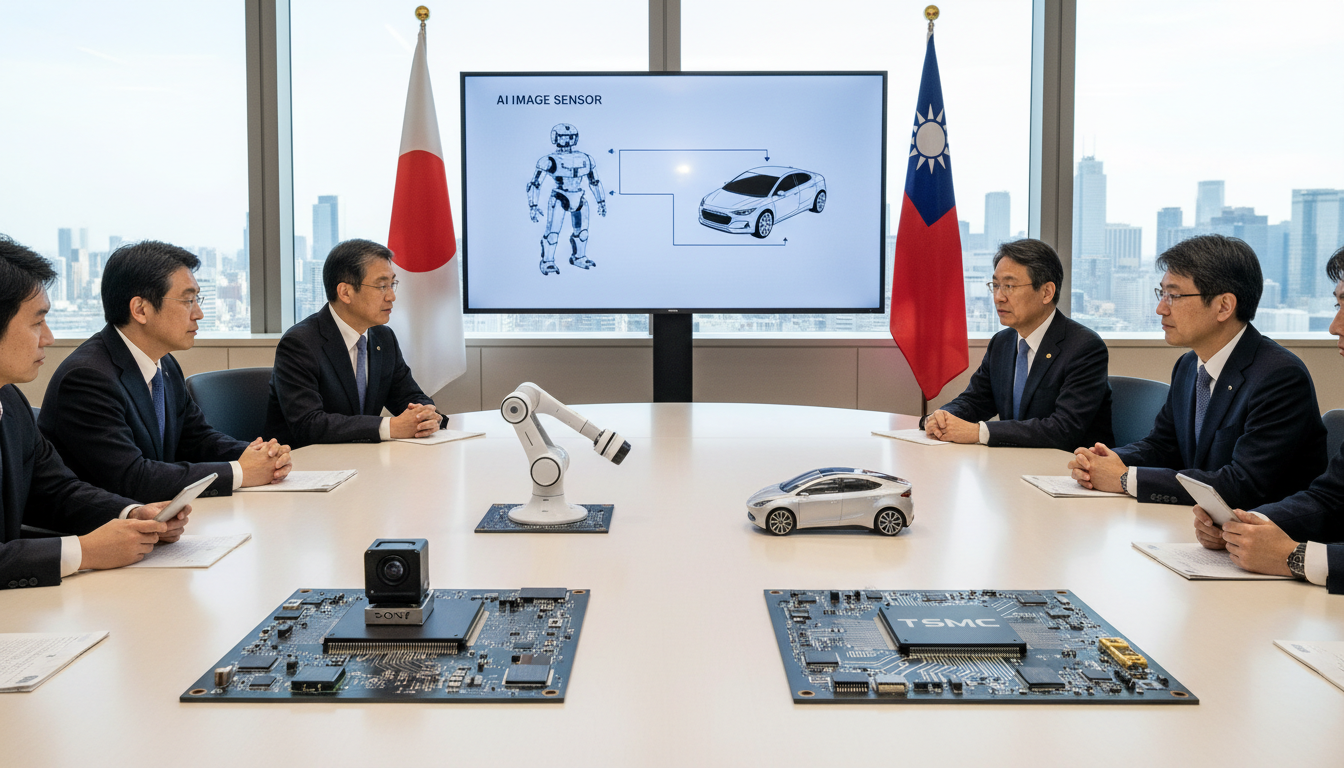
Sony-TSMC image sensors to power AI push into robotics and automotive
Sony-TSMC image sensors collaboration announced May 8, 2026, aims to build next-generation sensors for AI, targeting robotics and automotive while Sony forecasts double-digit profit growth.
Sony said on May 8, 2026 that it will deepen collaboration with Taiwan Semiconductor Manufacturing Co. (TSMC) to develop next-generation image sensors designed for artificial intelligence applications. The move, described by company officials as a strategic step beyond smartphones, positions Sony-TSMC image sensors as a core technology for robotics and automotive systems. Sony also signaled confidence in its near-term finances, forecasting double-digit profit growth driven in part by sensor demand.
Sony and TSMC deepen sensor tie-up
Sony will expand its technical partnership with TSMC to accelerate development of advanced image sensors, company sources confirmed. The agreement leverages Sony’s leadership in sensor design and TSMC’s manufacturing capabilities to shorten development cycles. Executives said the collaboration targets features and performance levels tailored to AI-based perception and on-device processing, rather than incremental improvements for consumer cameras.
The strengthened alliance aims to align roadmaps for process nodes and sensor architectures so suppliers can meet specialist needs for robotics and automotive customers. By co-designing sensors and fabrication steps, Sony expects to reduce technical risk and speed time-to-market for high-performance devices. The partnership also reflects a broader industry trend of closer cooperation between design houses and foundries.
Next-generation sensors aimed at AI workloads
The new sensors are intended to handle the heavy data and low-latency demands of AI inference at the edge, according to company statements. Capabilities such as higher frame rates, improved low-light performance, and advanced on-chip pre-processing are being prioritized to feed neural networks more useful visual inputs. Engineers are reportedly working on architectures that reduce data transfer and preprocessing burdens on downstream compute units.
These enhancements are critical where real-time perception is required, including autonomous navigation and collaborative robotics. Sensors that can pre-filter, compress or partially interpret imagery at the hardware level can lower system power, reduce latency, and simplify software stacks. Sony and TSMC say their joint efforts will emphasize practical, production-ready solutions that systems integrators can adopt.
Targeting robotics and automotive markets
Sony explicitly identified robotics and automotive as growth areas for its image-sensor business as it seeks to diversify beyond smartphones. Both sectors demand robust imaging under varied lighting and environmental conditions, along with long product life cycles and stringent reliability standards. Sony’s plan aims to tailor sensor specifications and manufacturing tolerances to meet those industrial requirements.
For automotive applications, the need for safety-certified sensors that perform across wide temperature ranges and comply with automotive-grade standards is a focal point. In robotics, modularity and adaptability are prized, as systems range from warehouse automation to inspection drones. Sony’s move signals an intent to capture higher-value, longer-duration contracts with OEMs and system integrators.
Production and manufacturing strategy
TSMC’s role will center on producing sensor wafers using advanced process technologies and process-integration techniques that match Sony’s design innovations. The collaboration includes joint work on lithography, pixel stacking, and packaging approaches that can improve yield and performance. Close coordination with a leading foundry is seen as essential to translate design gains into commercially viable products at scale.
Sony will continue to invest in its upstream design and sensor-development teams while relying on TSMC for high-volume fabrication. This division of labor allows Sony to focus on optical performance and integration, while TSMC addresses node migration and mass production challenges. Both companies will need to manage supply chain timing and capital expenditure to meet anticipated demand.
Financial outlook and profit guidance
Sony’s announcement came alongside an upbeat outlook for the group, which forecasted double-digit profit growth in the current fiscal period. The company attributed part of the improvement to rising demand for image sensors in AI-related applications and an expanding addressable market. Management emphasized that higher-margin industrial and automotive sales could improve profitability relative to more cyclical smartphone markets.
Analysts note that margins in automotive and industrial segments tend to be steadier but require upfront investment in qualification and support. Sony’s guidance suggests confidence that investments in sensor technology and its partnership with TSMC will translate into concrete revenue gains. Observers will watch order flow from automakers and robotics firms as a barometer of the strategy’s early success.
Industry implications and competitive response
The Sony-TSMC push is likely to intensify competition with other sensor suppliers and semiconductor groups that are targeting AI perception systems. Vendors in Asia, Europe, and the United States have been accelerating sensor roadmaps and assembling ecosystems around compute and software partners. The new tie-up may prompt rivals to similarly co-develop products with foundries or to deepen relationships with AI platform providers.
Procurement teams at automotive and robotics companies may gain leverage as multiple suppliers offer differentiated sensor solutions tailored to AI workloads. At the same time, increased specialization could raise barriers for smaller players who lack access to leading-edge fabrication. Market observers expect consolidation and more strategic partnerships as the industry reorients toward AI-driven sensing.
The collaboration between Sony and TSMC underscores a widening focus on perception hardware as foundational to autonomous machines and intelligent systems, and it marks a calculated step by Sony to convert its sensor leadership into broader industrial strength.

