
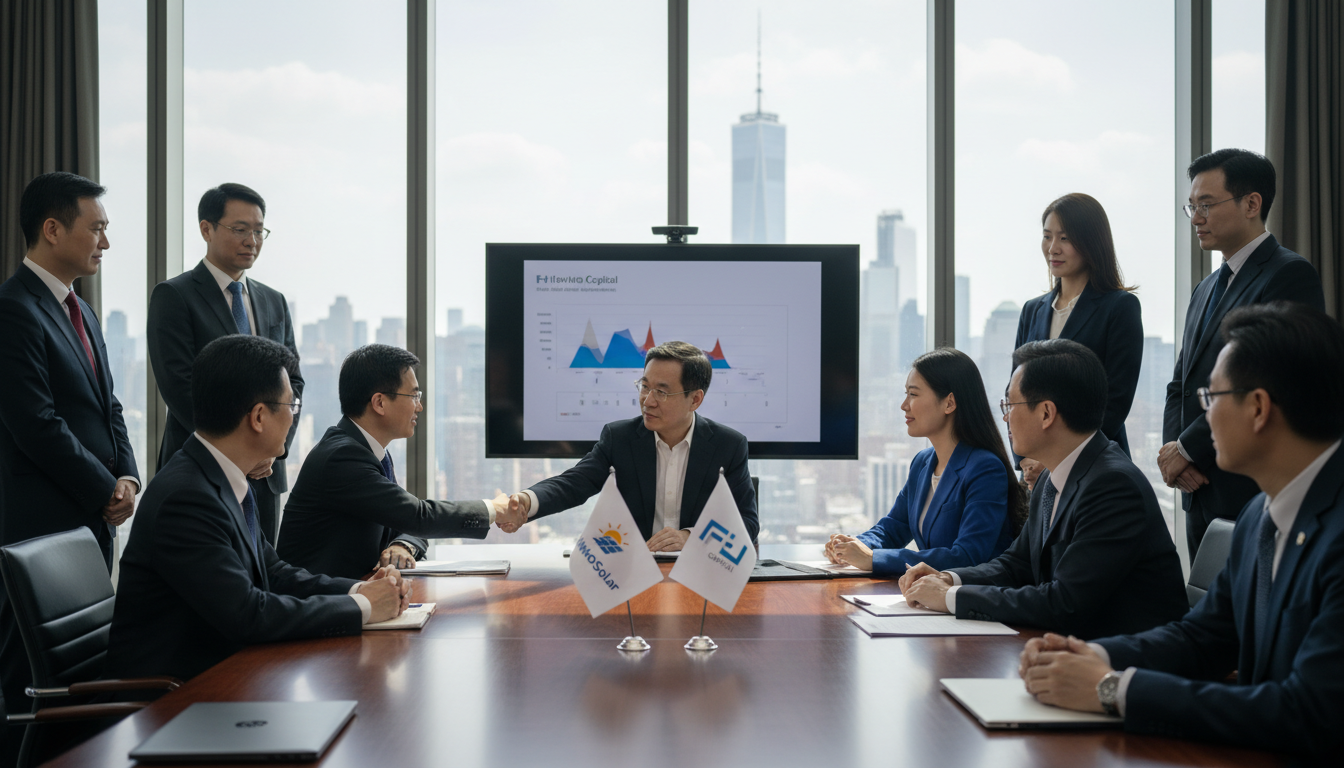
JinkoSolar stake sale: Chinese panel maker to sell 75.1% of U.S. unit to FH Capital
JinkoSolar stake sale will see FH Capital acquire majority control of the U.S. unit, giving the buyer oversight of a 2GW Florida production line and strengthening access to U.S. clean-energy incentives.
JinkoSolar Agrees to Sell 75.1% of U.S. Unit
JinkoSolar Holding has agreed to sell a 75.1% stake in its American subsidiary, Jinko Solar (U.S.) Industries, to U.S. private equity firm FH Capital, the companies announced Friday. The agreement transfers majority ownership of the unit as part of a strategic rearrangement of the Chinese manufacturer’s U.S. operations.
The JinkoSolar stake sale is framed by both firms as a move to separate ownership while preserving manufacturing capacity in the United States. Company statements described the transaction as aimed at stabilizing the unit’s operations and positioning the asset for growth under American management.
FH Capital to Control 2GW Florida Production Capacity
Under the terms disclosed, FH Capital will control approximately 2 gigawatts of production capacity at a manufacturing facility in Florida. That level of capacity is sizable for a single U.S. solar wafer and panel line and could supply modules for utilities, developers, and distributed-generation projects nationwide.
FH Capital said it intends to operate and potentially expand the plant to meet anticipated demand, while JinkoSolar will retain a minority stake and long-term commercial ties. The handover of operational control is expected to allow the factory to continue producing panels for the U.S. market with reduced regulatory and political friction.
Strategic Motives Linked to U.S. Clean-Energy Incentives
Industry observers say the deal reflects how foreign panel makers have reconfigured their footprint to access U.S. support under the Inflation Reduction Act and other Biden-era measures. Chinese and other overseas firms invested heavily to establish assembly and manufacturing sites inside the United States to qualify for production tax credits and investment incentives.
By moving majority control to an American private equity owner, JinkoSolar’s U.S. unit may better align with domestic policy goals while still leveraging the technology and supply relationships of its parent. The arrangement illustrates a broader trend where ownership structures are being reshaped to preserve market access amid tightened scrutiny of foreign-controlled critical manufacturing assets.
Market and Policy Context for the Transaction
The transfer comes as U.S. policymakers and industry leaders push to onshore battery and solar manufacturing to secure supply chains. The Florida facility’s 2GW capacity adds meaningful domestic manufacturing scale that state and federal officials have encouraged through grants, tax breaks, and procurement priorities.
Analysts note that the deal could reduce political risk for buyers of the plant’s output, who have increasingly sought product sources that meet “domestic content” or national-security-related criteria. For financiers, an American-led ownership structure may unlock new forms of capital and government support that are harder to access by foreign-controlled entities.
Financial Terms and Transition Arrangements
Neither JinkoSolar nor FH Capital disclosed the full financial terms of the transaction publicly. Company statements said the transaction would transfer operational control immediately upon closing, with minority-holdback provisions and transitional services likely to smooth the passage of management responsibilities.
JinkoSolar will remain linked commercially to the U.S. unit through supply agreements and technical collaboration, according to the announcement. FH Capital, for its part, has signaled intentions to invest in workforce development and production optimization to increase the plant’s competitiveness.
Implications for U.S. Solar Supply Chains and Competition
The deal highlights the competitive dynamics in the global solar industry, where Chinese manufacturers have dominated module production while Western investors seek to bolster domestic capacity. If FH Capital scales the Florida facility successfully, it could help diversify module supply for project developers and reduce lead-time pressures that have affected installation schedules.
However, some industry participants caution that ownership change alone does not erase the complexities of sourcing polysilicon, wafers, and other upstream components still concentrated overseas. Domestic assembly and cell production address important parts of the supply chain, but full resilience will require coordinated investment further up the value chain.
The transaction may also influence other Chinese manufacturers that have invested in U.S. operations; private equity ownership offers a model for reconciling foreign technology and investment with U.S. policy requirements. Market watchers will be watching for similar deals as companies navigate incentives, trade restrictions, and geopolitical scrutiny.
Looking ahead, the success of the JinkoSolar stake sale will depend on FH Capital’s ability to integrate the plant into U.S. markets, preserve contracts, and access available incentives. Observers say the immediate outcome to track will be whether production continues without interruption and whether the plant’s output gains preferential placement in procurement that rewards domestic manufacturing.
The broader solar sector will also monitor any shifts in pricing, supply timelines, and partnerships that follow the change in ownership, as these factors will shape project economics and deployment rates across the United States.
The JinkoSolar stake sale underscores how ownership structures and industrial policy are reshaping where and how solar panels are made, and it marks a notable step in efforts to expand U.S.-based renewable energy manufacturing.

