
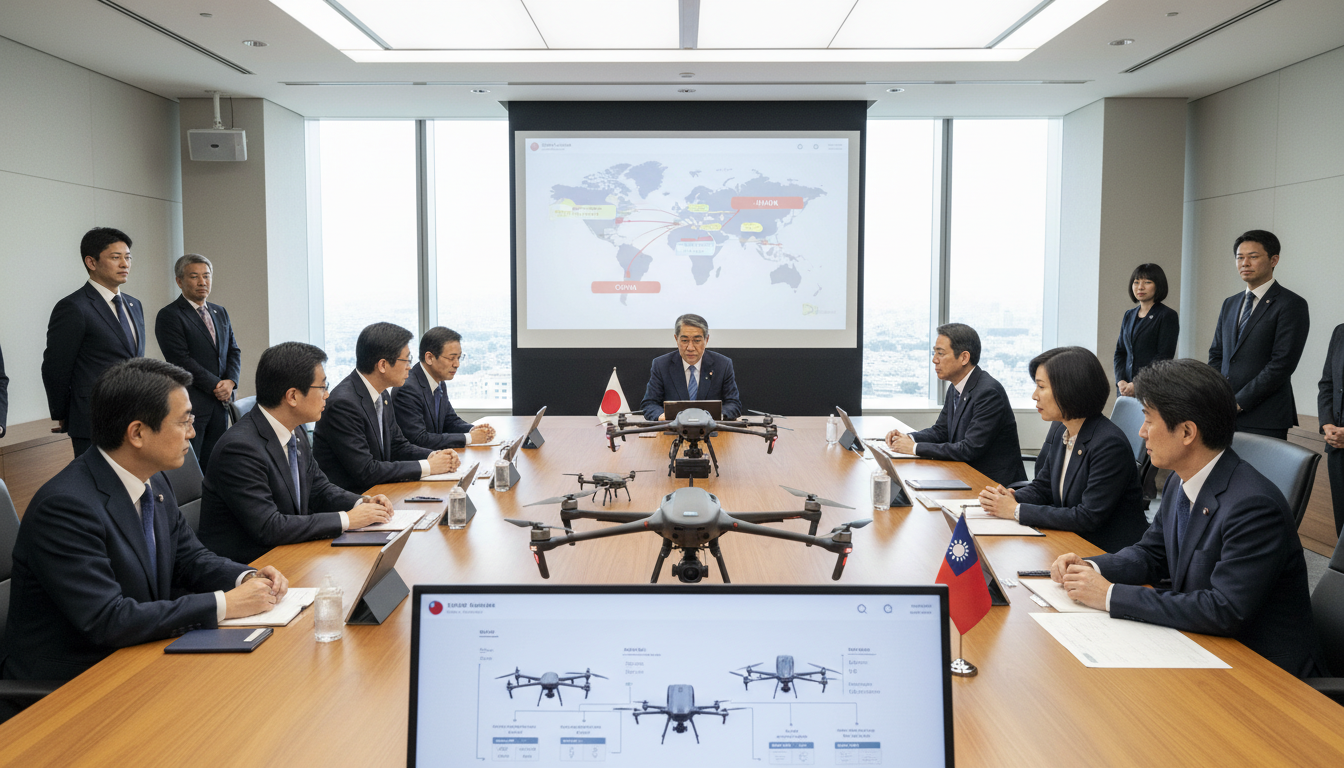
Japan-Taiwan drone cooperation gains momentum as Tokyo and Taipei seek supply-chain resilience
Japan-Taiwan drone cooperation expands as Tokyo and Taipei pursue joint development, manufacturing and training to reduce China’s supply-chain dominance.
Japan and Taiwan Expand Drone Cooperation
Nascent Japan-Taiwan drone cooperation has begun to take shape as both governments and private companies intensify talks on joint projects. Officials in Tokyo and Taipei say the effort aims to diversify procurement and strengthen domestic manufacturing capacity. The move is driven in part by concerns over China’s dominance in key components and the cost advantages enjoyed by mainland suppliers.
Shared Supply-Chain Concerns Drive Policy
Japanese and Taiwanese strategists describe supply-chain vulnerability as a primary impetus for collaboration on unmanned systems. Both sides face a market where sensors, chips and propulsion components are often sourced from the same limited supplier base in the region. Reducing dependence on those suppliers is seen as essential to maintaining operational resilience and price stability.
Joint Manufacturing and Research Initiatives
Industrial partners on both sides are exploring co-production arrangements that combine Taiwan’s advanced manufacturing of airframes with Japanese expertise in avionics and software. Proposals under discussion include clustered supply hubs in Japan and Taiwan and shared R&D facilities for autonomy and electronic warfare resilience. Industry representatives say such arrangements could accelerate certification and lower overall costs by pooling investment.
Training and Operational Exercises
Military and civilian agencies have begun to coordinate exercises focused on interoperability and safety standards for unmanned aircraft. Training programs aim to harmonize procedures for command-and-control, airspace deconfliction and counter-drone measures across different environments. Officials emphasize that frequent joint drills will help translate technical cooperation into operational readiness.
Economic Incentives and Industrial Strategy
Tokyo has signaled fiscal incentives for domestic firms that form partnerships with Taiwanese producers, including subsidies for joint factories and tax breaks for shared R&D. Taipei, meanwhile, is offering streamlined export licensing and co-investment schemes to attract Japanese capital into its drone sector. Both governments view these measures as a way to create jobs, secure supply chains and capture more of the global market for advanced unmanned systems.
Strategic Calculations and Regional Context
Analysts say the collaboration also reflects broader regional strategic calculations as states reassess dependence on single-source suppliers. Drones are now central to surveillance, logistics and crisis response, making reliable access to components a national-security priority. Tokyo and Taipei are careful to frame cooperation as industrial and technical rather than explicitly military, though defense applications remain an important driver.
Technology Transfer and Intellectual Property Safeguards
Negotiators are reportedly placing significant emphasis on intellectual property protections and the terms of technology transfer. Both sides are seeking arrangements that allow joint innovation while protecting proprietary designs and software. Legal frameworks under discussion include joint patents, secure development enclaves and stipulations to prevent unauthorized transfer of critical subsystems.
Challenges: Cost, Standards and Diplomatic Sensitivities
Despite momentum, several obstacles remain, including bridging cost differences and agreeing on technical standards across manufacturers. Mainland China’s scale and price competitiveness continue to pose commercial challenges that co-production alone may not fully overcome. Diplomatic sensitivities also complicate certain procurement decisions, prompting Tokyo and Taipei to balance transparency with caution.
Industry Reaction and Market Implications
Private-sector players view the partnership as an opportunity to expand into new markets for logistics, precision agriculture and infrastructure inspection. Japanese firms are particularly interested in Taiwan’s small- to medium-sized drone manufacturing base, while Taiwanese companies value access to Japan’s systems-integration expertise. Market watchers expect the collaboration to spur a wave of joint ventures and to attract investment from allied economies.
The initial phase of Japan-Taiwan drone cooperation centers on building supply-chain resilience through joint development, shared manufacturing and coordinated training. As plans move from discussion to implementation, the partnership will be tested by commercial realities and geopolitical sensitivities. Continued dialogue and concrete pilot projects will determine whether the initiative can deliver sustainable alternatives to existing regional suppliers.

