
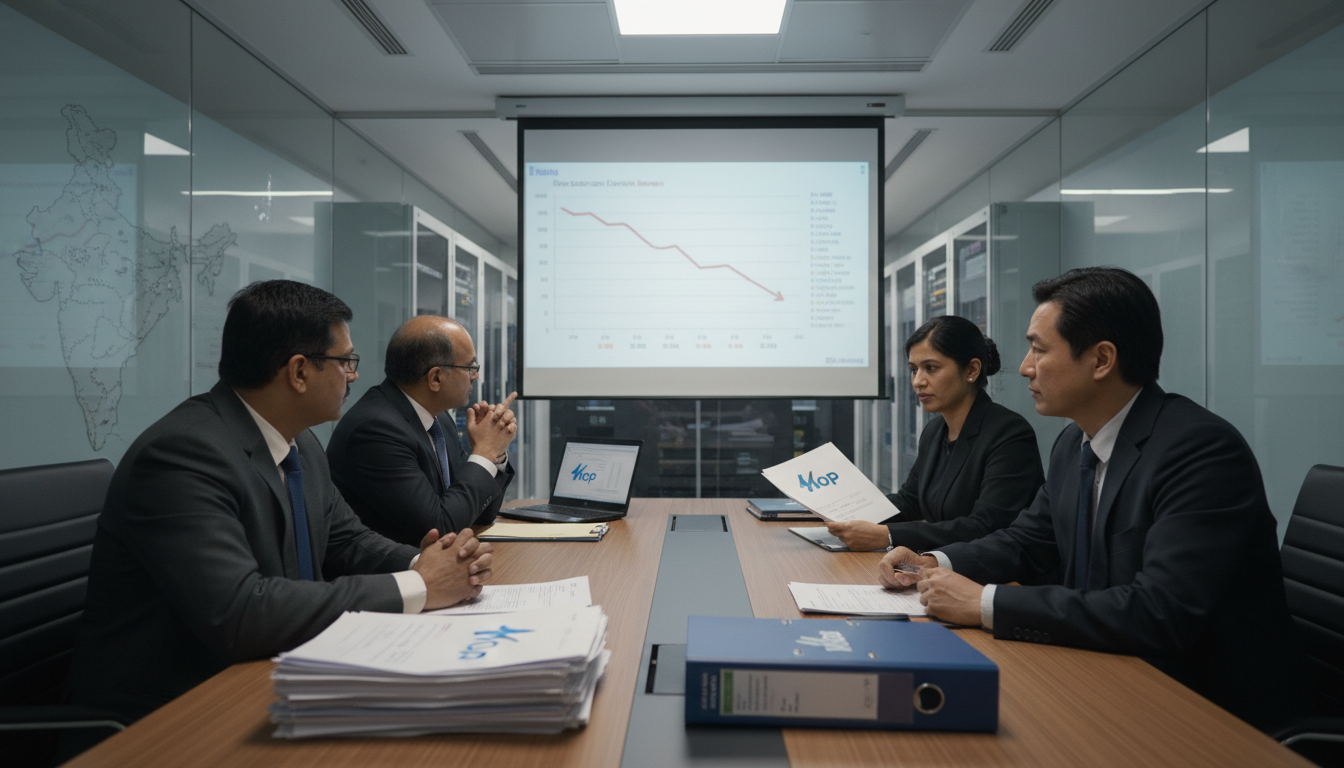
Data Centers Seek Distribution Licenses as Indian Discoms Lose Industrial Customers
Data centers seek distribution licenses in India, intensifying pressure on state-owned discoms as industrial users go off-grid and middlemen accrue heavy debts.
BENGALURU — India’s power distribution landscape is undergoing a rapid shift as data centers seek distribution licenses and large industrial customers increasingly move off-grid or purchase directly from private suppliers. The trend has placed state-owned distribution companies, known as discoms, under mounting revenue pressure. Market participants and analysts warn the moves could reshape how electricity is bought, sold and regulated across the country.
Discoms see shrinking load and revenue
State-owned discoms have traditionally relied on a mix of residential, commercial and industrial consumption to balance revenue and cross-subsidies. With industrial users reducing dependence on the grid and buying cheaper alternatives, the load base that underpins discom finances is shrinking. Officials from several distribution utilities have reported higher losses and rising payment arrears as large consumers either self-generate or contract privately.
The shift erodes a predictable revenue stream and complicates long-term planning for maintenance and grid upgrades. Discoms face a dual squeeze: falling sales to high-tariff industrial customers and continued obligation to provide reliable supply to remaining consumers.
Data centers pursue distribution licenses and autonomy
Growing demand for secure, uninterrupted power has led data centers to explore new arrangements, including seeking distribution licenses that would allow them to buy, distribute and manage electricity more directly. For hyperscale and large-scale facilities, a distribution license offers control over procurement, pricing and backup arrangements, and reduces dependence on a single state utility.
Proponents argue that such licenses enable more efficient procurement from private power producers and facilitate investment in captive generation, battery storage, and renewable integration. Critics caution that if enough large consumers secure distribution rights, the regulatory compact that supports universal service could be weakened.
Private suppliers and captive generation reshaping supply chains
Private power companies, captive generation plants and renewable developers have expanded offerings tailored to industrial and digital infrastructure customers. Long-term power purchase agreements (PPAs), open access arrangements and behind-the-meter generation give buyers alternatives to traditional discom supply. For many factories and data centers, the total cost of ownership for private supply can be lower than grid tariffs once reliability and quality are factored in.
These developments have accelerated the unbundling of power supply, transmission and distribution roles, creating a more fragmented market. While competition can reduce costs for some consumers, it also leaves utilities with higher per-customer fixed costs and more complex load forecasting.
Middlemen and traders face mounting debts
The reconfiguration of the power market has left brokers, aggregators and smaller traders—often described as middlemen—exposed to credit risk and stranded positions. Many of these intermediaries had financed deals on the expectation of stable demand from industrial buyers and revenue clearance through discom channels. As customers bypass traditional procurement routes or secure their own distribution rights, middlemen have been left with unpaid invoices and reduced turnover.
The financial strain on these actors has knock-on effects for suppliers and smaller generators that relied on trading volumes to sell output. Insolvency risks among trading firms could disrupt short-term power flows and complicate liquidity in wholesale markets.
Regulatory responses and policy dilemmas
Regulators face a delicate balancing act: supporting efficient, competitive supply options for major consumers while preserving the fiscal health of discoms and ensuring universal access. State electricity regulators and the central authorities can adjust wheeling charges, open access rules and license conditions, but such changes often provoke political and economic pushback.
Possible interventions include revising tariff structures to recover fixed costs from a broader customer base, tightening licensing criteria for new distribution entrants, and designing mechanisms to hedge revenue risk for legacy utilities. Each option carries trade-offs between encouraging investment and protecting the public interest.
Impact on consumers and grid reliability
If trends continue, residential and small commercial consumers could shoulder a greater share of the system’s fixed costs, potentially leading to higher tariffs or reduced service quality. Grid operators may also contend with less predictable demand patterns as large loads leave the system or switch between suppliers, complicating scheduling and frequency control.
At the same time, increased private investment in generation and storage could enhance overall system resilience if appropriately coordinated with grid operations. The key question for policymakers is how to harness private capital without undermining the capacity of discoms to fulfill universal service obligations.
Looking ahead, the trajectory of India’s power distribution sector will depend on regulatory choices, the pace of private investment, and the willingness of stakeholders to share transition costs. Data centers seeking distribution licenses exemplify a broader shift toward buyer-driven procurement and localized control of energy assets, a development that promises efficiency gains but raises difficult questions about equity, grid stability and the financial viability of public utilities.

