
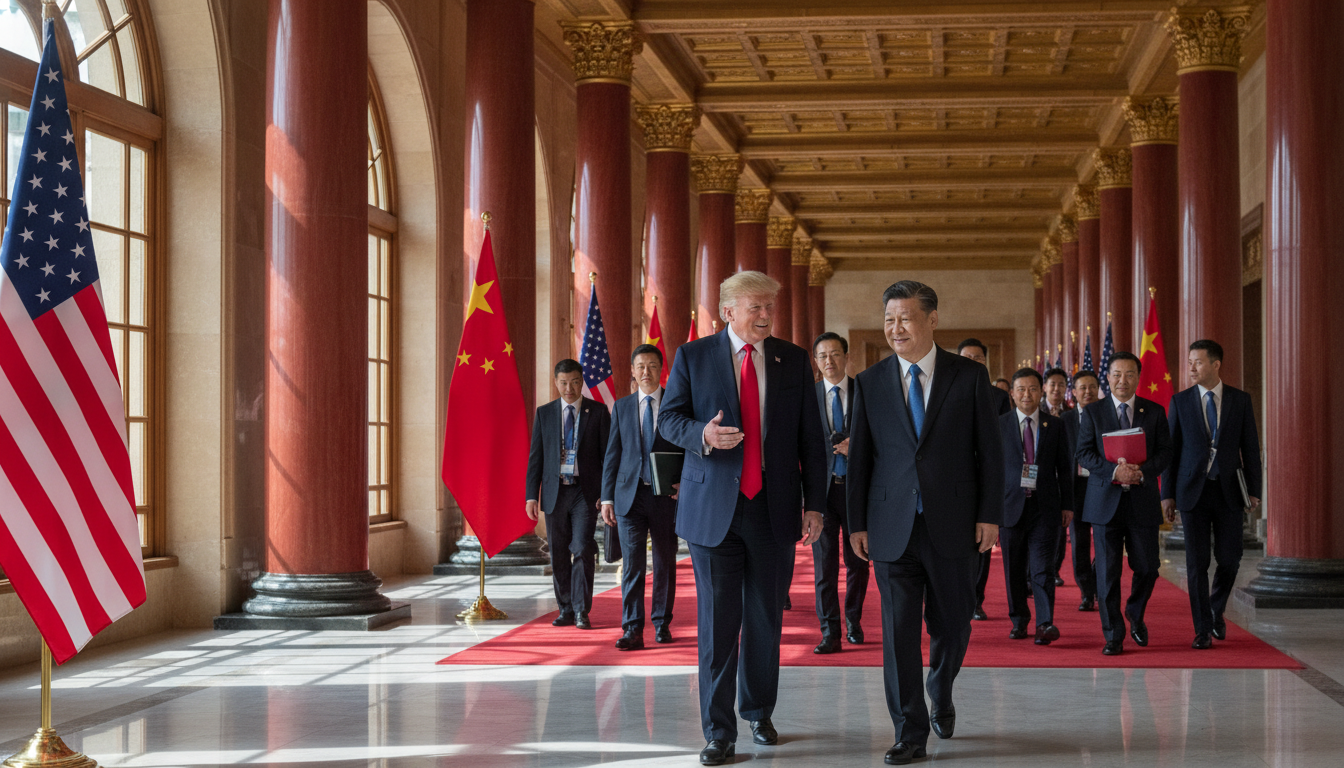
Trump-Xi summit in Beijing focuses on trade, technology and regional security
Trump-Xi summit in Beijing on May 15, 2026 seeks concrete agreements on trade, technology controls and regional security amid high diplomatic and economic stakes.
U.S. President Donald Trump and Chinese President Xi Jinping met on the second day of the Trump-Xi summit at the Communist Party leadership compound in Beijing on May 15, 2026, aiming to cement tangible results from the visit. The talks, held at Zhongnanhai, moved beyond formal greetings to detailed discussions as both sides sought to define deliverables in trade, technology and regional security. Delegations from Washington and Beijing remained in parallel sessions throughout the day, with leaders and aides signaling a rare push for near-term outcomes.
Second Day Talks Held at Zhongnanhai
The summit’s second day took place at Zhongnanhai, where Mr. Xi and Mr. Trump conducted face-to-face meetings and working sessions on May 15. A photograph from the session showed the two leaders in direct conversation, underscoring the personal diplomacy framing the negotiations. Officials described the schedule as tightly choreographed to allow both principals to address priority dossiers and to instruct teams on follow-up actions.
Senior aides from both capitals were reported to shuttle between bilateral rooms and multilateral briefings, underscoring the operational intensity of the visit. The setting — inside the inner leadership compound — highlighted the political importance Beijing attached to the engagement and the desire to present the meetings as high-level and substantive.
Negotiations Center on Trade, Tariffs and Technology
Trade and tariffs were central topics as negotiators sought to narrow differences that have persisted for years. Discussions included market access, agricultural purchases, and tariff rollbacks, with technical teams working through schedules and phased commitments. Technology controls and export restrictions also featured prominently, reflecting Washington’s concerns about advanced semiconductor supply chains and dual-use goods.
Both sides emphasized the need to stabilize economic ties that underpin global supply chains, but they differed on sequencing and enforceability of any commitments. Chinese officials pressed for tariff reductions tied to reciprocal measures, while U.S. representatives sought verifiable safeguards and mechanisms to prevent backsliding on technology transfers.
Security Topics Include Taiwan, North Korea and Military Posture
Security issues formed a parallel strand of the summit, with Taiwan and the Korean Peninsula high on the agenda. The leaders discussed ways to reduce miscalculation risks in the Taiwan Strait and to maintain channels for crisis management between their militaries. North Korea’s nuclear program and recent missile activity were raised as common concerns requiring coordinated pressure and diplomatic engagement.
Military posture and transparency in regional waters were also on the table, as both capitals explored confidence-building steps to prevent incidents at sea and in airspace. While statements after closed-door sessions were limited, diplomats said the talks aimed to create clearer lines of communication and contingency procedures.
Economic Implications for Japan and the Region
Tokyo is watching the Trump-Xi summit closely because outcomes in Beijing will have direct repercussions for Japan’s trade, regional security planning and corporate strategy. Japanese exporters and manufacturers depend on stable U.S.-China relations for supply-chain predictability, and any shifts in tariffs or export controls could prompt rapid realignments. Government officials in Tokyo have emphasized the need to prepare contingency plans and to engage with allies on economic and security spillovers.
Regional economies across Asia also stand to be affected by changes in technology cooperation and trade barriers discussed in the summit. Investors and central banks are likely to monitor the summit’s communiqués and subsequent technical agreements for signals on growth, inflation and capital flows.
Signals to Markets and Global Supply Chains
Markets reacted to statements and images from the summit as traders factored in the possibility of incremental but consequential agreements. Currency and equity moves reflected investor hopes for de-escalation in bilateral economic measures, though analysts cautioned that detailed implementation would determine the real impact. Corporate procurement teams in technology and manufacturing sectors said they were awaiting precise language on export controls and tariff timetables before altering sourcing strategies.
Supply-chain managers noted that even preliminary understandings could accelerate investment decisions and logistics planning across Asia. Any clarity on semiconductor supply, for example, would influence factory footprints and long-term contracts for equipment and materials.
Joint Statement Expected but Details Remain Unclear
Officials indicated a joint statement or communiqué could be issued at the close of the summit, but they cautioned that the timing and content would depend on last-minute negotiations. Past summits have produced broad commitments, and diplomats from both sides appeared to be negotiating the degree of specificity and enforcement language. Observers said the degree to which the document included verification mechanisms would be critical to its credibility.
Analysts noted that even a modest set of agreed next steps — technical working groups, deadlines for tariff reductions, or pilot projects on technology cooperation — would be treated as a success by markets and governments. Conversely, a vague or symbolic statement would likely temper expectations and prolong uncertainty.
The Trump-Xi summit in Beijing on May 15 underlined a mutual interest in stabilizing a pivotal bilateral relationship while leaving open difficult questions on verification, sequencing and strategic competition. Both sides signaled an appetite for concrete deliverables, but the durability of any agreements will hinge on detailed technical work and follow-through by ministries and agencies in the coming weeks.

