
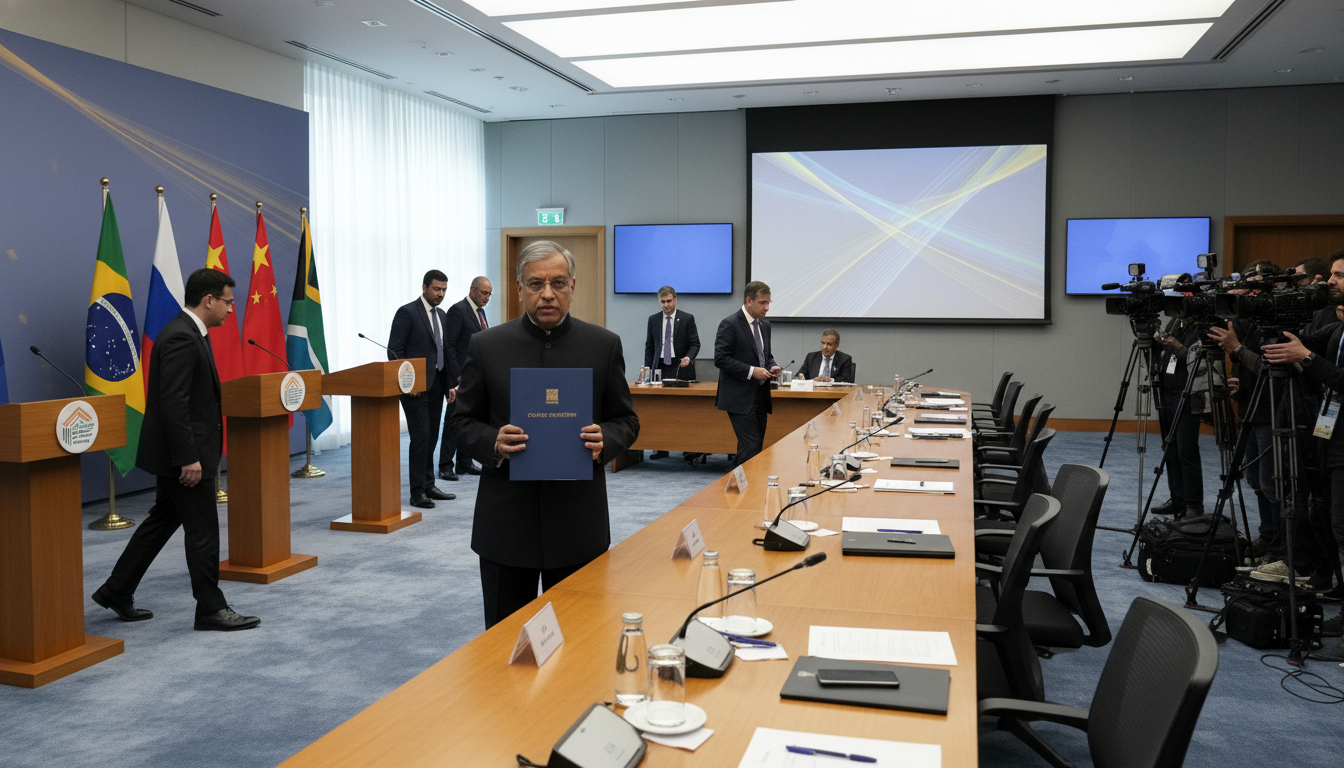
BRICS foreign ministers’ meeting in New Delhi ends without joint statement
BRICS foreign ministers’ meeting in New Delhi ends without a joint statement as chair cites differing views on the Middle East; Iran accuses UAE over strikes.
The BRICS foreign ministers’ meeting held in New Delhi concluded on May 15, 2026, without a joint statement after India, as chair, said there were "differing views among some members" on the Middle East situation. The failure to agree came a day after Iran publicly accused the United Arab Emirates of involvement in U.S.-Israeli strikes, a claim that heightened tensions among attending delegations. The absence of a collective communiqué marks a rare public display of division within the bloc during India’s chairmanship. Diplomats said the impasse underscores the difficulty BRICS faces in reconciling members’ divergent positions on active conflicts.
BRICS foreign ministers’ meeting ends without consensus
The meeting at Bharat Mandapam closed without the customary joint text that typically summarizes outcomes and shared positions. New Delhi issued a chair’s statement noting the lack of consensus while emphasizing the need for continued dialogue among members. Officials present described exchanges as frank but stopped short of naming which delegations opposed specific language. The public acknowledgement of differing views is notable given BRICS’ recent push to display cohesion on global issues.
India frames the chair’s statement
India, hosting the talks, highlighted its role in steering discussions and framed the chair’s statement as a call for further consultations. The statement, released on May 15, said members had differing views regarding the Middle East situation and that no unified language could be agreed. Indian officials indicated the chair sought to reflect the range of perspectives rather than force an artificial consensus. The approach signals New Delhi’s preference for keeping channels open while avoiding an escalation of disagreement within the bloc.
Iran’s accusation raises tensions
Iran’s foreign minister, Abbas Araghchi, attended the meeting and the accusation against the UAE came to the fore during the summit period. Tehran said the UAE was involved in strikes it attributed to U.S.-Israeli action, a claim that representatives at the meeting discussed privately. Delegations expressed concern about public allegations aired during multilateral talks, noting they complicate efforts to craft common language. The episode underscored how regional conflicts can reverberate through broader diplomatic platforms such as BRICS.
Diverging views on the Middle East exposed
Members’ differing assessments of the Middle East, including causes and appropriate responses, emerged as the primary obstacle to a joint declaration. Some delegations favoured stronger language condemning military actions and urging restraint, while others urged caution and emphasized de-escalation through bilateral diplomacy. These fault lines reflect deeper strategic alignments and bilateral relationships that influence how states approach the crisis. Observers said the split is illustrative of BRICS’ heterogeneous membership, which ranges across continents and geopolitical outlooks.
Implications for BRICS unity and agenda
The failure to issue a joint statement could complicate efforts to showcase BRICS as a unified alternative voice on major international issues. India had sought to use its chairmanship to advance cooperation on trade, development finance and global governance reform, but the diplomatic rift diverts attention. Some analysts warn that recurrent public divisions could weaken the bloc’s bargaining power in multilateral forums. Nevertheless, diplomats stressed that BRICS retains substantive areas of cooperation and that a single inconclusive meeting does not signal an end to collaboration.
Next steps and diplomatic follow-up
Officials said follow-up consultations are expected in the coming weeks as capitals review the talks and pursue bilateral outreach. India, as chair, indicated it would continue to consult members to seek common ground before larger leaders’ gatherings. Delegations are also likely to intensify behind-the-scenes diplomacy to manage tensions stirred by public accusations and competing policy priorities. The coming weeks will test whether BRICS can reconcile immediate disagreements while maintaining its broader agenda.
The New Delhi meeting’s outcome highlights the challenge of translating a diverse set of national interests into a single diplomatic text, and it raises questions about how BRICS will handle future crises that cut across member alignments. The decision to record the lack of consensus in the chair’s statement nevertheless offered a transparent account of the meeting for international observers. As members return to capitals, attention will shift to whether bilateral engagements and further consultations can restore momentum before the next round of high-level BRICS meetings.

