
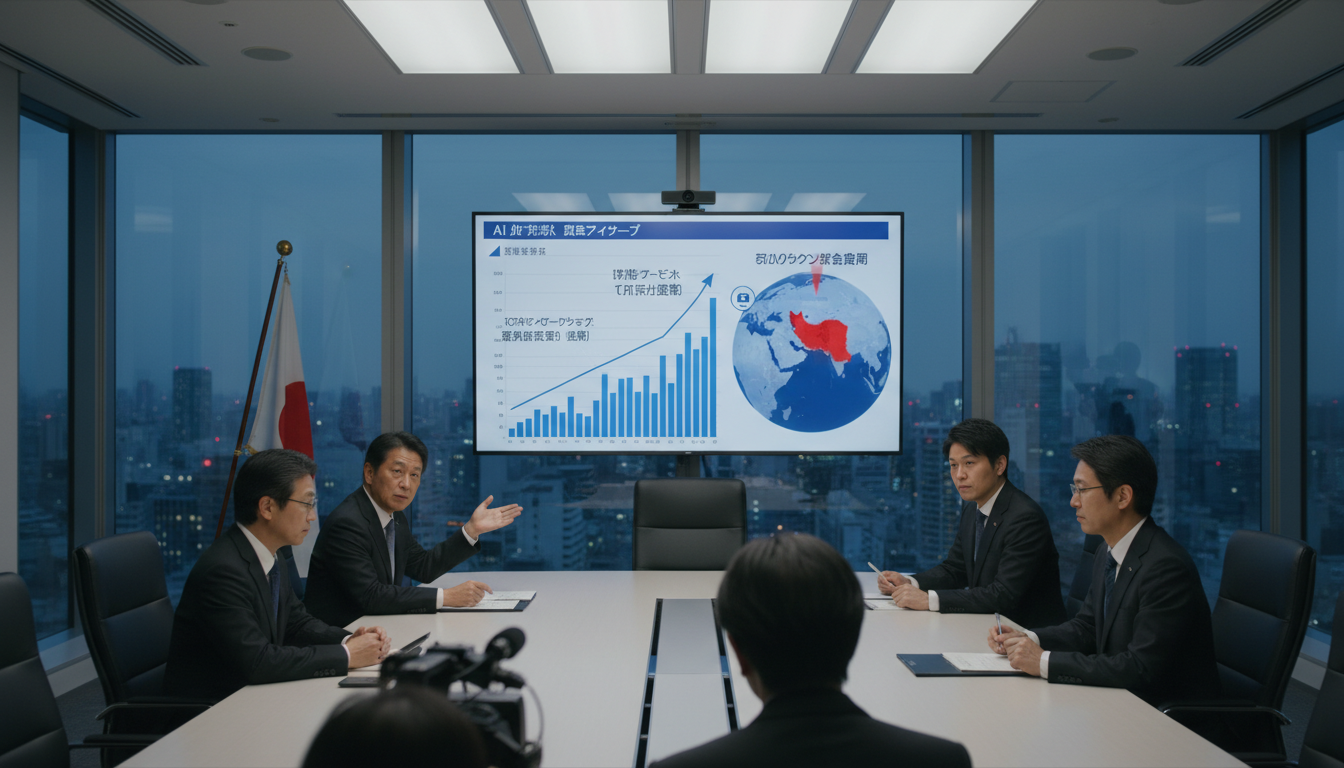
AI boom drives strong corporate earnings as Iran turmoil clouds outlook
Japanese firms report robust profits on AI boom, but geopolitical risk from Iran and supply-chain strains leave many firms revising forecasts and planning countermeasures.
Japanese companies reported a wave of strong financial results driven largely by demand linked to the global AI boom, yet executives warned that geopolitical turmoil around Iran has injected fresh uncertainty into near-term forecasts. Combined net profits for TOPIX-listed firms, excluding financials and select sectors, remain elevated at roughly ¥36 trillion for the year ending March 2026, even as analysts expect an aggregate decline for the first time in five years. While semiconductor and electronics groups delivered the most pronounced gains, a spread of firms have flagged supply-chain, raw material and logistics risks that could blunt momentum going forward.
AI boom lifts semiconductor and electronics earnings
Kioxia and other memory-chip makers were among the standout performers, citing surging orders from data-center operators and cloud providers that support AI services. Kioxia’s profit more than doubled, driven by memory demand, while major electronics companies recorded notable upticks in AI-related businesses. Five of seven leading electronics firms, including well-known conglomerates, posted significant year-on-year gains as AI hardware and software investments translated into higher sales and margins.
Industry executives said the AI boom has reshaped capital spending patterns and product road maps, with firms accelerating development of components and systems tailored for machine learning workloads. That shift has increased revenues for upstream semiconductor suppliers and created new service opportunities for system integrators and software vendors.
TOPIX aggregate profits high but set to dip
Despite headline strength, the picture is mixed when viewed from a broader index level. Combined net profits for companies tracked by TOPIX remain high at about ¥36 trillion, yet the total is expected to mark a fall compared with the prior year. Excluding banks, insurers and several other categories, the decline would represent the first downward move in five years for those listed firms. Analysts attribute the moderation to one-off factors and uneven performance across sectors even as pockets of strength persist.
The unevenness underscores how concentrated gains have been, with semiconductors and certain electronics segments offsetting weaker results in other industries. Corporate balance sheets look healthier than in prior cycles, but the aggregate metric suggests the recovery is not uniform across Japan’s listed economy.
Market reaction and investor expectations
Investor sentiment responded quickly to the earnings flow, pushing the Nikkei Stock Average up and briefly lifting it toward the 64,000 level, reflecting elevated expectations for continued growth from AI-related demand. Market participants have signalled optimism about the earnings outlook for companies tied to data centers and cloud infrastructure. Still, analysts caution that enthusiasm could be volatile given external shocks, and advised investors to weigh geopolitical and commodity risks alongside the AI-driven narrative.
Equity strategists noted that valuation gains in some tech-linked names are now being balanced against higher uncertainty premiums in sectors more exposed to energy and shipping disruptions. This divergence has produced a mixed breadth in market leadership despite headline index gains.
Companies flag Middle East turmoil as key risk
The ongoing turmoil surrounding Iran has prompted many corporate treasuries and planning departments to reassess their risk scenarios. Several firms in energy, petrochemicals and food processing have described earnings forecasts for the business year ending March 2027 as “undetermined” amid concerns about oil supply disruptions and logistics bottlenecks. Executives cited the difficulty of modelling fuel and commodity prices when geopolitical developments can trigger sudden shifts.
Food and consumer-goods manufacturers have already outlined contingency moves. One edible-oil manufacturer warned that production adjustments may become necessary for specific products, reflecting potential feedstock or shipping constraints. Another snacks producer disclosed plans to alter packaging temporarily because of an acute ink shortage, an example of how seemingly small supply-chain issues can have visible operational effects.
Corporate responses: cost cuts and supply-chain moves
Automakers and industrial groups are prioritizing measures to reduce exposure to rising or volatile input costs. Toyota has forecast a material drop in profit for the year ending March 2027, projecting a roughly 22% decline to near ¥3 trillion, and has signalled a stepped-up programme of global cost reductions. The company plans to standardize equivalent parts across models and to cut the number of components used, alongside efforts to reduce material consumption throughout the group.
Other firms are reassessing sourcing, stockpiling critical inputs, and diversifying suppliers to blunt the impact of potential disruptions. Packaging changes and production adjustments already announced by several consumer companies illustrate a broader trend toward tactical flexibility and contingency planning.
Calls for wage gains and strategic investment
Policy makers and shareholders are pressing firms that posted strong results to translate profits into higher wages and fresh investment rather than concentrating returns in financial markets. Corporate observers say that meaningful, across-the-board wage increases and sustained capital expenditures will be crucial to demonstrate the resilience of Japan’s economy amid global uncertainty. Firms that reinvest gains in productivity-enhancing technologies and workforce pay are more likely to sustain domestic demand and weather external shocks.
At the same time, boards and management teams face trade-offs between shoring up margins through cost discipline and making strategic bets that underpin long-term competitiveness in AI, electric vehicles and clean energy. The path chosen will shape whether current earnings strength spurs a broader and more durable economic upswing.
The recent results show that Japan’s listed firms have harnessed demand generated by the AI boom to lift profits, but the persistence of geopolitical risk and supply-chain vulnerabilities means momentum is fragile. How companies allocate these gains—between wages, investment and cost restructuring—will determine whether the current upswing translates into sustained growth or a shorter-lived financial-cycle boost.

