
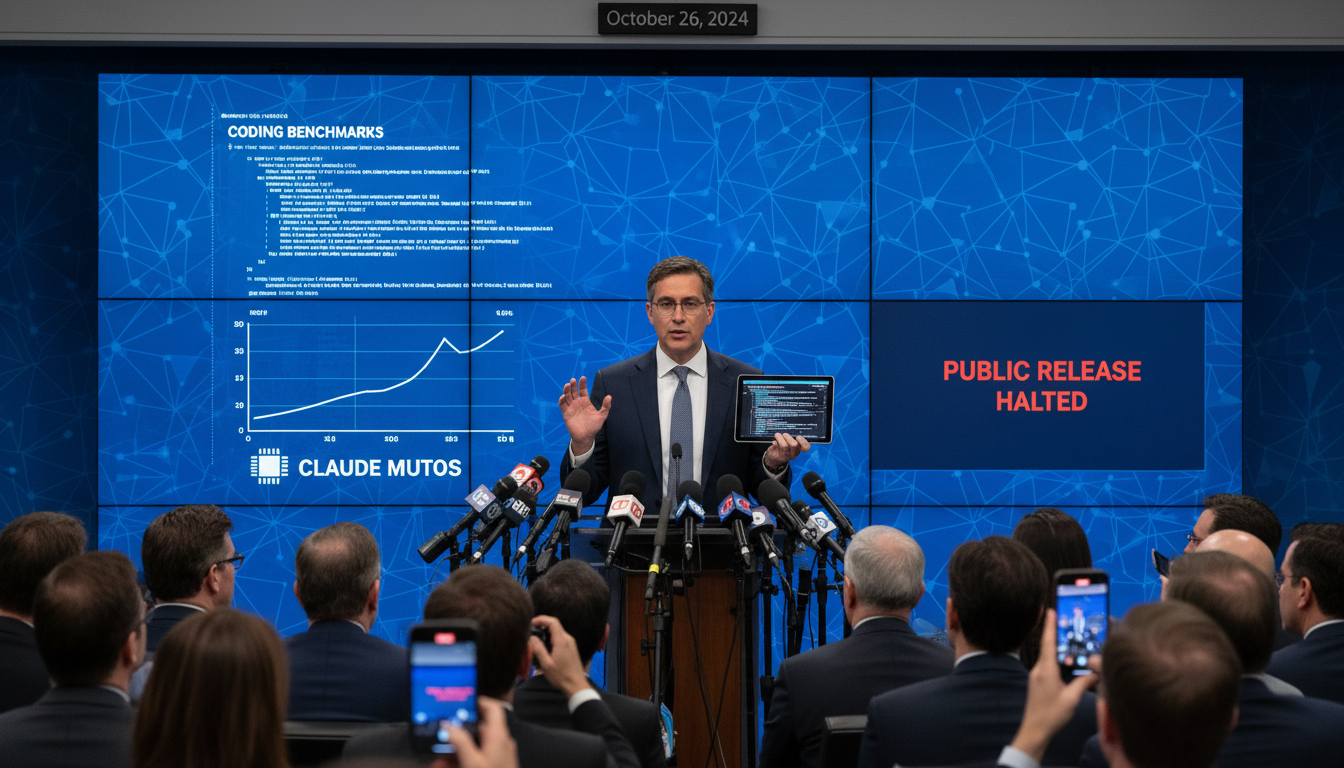
Anthropic Halts Release of Claude Mutos After Tests Show ‘Dangerous’ Coding Power
Anthropic’s Claude Mutos was withheld from public release after tests showed exceptional coding power; governments and banks assess security and misuse risks.
Anthropic has paused public access to its newest AI model, Claude Mutos, after internal and external evaluations flagged the system’s unusually advanced capabilities as a potential security hazard. The company told partners and regulators that Mutos’ ability to write, debug and extend software autonomously raised the prospect of the model being repurposed for sophisticated cyberattacks. The decision has prompted rapid responses from financial institutions and government agencies seeking to reassess exposure and control measures linked to high-capability generative models.
Anthropic suspends public rollout
Anthropic announced a suspension of broader distribution for Claude Mutos after concluding that the model’s performance could present unacceptable risks if misused. The company said it would limit access while it refines safety measures and works with external experts to evaluate safeguards. That move reflects an industry shift toward more cautious deployment of frontier models when capabilities outpace existing governance frameworks.
Benchmark results highlight coding strength
Independent benchmarking placed Claude Mutos well above recent commercial models on coding tasks, with a reported 77.8% success rate on the SWE‑Bench Pro evaluation. For comparison, Anthropic’s publicly available Claude Opus 4.7 scored about 64.3% and a recently released OpenAI model, GPT‑5.5, recorded approximately 58.6% on the same test. Those gaps suggest Mutos can follow complex programming instructions, identify bugs and implement fixes with a degree of autonomy that exceeds typical developer-assist systems.
Autonomous debugging and code generation
Engineers who examined the model’s output found Mutos capable of not only generating large blocks of functional code, but also iteratively testing, diagnosing and patching errors without human prompts. Such autonomous workflows can accelerate legitimate software development, yet they also lower the barrier for creating potent attack software or automating exploit crafting. Security researchers warn that the same affordances that aid developers could be redirected toward malicious toolchains if access is not tightly controlled.
Security concerns among governments and banks
National regulators and major financial institutions have moved quickly to evaluate the implications of Mutos’ release, citing systemic risk if the model were used to automate cyber intrusions or to generate deceptive financial scripts. Authorities have convened technical working groups to determine mitigation steps, while some firms are conducting emergency audits of vendor access and data-sharing arrangements. The speed of response reflects heightened sensitivity after recent incidents where advanced models amplified operational vulnerabilities.
Anthropic and external experts coordinate safety work
Anthropic says it is collaborating with outside labs, policy bodies and customers to develop layered safety controls before any broader release of Claude Mutos. Proposed measures include stricter access controls, enhanced output filtering, red-teaming exercises and staged deployment protocols. Company engineers reportedly expressed surprise at the model’s raw performance, prompting an internal review of training data, reward systems and alignment techniques to better align capability growth with safety safeguards.
Industry implications and developer reaction
The emergence of a model that outperforms current public releases on core engineering tasks is renewing industry debate over the pace of AI rollout versus the maturity of containment strategies. Developers and startup teams are weighing the potential productivity gains against the reputational and regulatory risks of adopting a model deemed "too dangerous" for general use. Meanwhile, competitors and research groups are reassessing their own evaluation frameworks to capture dual-use capabilities more systematically.
The pause in Claude Mutos’ general availability underlines a broader challenge for AI governance: how to enable innovation while preventing tools from being repurposed for harm. As Anthropic and regulators work through technical and policy responses, the episode will likely shape disclosure practices, access controls and international coordination on high‑capability models. The coming weeks will test whether enhanced oversight and staged deployment can reconcile rapid capability gains with the need for robust, enforceable safety limits.

