
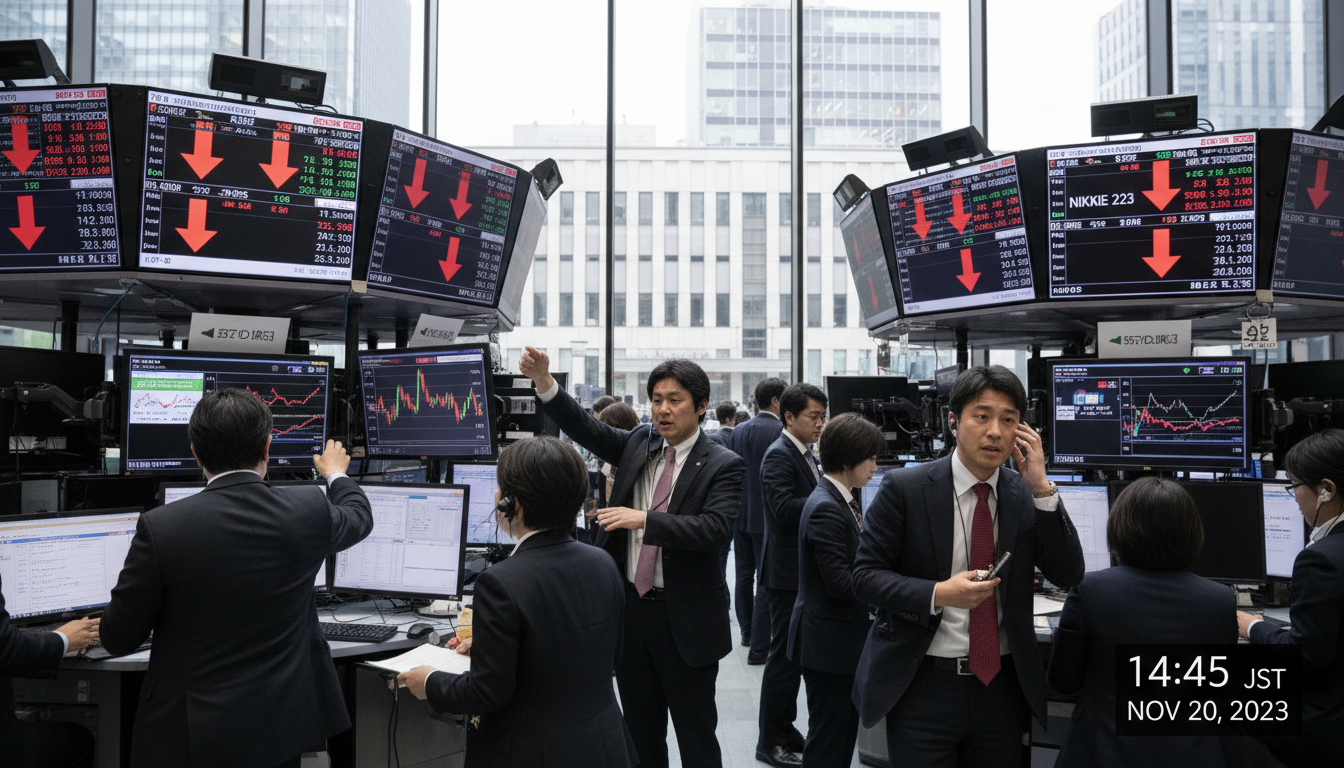
Nikkei 225 Falls for Third Straight Day as Bond Yields Rise and Middle East Tensions Spur Risk-Off Sentiment
Japan’s Nikkei 225 plunged on Monday, extending a three-day slide as a global bond market selloff and renewed Middle East tensions sapped investor appetite for risk. The Nikkei 225 decline featured weakness across large-cap technology and financial stocks, while Japanese government bond yields climbed sharply, intensifying market pressure.
Nikkei 225 posts third consecutive decline
The Nikkei 225 fell roughly 1.2% to about 60,646, marking its third straight session of losses as traders reassessed risk exposures. The broader Topix also retreated more than 1%, reflecting broad-based selling across both cyclical and defensive sectors.
Market breadth was heavily skewed to the downside, with decliners far outnumbering advancers on the Tokyo exchange. Equity turnover picked up as investors rebalanced portfolios in response to higher yields and softer global equity cues.
Japanese government bond yields surge
Yields on Japanese government bonds climbed on Monday, part of a wider global fixed-income selloff that pushed borrowing costs higher across major markets. The rise in yields increased concerns about tighter financial conditions, which in turn weighed on asset prices sensitive to discount rates, such as growth and technology names.
Analysts said the bond move was driven in part by fears that the conflict in the Middle East could add to inflationary pressures, prompting investors to demand higher compensation for duration risk. The rapid shift in the yield curve forced some funds to reduce equity exposure to limit interest-rate vulnerability.
Wall Street weakness and AI stock sell-off ripple through Asia
Negative tone on Wall Street over the prior session amplified selling in Tokyo, with declines concentrated among semiconductor and AI-related companies. Large-cap tech shares, which had powered earlier gains, were particularly vulnerable as investors rotated out of high-valuation names.
The spillover effect underscored Tokyo’s sensitivity to developments in the U.S. market, where futures and overnight moves often set the opening tone for Asian trading. Traders cited a combination of profit-taking and recalibration of growth expectations as reasons behind the AI-led pullback.
Geopolitical escalation in the Middle East heightens risk aversion
Reports of drone incursions in the United Arab Emirates and Saudi Arabia over the weekend stoked fresh geopolitical concerns that helped tip markets toward risk aversion. U.S. political commentary warning that Iran must act “fast” added to perceptions that diplomatic efforts were losing momentum.
Market participants said the potential for a prolonged regional flare-up increased the chance of supply disruptions and upward pressure on energy prices, amplifying inflation worries. The combination of geopolitical uncertainty and higher yields created a challenging backdrop for risk assets globally.
Large-cap declines and sector winners and losers
Among individual movers, several heavyweights in Tokyo suffered steep losses, with retailers and financial institutions among the largest decliners. Names such as Marui Group and Mizuho Financial Group were cited by traders as significant contributors to the Nikkei’s drop, as position adjustments and margin pressures amplified declines.
Conversely, some defensive sectors and exporters exhibiting more stable cash flows saw relative resilience amid the risk-off swing. Market participants noted that sector rotation toward value and yield-supporting stocks could accelerate if bond yields remain elevated.
Investor sentiment and market implications
Brokerage strategists said the twin shocks of rising yields and geopolitical unease created an environment where investors prioritized liquidity and lowered beta exposure. Maki Sawada, an equities strategist at Nomura Securities, described the market as being heavily influenced by last week’s U.S. index drops and the spike in Japan’s 10-year yield.
Looking ahead, traders will be closely watching further developments in the Middle East, U.S. equity performance, and the path of Japanese government bond yields for cues on whether the recent volatility will persist. Policy reactions from central banks and any shifts in diplomatic engagement are expected to be key near-term drivers.
Market participants advised caution but noted that volatility can also create selective buying opportunities for long-term investors focusing on fundamentals. For now, liquidity management and hedging strategies have returned to the forefront for funds navigating a rapidly evolving risk landscape.
Markets will likely remain sensitive to headlines and yield movements in the coming sessions, with Tokyo’s direction tied to overseas market cues and any new developments on the geopolitical front.

