
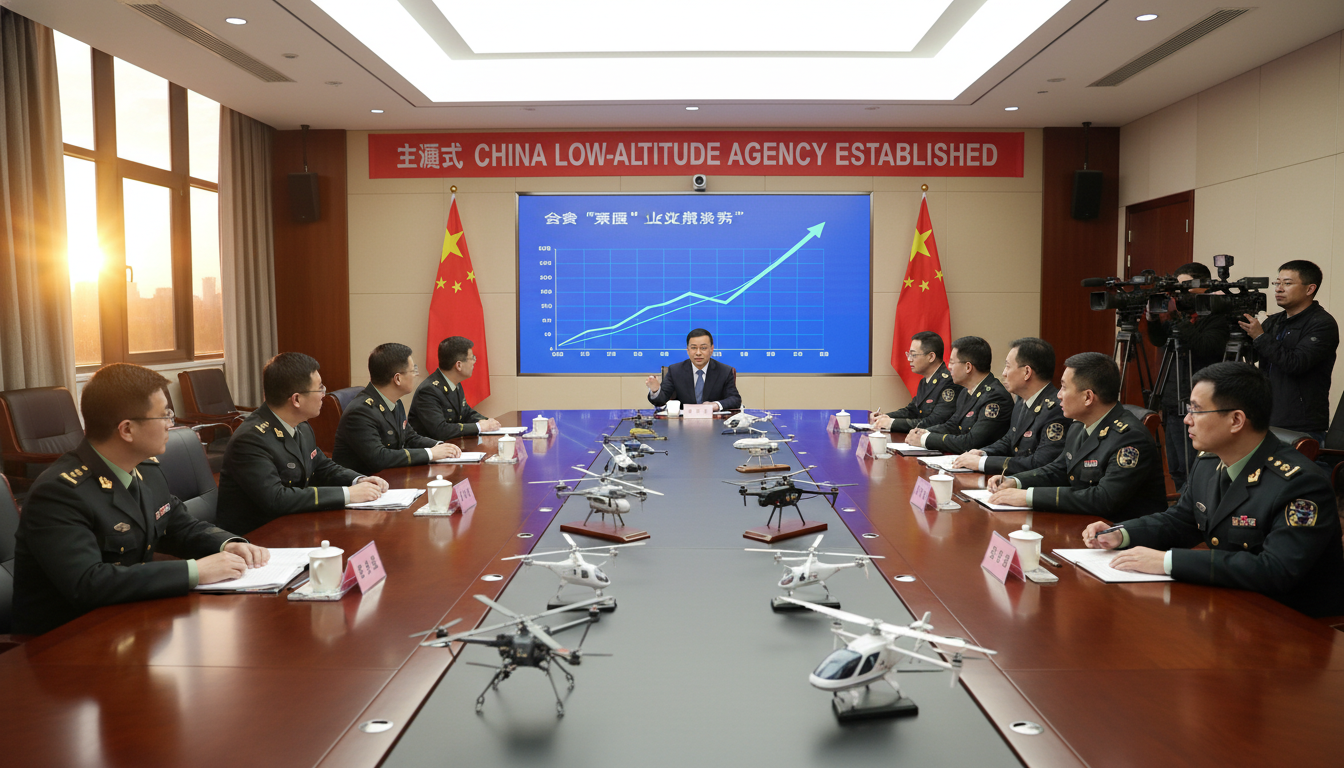
China Forms New Agency to Boost Low-Altitude Economy and Greenlight EHang Flying Taxi
China creates agency to oversee the "low-altitude economy," aiming to scale drone and flying-taxi operations; EHang wins the country’s first flying taxi license.
China has established a government agency to support the rapidly growing low-altitude economy, a move designed to accelerate commercial drone services and the rollout of electric vertical take-off and landing (eVTOL) aircraft. The announcement, made as regulators expand rules for operations below cloud level, coincides with the country’s first operating license granted to drone startup EHang for a flying taxi service. The creation of the new agency signals Beijing’s intent to coordinate industry growth and streamline airspace access for a range of unmanned and piloted low-altitude vehicles.
New Agency Formed to Oversee Low-Altitude Flights
The newly formed agency will centralize planning, regulation and support for operations in the low-altitude band, defined by authorities as the airspace below conventional commercial flight paths. Officials said the unit’s remit includes licensing, safety oversight, and coordination with local governments to enable commercial routes for drones and eVTOLs. The agency is being positioned as the focal point for a sector that regulators believe can expand rapidly if infrastructure and rules keep pace.
The move reflects a broader push by Chinese policymakers to transform the domestic aviation supply chain and to cultivate services ranging from passenger air taxis to logistics and aerial surveying. By consolidating responsibilities, the government aims to reduce bureaucratic friction and provide clearer standards for operators, manufacturers and municipal planners.
EHang Receives First Operating License for Flying Taxi
EHang, a Guangzhou-based drone company, became the first private operator in China to receive a formal license to run a flying taxi service, marking a milestone for commercial eVTOL operations in the country. The license covers operational parameters within defined urban corridors and signals regulatory willingness to permit routine passenger flights under controlled conditions. Company officials called the approval a landmark step toward regular commercial service.
Regulators framed the license as conditional on compliance with monitoring, safety and maintenance requirements, including real-time flight oversight and contingency procedures. Authorities said they will expand approval pathways for other qualified operators as infrastructure and air traffic management systems evolve.
Aviation Administration Predicts Rapid Growth of Low-Altitude Economy
China’s aviation authorities project that the low-altitude economy could at least double over the next decade as new services scale and demand rises. That forecast includes passenger eVTOL services, drone-based logistics, agricultural spraying, aerial inspection and emergency response roles. Officials and industry analysts argue that greater commercial activity in the sector could deliver economic benefits while easing ground congestion in major cities.
Policy planners expect growth to be driven by falling unit costs for electric propulsion, advances in autonomy and an expanding network of vertiports and dedicated corridors. Still, observers caution that projections depend on harmonized national standards, robust safety records and effective urban integration.
Airspace Management and Safety Systems Under Development
Central to expansion plans is the development of low-altitude airspace management systems capable of integrating thousands of drones and eVTOLs with minimal interference to existing aviation. Authorities are prioritizing remote identification, geofencing, and beyond-visual-line-of-sight (BVLOS) approvals to enable commercial-scale operations. The new agency will coordinate technical standards and certification processes for onboard systems and ground-based traffic management.
Safety requirements being developed include mandatory fail-safe capabilities, standardized pilot or remote-operator training, and certified maintenance regimes. Regulators emphasized that licensing will remain contingent on demonstrable safety performance and interoperability with manned aviation, particularly near airports and major transport hubs.
Urban Infrastructure and Community Acceptance Challenges
Scaling the low-altitude economy will require substantial investment in physical infrastructure such as vertiports, charging facilities, and secure logistics hubs. Municipalities are being asked to identify sites, set zoning rules, and integrate aerial services into existing transport networks. Noise mitigation, visual pollution, and public safety concerns are emerging as central considerations for local authorities and residents.
Public acceptance will hinge on demonstrable safety records, predictable operational windows and transparent noise and flight path management. Industry stakeholders note that early routes are likely to focus on corridor services and airport shuttles where demand and justification for investment are clearest.
Industry Ambitions and International Competition
Chinese manufacturers and startups are positioning themselves to capture domestic demand and export opportunities as global demand for eVTOLs and drone services grows. Companies cite integrated supply chains and established electric vehicle and battery industries as competitive advantages. Meanwhile, international firms and regulators are watching China’s regulatory experiments closely as potential templates for harmonized global standards.
Analysts warn that the race will hinge not only on technology but on regulatory interoperability and certification agreements that enable cross-border operations. Collaboration on safety protocols and air traffic management standards between major aviation authorities could accelerate market adoption and reduce fragmentation.
China’s new agency and the licensing of the first flying taxi mark a decisive phase for the low-altitude economy, but officials say practical rollout will proceed in measured stages. Piloted and remotely operated services will expand in parallel with infrastructure investments and regulatory refinements, and authorities stress that safety and orderly integration remain the foremost priorities as the sector moves toward routine commercial service.

