
Self-Defense Forces singer’s appearance at LDP convention raises civil-military control concerns
Keio University constitutional scholar warns that the Self-Defense Forces singer who performed in uniform at the April 12 LDP convention risks undermining civilian control and political neutrality of the military.
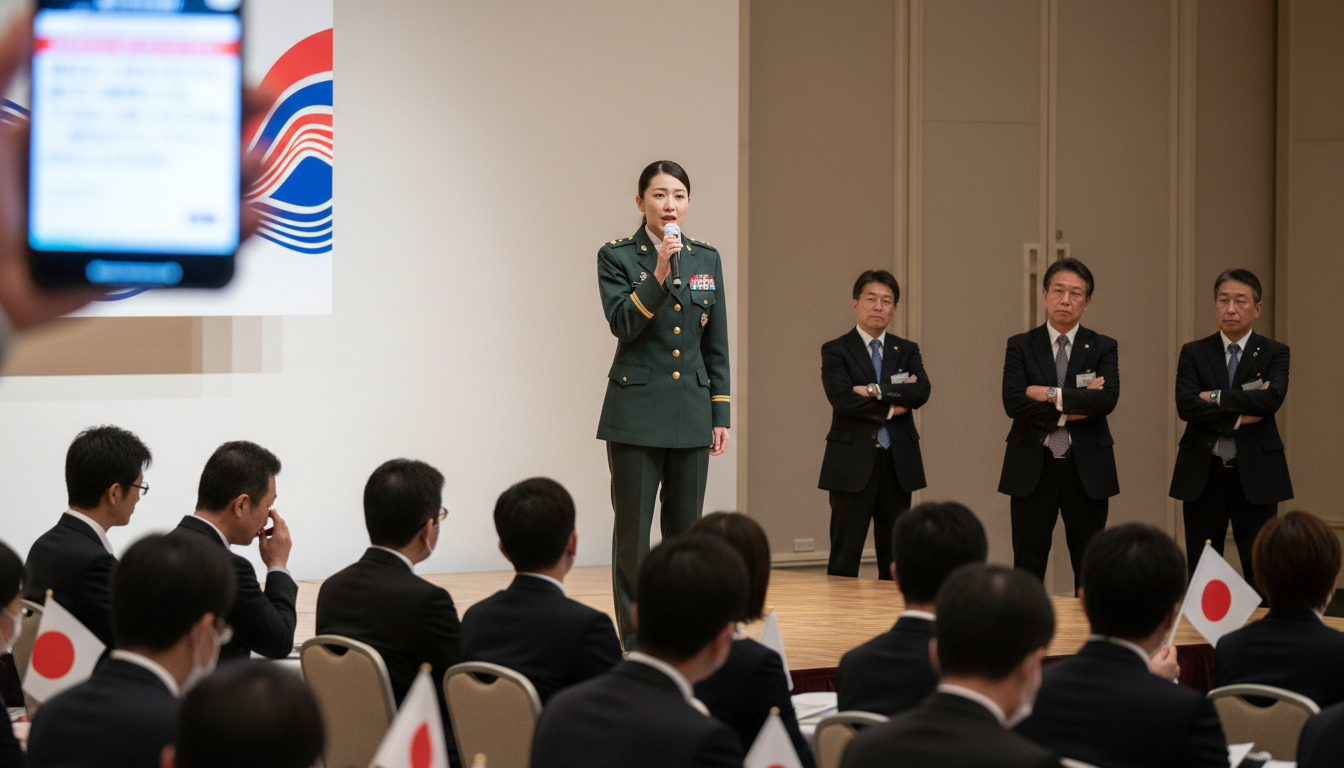
The appearance of a Self-Defense Forces singer in uniform at the Liberal Democratic Party’s April 12 convention in Takanawa has sparked renewed debate over Japan’s civilian control of the military and the political neutrality expected of service members. Keio University constitutional law professor Keigo Komamura told reporters the event should not be reduced to a celebrity moment because it raises constitutional and legal questions about the role of a special-status national public servant. The controversy centers on whether singing the national anthem in uniform at a partisan gathering constitutes political activity that conflicts with the Self-Defense Forces’ obligations.
April 12 convention performance and immediate concerns
Eyewitnesses reported that a uniformed member of the Self-Defense Forces sang the national anthem at the LDP gathering, prompting criticism from legal scholars and commentators. The performance has been interpreted by some as an implicit endorsement of a specific political party when conducted in uniform, a circumstance that raises issues distinct from a civilian entertainer’s appearance.
Professor Komamura said framing the performer as a “songstress” risks trivializing the constitutional implications and the special legal status of Self-Defense Forces personnel. He urged the public and policymakers to view the episode through the lens of institutional rules and long-standing postwar precautions designed to keep the armed services outside partisan politics.
Historical and constitutional background cited by scholar
Komamura traced concerns to postwar constitutional design, noting that deliberations in the Diet and subsequent Allied interventions shaped how civilian oversight would be embedded in Japan’s institutions. He said the insertion of a so-called “civilian clause” into the constitution during those debates was aimed at ensuring the military’s subordination to democratic political authority.
The professor emphasized that civilian control was further institutionalized when the Self-Defense Forces were established several years after the constitution’s promulgation, with the prime minister positioned as the head of the Cabinet and, by extension, the supreme political authority over defence matters. This historical context, he argued, underpins current legal expectations for non-partisanship among uniformed personnel.
Legal limits on political acts by Self-Defense Forces personnel
According to Komamura, Japan’s Self-Defense Forces Act and related enforcement regulations impose restrictions on political activities by service members that go beyond the rules for ordinary public servants. Those rules are designed to prevent party affiliation or visible support that could suggest institutional bias and to keep the military from being used as an instrument of partisan politics.
He noted that these statutory and regulatory limits explicitly encourage distance from political parties and partisan events, and that performing in uniform at a party rally can be read as supporting a particular political organization. Such conduct, he said, should be treated with “heightened attention” because of the unique trust invested in the armed services under a democratic constitution.
Potential institutional and public trust implications
Legal scholars warn that blurring the line between military symbolism and party politics risks eroding public confidence in the neutrality of the Self-Defense Forces. Komamura warned that even symbolic acts—uniforms, national songs and ceremonial settings—carry powerful messages that can be interpreted as institutional alignment if they occur in partisan spaces.
He added that the long-term consequence of repeated incidents could be a weakening of civil-military boundaries, making it more difficult for democratic institutions to exercise meaningful oversight and for the public to perceive the military as a nonpartisan body. That perception, he said, is a cornerstone of postwar democratic governance.
Calls for clearer guidance and administrative review
The episode has prompted calls for the Defense Ministry and political parties to clarify rules and to review protocols governing appearances by active-duty personnel. Komamura suggested that administrative guidance, internal discipline measures and public statements could help reaffirm the principle of political neutrality and prevent similar controversies.
He also urged lawmakers to consider whether existing statutes and enforcement mechanisms remain adequate for today’s media environment, where images and performances can propagate rapidly and widely. Strengthening internal compliance training and revisiting the application of prohibitions on political acts were among the measures he said merit discussion.
Public debate over the April 12 performance highlights the tension between individual expression and institutional constraints for members of the Self-Defense Forces. As Professor Komamura and others call for careful institutional responses, policymakers face a choice between reinforcing existing safeguards for civilian control and allowing ambiguous practices that could gradually reshape civil-military relations.

