
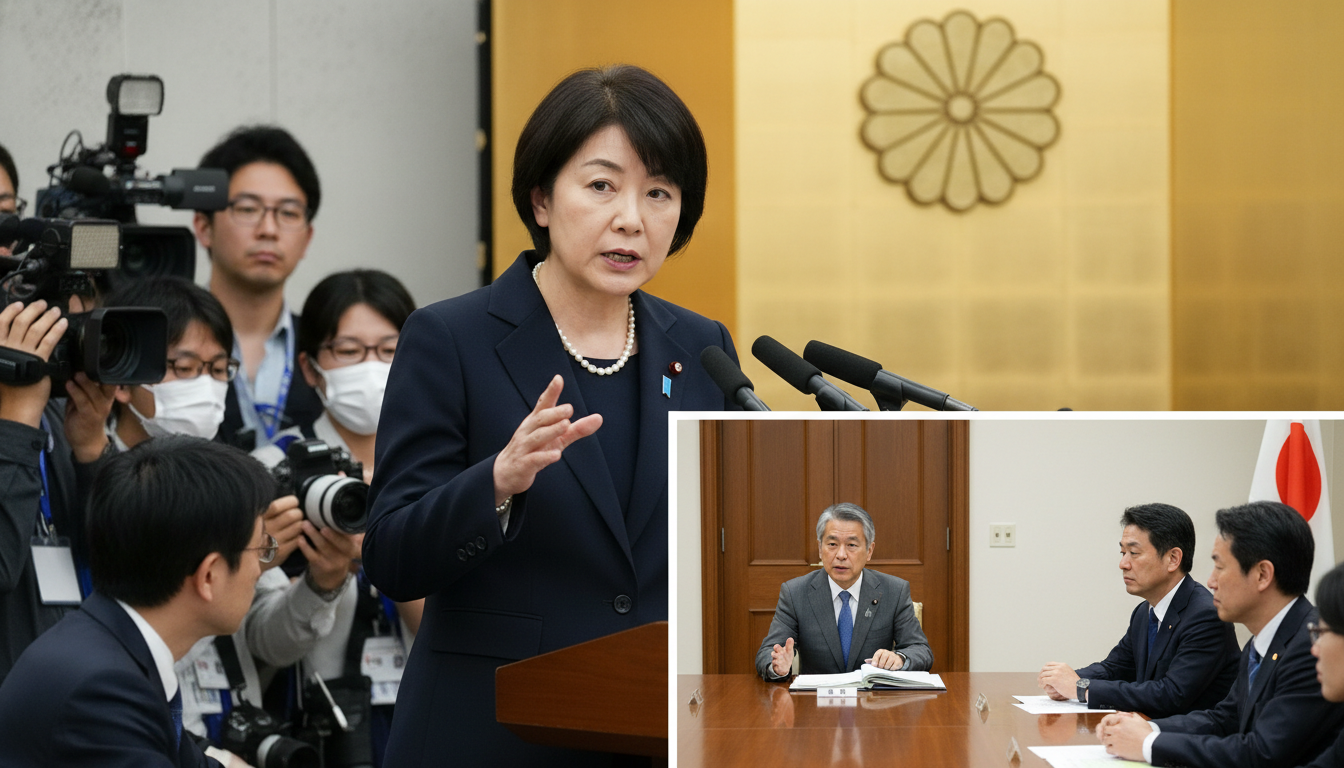
Takaichi press handling draws criticism as Kihara defends limited briefings
May 29, 2026 – Kihara defended Prime Minister Takaichi’s press handling after criticism of a brief May 25 roadside briefing, citing tight schedule and X posts.
Prime Minister Sanae Takaichi’s press handling came under scrutiny on May 29, 2026, when Cabinet Secretary Minoru Kihara faced repeated questions from reporters at a regular press briefing. The questions focused on the prime minister’s choice on May 25 to hold a short, limited roadside briefing rather than a full press conference in the official press room. Kihara said the government would continue to strive for timely, appropriate information release while explaining the constraints behind the decision.
Kihara addresses reporters over May 25 briefing
Kihara told the media that the government conducts formal press conferences at key moments such as the start of the year, at Diet adjournment and during foreign visits, and that ad hoc briefings are used when the prime minister judges timely communication is needed. He noted the May 25 session lasted roughly 20 minutes, with about ten minutes of explanation by the prime minister followed by a single representative reporter’s questions. Kihara also said the prime minister’s busy schedule often requires flexible arrangements to secure any time for direct remarks to the press.
Several foreign correspondents present at the briefing expressed concern that the shorter, limited-format session reduced transparency and excluded wider journalistic participation. They argued that matters addressed in the May 25 explanation, including elements of the 2026 supplementary budget, merited a full press conference where multiple outlets could pose questions. Kihara responded by asking the press club to consult internally on requests for formal conferences, while reiterating the administration’s use of various channels for information.
Details of the May 25 roadside session and access limits
Officials said the May 25 roadside briefing began with the prime minister delivering a verbal explanation for approximately ten minutes, after which the press corps selected a single representative to ask questions. The prime minister’s office had informed reporters beforehand that, for reasons of official business, only one outlet would be designated to ask questions. That decision prompted objections from several domestic and international journalists who said the limitation impeded broader scrutiny and reporting.
The mode of the May 25 encounter—known in Japanese media practice as a “burashibari” or roadside-style briefing—typically allows for quicker, more controlled exchanges but limits the number of participating reporters. Media organizations noted that while such sessions are not unprecedented, their increasing use for significant policy explanations raises questions about equitable access and the role of the official press room in fostering comprehensive coverage.
Government rationale: schedule constraints and digital outreach
Kihara explained that the prime minister’s calendar is frequently tightly packed, and that scrapping a formal conference in favor of a shorter briefing can be a pragmatic choice to allow some direct communication. He emphasized that time pressures can make it difficult to accommodate a full question-and-answer session without affecting other official duties. The Cabinet Office also pointed to the prime minister’s growing use of X to publish statements and policy summaries as part of a broader information strategy.
Officials framed social media posts as a complement to in-person briefings, arguing they enable immediate dissemination to the public. Critics countered that social media cannot substitute for live exchanges in which journalists from diverse outlets press for clarification and follow-up. The debate reflects a wider international conversation about how leaders balance direct messaging via platforms like X with transparent, accountable engagement with the press.
Press club rules and the division of responsibility
The Cabinet press club, comprised of newspaper and television organizations, is formally empowered to organize press conferences for the convenience of reporting, according to its rules. In practice, however, the government often sets the timing and format of encounters in the prime minister’s residence and the press room. Several reporters at Kihara’s May 29 briefing urged clearer procedures, saying the club and the government need to coordinate to ensure that decisions about access and format do not undermine journalistic oversight.
Kihara’s suggestion that the press club discuss the matter reflected a desire to shift some responsibility back to the organized media corps. Still, members of the press club expressed concern that structural imbalances—such as officials’ control over scheduling and access—leave little room for collective demands that could ensure fuller, more open coverage.
International media emphasize transparency and equal access
Foreign correspondents who questioned Kihara pressed the government on standards of access and transparency, saying that limited briefings make it harder to hold officials to account and to explain policy decisions to international audiences. They argued that the handling of the May 25 exchange could set a precedent if repeated for other substantial policy announcements. The foreign media’s intervention at the May 29 briefing signaled broader unease about access norms and about whether social media posts offer sufficient context for complex fiscal measures.
Domestic outlets echoed those concerns while emphasizing the practicalities Kihara cited, creating a split between calls for procedural reform and acceptance of ad hoc arrangements when schedule constraints are genuine. Observers said the issue may lead to renewed discussions within the press club and between media organizations and the Cabinet Office about expectations for future prime ministerial communications.
The government says it will continue to use multiple channels to convey information and has asked the press club to consult on when formal conferences should be sought, but the exchange on May 29 illustrated ongoing tensions between demands for broader press access and the administration’s reliance on constrained briefings and online posts.

