
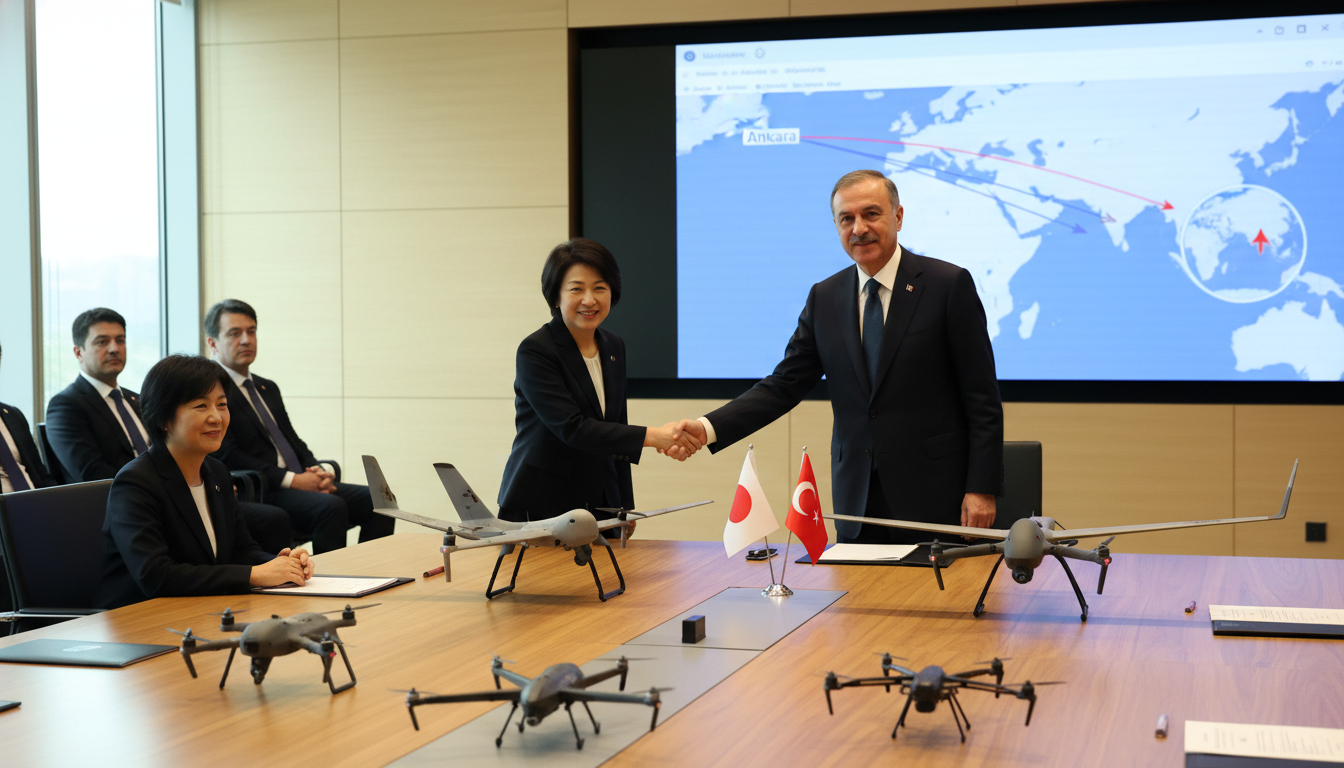
Turkey-Japan drone cooperation proposed as Hakan Fidan pushes joint development
Turkish FM Hakan Fidan urges Turkey-Japan drone cooperation, proposing joint development and co-production of unmanned aerial systems to deepen ties regionally.
ISTANBUL — Turkish Foreign Minister Hakan Fidan said Turkey is eager to pursue Turkey-Japan drone cooperation through joint development and co-production of unmanned aerial systems, describing the proposal as part of a broader push for middle-power collaboration. He also signaled that diplomatic efforts over the US-Iran nuclear negotiations remain active, calling the deal "closer than ever" while urging like-minded countries to coordinate more closely. The minister outlined the initiative during a London-to-Asia outreach that, he said, seeks to pair Turkish defense manufacturing experience with Japanese technology and industrial capacity.
Fidan Announces Turkey-Japan Drone Cooperation Plan
Fidan presented the proposal as a strategic offering to Japan that would combine Turkey’s recent experience in mass-producing tactical drones with Japan’s advanced avionics and industrial standards. He framed the plan as practical cooperation rather than an ideological alignment, saying the aim is co-development, co-production and mutually beneficial technology sharing. The minister emphasized that the initiative is intended to strengthen bilateral ties while contributing to regional capabilities in unmanned aerial systems.
Technical and industrial scope of the partnership
Officials described the envisioned partnership as encompassing design work, joint research and shared production lines for medium-altitude and tactical unmanned aerial systems. Potential areas for collaboration include propulsion, sensor integration, communications links and payload modularity to serve civilian and security uses. Both sides would need to negotiate technical standards, intellectual property arrangements and supply-chain responsibilities before any formal program agreement is signed.
Diplomatic pitch to middle powers and broader agenda
Fidan framed the drone cooperation within a larger diplomatic pitch to so-called middle powers, arguing that countries like Turkey and Japan can act as stabilizing actors amid shifting great-power dynamics. He said middle-power coordination should extend beyond security hardware to include diplomatic initiatives, trade frameworks and crisis management. In the same remarks, Fidan described progress in US-Iran talks as significant and said improved major-power diplomacy could open space for regional actors to pursue cooperative projects.
Security, export controls and legal constraints
Any Turkey-Japan drone cooperation would need to navigate Japan’s strict arms export rules and Turkey’s own export controls, diplomats and analysts noted. Tokyo has historically restricted military exports, while recent policy shifts have opened limited avenues for co-development under stringent oversight. Both governments would be required to establish end-use assurances, compliance mechanisms and export licensing processes before transferring technologies or moving into co-production.
Economic implications for Japanese industry and Turkish manufacturing
For Japanese firms, a joint program could provide a pathway into an expanding market for tactical unmanned systems and associated services, including maintenance and training. For Turkey, co-production deals would bolster local employment, scale production capacity and potentially open new export markets that favor lower-cost, ruggedized platforms. Industrial planners from both countries will likely evaluate cost-sharing models, financing arrangements and the role of private-sector contractors in any prospective tender.
Regional reactions and strategic calculations
Neighboring states and allied capitals will watch closely for signs that the partnership alters regional balances or export patterns. Some observers caution that increased drone production and export activity can raise proliferation concerns if end-use safeguards are not enforced. Others argue that transparent, rules-based cooperation between established industrial partners can raise standards and introduce more rigorous compliance into sectors that have sometimes operated in a grey zone.
Fidan’s proposal arrives amid a complex global environment in which demand for unmanned systems has expanded across security and civilian domains. The minister’s emphasis on combining Turkish production experience with Japanese technological strengths reflects a pragmatic approach to partnership-building in an era of constrained budgets and elevated strategic uncertainty. If Tokyo and Ankara proceed to formal talks, negotiators will need to reconcile differing domestic rules, export control regimes and strategic priorities before moving from concept to contract.

